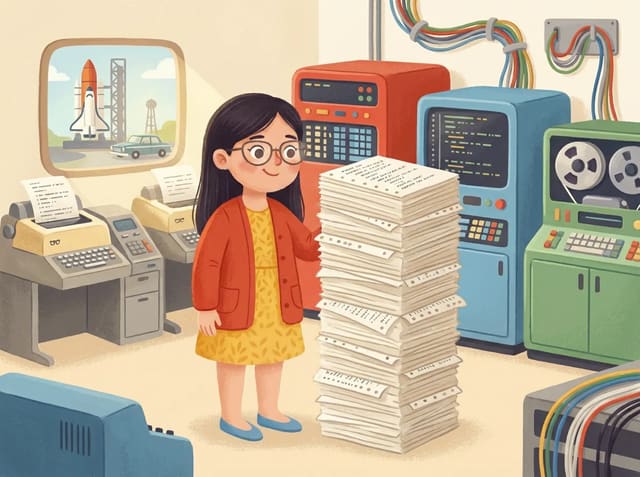
Margaret Hamilton for kids: a true picture book
Margaret and the Code That Kept Going. Things that did not exist, until someone made them. 10 pages, fact-checked, at three reading levels, read aloud.
The lesson: Plan for the thing that goes wrong.
Read the first pages free
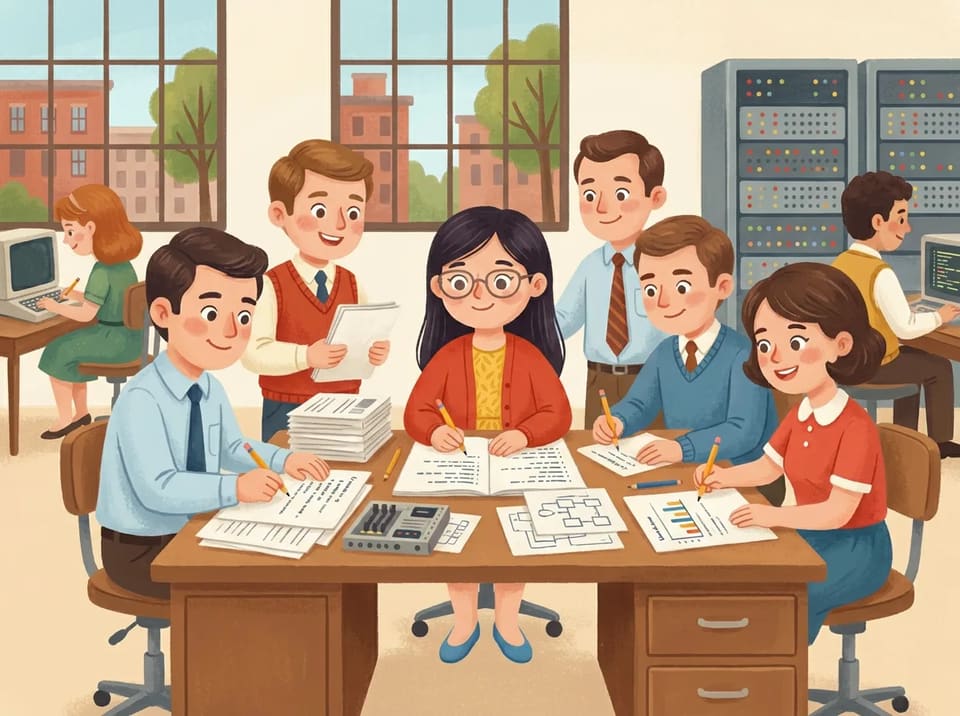
This is Margaret. She worked with a team. Together, they wrote code. Tap, tap, tap!
This is Margaret Hamilton. She worked at a school called MIT. She led a team of people. Their job was to write code for NASA's Apollo missions.
In the 1960s, Margaret Hamilton worked at MIT, where she led a team with a giant job. They wrote the onboard flight software for NASA's Apollo missions. Software is a set of instructions that tells a computer what to do, step by step. A computer cannot guess. It only does what its software tells it to do, so every instruction had to be right.
Page 1 of 10
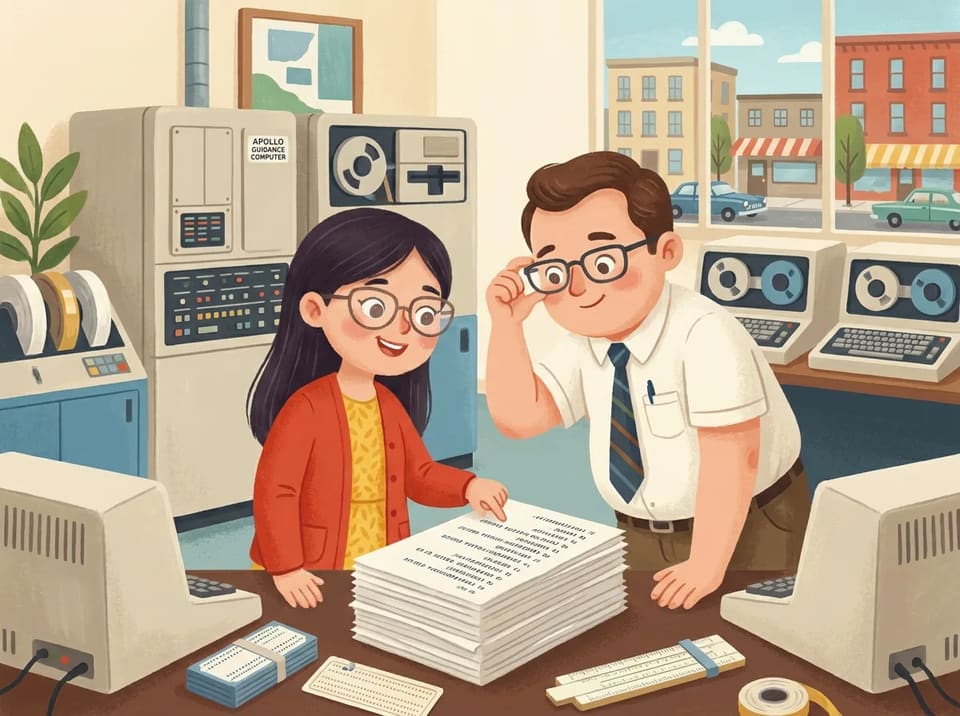
Code tells a computer what to do. Step by step. Step by step!
Code is a list of steps for a computer. The computer does each step, one by one. Margaret's team wrote code that would ride along on the Apollo spacecraft.
Margaret's team wrote onboard software. Onboard means it was on the spacecraft itself, traveling with the mission. Nobody could reach up and fix it once it was flying. The computer would have to follow the team's instructions all on its own. That meant the code had to be ready for more than a perfect day.
Page 2 of 10
Margaret Hamilton: a timeline of true facts
- 1960s At MIT she led the team that wrote the onboard flight software for NASA's Apollo missions. source
- 1969 During the Apollo 11 landing, the computer was overloaded and showed alarms. Her team's software dropped less important jobs and kept the landing tasks running. source
- 1969 A famous photo shows her standing next to printouts of the Apollo code stacked as tall as she was. source
- 2016 She received the Presidential Medal of Freedom. source
3 reading levels
- Read to me (ages 3–5)
- Read together (ages 6–8)
- I'll read (ages 9–12)
The same true story, written three ways. Little kids hear short, bouncy lines; big kids get the details and the numbers.
Quiz time
What did the computer show during the landing?
Show the answer
Alarms.
Try this at home
- Stack paper or books next to your child until the pile is as tall as they are. Then talk about how much writing it would take to fill every page.
- Play 'Too Many Jobs!' Give your child five silly tasks at once, like hop, clap, sing, spin and wave. Ask which one matters most, then do just that one. That's setting priorities!
- Build a block tower. Then plan for what could go wrong, like a bump, a breeze or a pet. Test it and add something that helps it keep standing.
More true heroes
Space and rockets for kids · Inventors for kids · All heroes