Who invented Christmas lights, candy canes and more?
Edward H. Johnson, a vice president at Edison’s electric company, lit the first electric Christmas tree in 1882. Nobody knows who invented the candy cane. Robert L. May created Rudolph in 1939 for a Chicago store. Here’s who came up with each Christmas thing, true stories only, with sources.
Who invented what, at a glance
| Thing | Who | When |
|---|---|---|
| Electric Christmas lights | Edward H. Johnson | 1882 |
| Candy canes | Nobody knows | By 1847 in the US |
| Christmas trees | No one person; Germany | 1500s |
| Rudolph | Robert L. May | 1939 |
| Printed gift wrap | The Hall brothers (Hallmark) | 1917 |
| Santa’s look | Many writers and artists | 1809 to 1931 |
| Christmas cards | Sir Henry Cole and John Callcott Horsley | 1843 |
| Christmas crackers | Tom Smith, by tradition | 1847 |
| Tinsel | Makers in Nuremberg | About 1610 |
| Gingerbread houses | No one person; Germany | Early 1800s |
| The Elf on the Shelf | Carol Aebersold and Chanda Bell | 2005 |
| December 25 | First recorded in Rome | AD 336 |
Who invented Christmas lights?
Edward H. Johnson, a vice president of the Edison Electric Light Company. On December 22, 1882, he lit a tree in the parlor of his New York City home with 80 hand-wired red, white and blue bulbs.
He stood the tree on a revolving box, and as it turned the lights blinked on and off. A reporter named William Croffut wrote it up for the Detroit Post and Tribune. Edison himself wasn’t the one who lit it. For years after, only the wealthy could afford lights like that, until General Electric sold the first prewired strings of sockets in 1903. A 1900 GE ad gave the reason to switch from candles: “No Danger, Smoke or Smell.”
Ask your kid: Why would a wire be safer than a flame on a tree?
Sources: IEEE Spectrum, History.com.
Who invented candy canes?
Nobody knows. A popular story says a choirmaster at Cologne Cathedral in Germany had sugar sticks bent like shepherds’ crooks to keep children quiet, but there’s no proof of it.
The first known candy canes in America are from 1847, when August Imgard, a German immigrant in Wooster, Ohio, put up a Christmas tree. An 1844 cookbook already told how to make striped peppermint sticks, and the words “candy canes” were in print by 1866. The engineering came later. In 1919 Robert McCormack of Albany, Georgia, began making candy canes. They were bent by hand, and often more than one in five broke. His brother-in-law, a priest named Gregory Keller, invented a machine to bend them. He applied for a patent in 1957 and got it in 1960.
Ask your kid: If one candy cane in five breaks, what would you change: the candy, the bending or the packing?
Sources: National Geographic, Wikipedia, Google Patents.
Who invented the Christmas tree?
No one person. Germany is credited with starting the tradition as we know it, in the 1500s. Many people say Martin Luther first put candles on a tree, but that’s a story passed down, not a record.
It reached English homes in a big way after 1848, when the Illustrated London News printed a picture of Queen Victoria’s family around a tree at Windsor Castle. Artificial trees began in 19th-century Germany, made of goose feathers dyed green. In 1930 a British company, Addis, made one from the same bristles it used in toilet brushes, dyed green.
Ask your kid: What could you make a tree from, if you couldn’t use a tree?
Sources: History.com, Wikipedia on artificial trees.
Who created Rudolph the Red-Nosed Reindeer?
Robert L. May, a copywriter at the Montgomery Ward store chain in Chicago, in 1939. The store bought Christmas booklets to give away each year, and writing its own saved money.
May thought about calling him Rollo or Reginald. The store gave away 2.4 million copies in the first year. May’s brother-in-law, Johnny Marks, wrote the song, and Gene Autry’s recording went to No. 1 at Christmas 1949.
Ask your kid: The store made its own book to save money. What would you make yourself instead of buying it?
Sources: Wikipedia on Robert L. May, Wikipedia on Rudolph.
Who invented wrapping paper?
People have wrapped gifts for a very long time, so no one person invented it. The gift wrap you buy today is usually credited to the Hall brothers, who started Hallmark, in Kansas City in 1917.
By the company’s own story, their shop ran out of tissue paper at Christmas. Rollie Hall found fancy envelope liners from France at the plant, and they sold those instead. Two years later the company was making its own.
Ask your kid: What else in your house was made because something ran out?
Who invented Santa Claus as we picture him?
No one person. The picture grew over a long time, from Saint Nicholas, a bishop who lived about 1,700 years ago in what’s now Turkey, to the red suit we draw today.
Dutch settlers brought stories of Sinterklaas to New York. Washington Irving wrote about him in 1809, and an 1823 poem, usually credited to Clement Clarke Moore, describes a sleigh and eight reindeer. Thomas Nast drew him for Harper’s Weekly from 1863, in a red suit by about 1869. Haddon Sundblom painted him for Coca-Cola’s ads from 1931, though Coca-Cola’s own site says it didn’t create him.
Ask your kid: Draw Santa without looking at a picture. Which parts did you get from an old drawing?
Sources: St. Nicholas Center, Coca-Cola, Wikipedia on the poem.
Who invented the Christmas card?
Sir Henry Cole ordered the first card sold commercially, in London in 1843, and the artist John Callcott Horsley designed it.
It shows three generations of a family raising a toast, with the words “A Merry Christmas and A Happy New Year.” On either side, people give food and clothing to the poor.
Ask your kid: What would you put on a card if you had to invent the idea?
Sources: Wikipedia.
Who invented Christmas crackers?
By tradition, Tom Smith, a London candy maker, in 1847. Sales of his paper-wrapped sweets were slumping, so he kept adding new ideas.
His son Walter added the gifts and paper hats, to stand out from the rivals who had sprung up.
Ask your kid: What would you add to a cracker to beat the other crackers?
Sources: Wikipedia.
Who invented tinsel?
Modern tinsel came from Nuremberg, Germany, around 1610, as thin strands of real silver. No one name is on it.
Silver tarnishes quickly, so makers switched to other shiny metals. It first went on sculptures, and only later on trees, to make candlelight flicker.
Ask your kid: Why would a shiny thing make a flame look brighter?
Sources: Wikipedia.
Who invented gingerbread houses?
No one person. Decorated gingerbread houses started in Germany in the early 1800s, and some researchers tie them to the Brothers Grimm’s tale of Hansel and Gretel.
A gingerbread house is a real building problem: walls that have to stand up, a roof that wants to slide off, and glue you can eat.
Ask your kid: Would you build the walls first, or lay them flat until the icing sets?
Sources: Wikipedia.
Who invented The Elf on the Shelf?
Carol Aebersold and her daughter Chanda Bell wrote the book, published in 2005. It came from a tradition in Aebersold’s own family when she was a child.
Bell suggested turning the family tradition into a book, and another daughter, Christa Pitts, joined them.
Ask your kid: What does your family do every year that could be a book?
Sources: Wikipedia.
Who invented Christmas?
Nobody invented it. Christmas is the Christian holiday for the birth of Jesus. The oldest record that puts it on December 25 is a Roman calendar, in a part historians date to AD 336.
That calendar is called the Chronograph of 354. Most of the things on this page came far later: trees in the 1500s, cards in 1843, electric lights in 1882.
Ask your kid: Pick one custom from your holiday. How old do you think it is? How could you find out?
Sources: Wikipedia.
Make a true book about one of them
In Tumbly Inventors a grown-up can type any real person’s name, such as Edward Johnson or Tom Smith, and Tumbly researches, writes, fact-checks, illustrates and narrates a new book in about five minutes. Or start with a true book that’s ready, like the Wright brothers or Benjamin Franklin.
Then quiz the family: these inventions are in the Christmas trivia questions for kids, along with reindeer, snowflakes and songs.
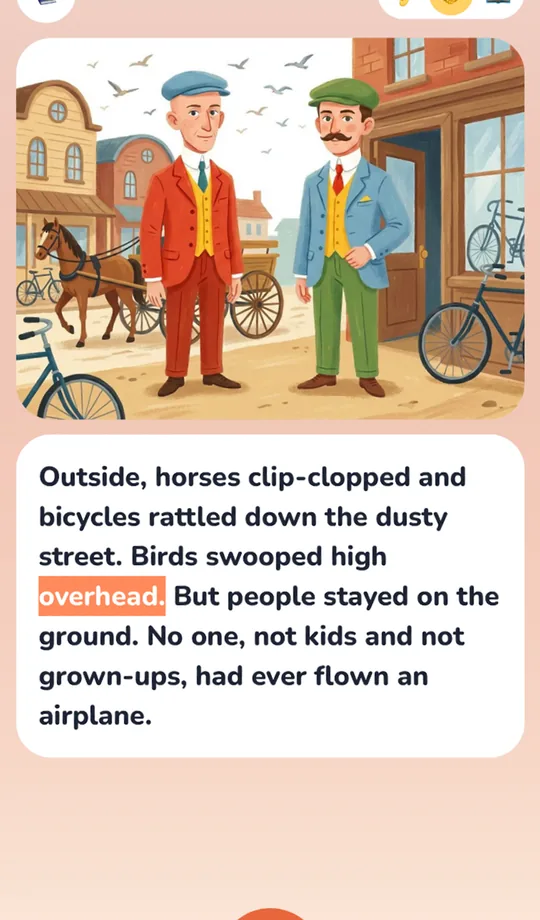
Meet more inventors in Tumbly Inventors.
True picture books about people who built things, read aloud with the words lighting up, at three reading levels. Finish one to win the hero card.


Scan with your iPhone cameraor open it in your browser
Questions parents ask
Who invented Christmas lights?
Edward H. Johnson, a vice president of the Edison Electric Light Company. On December 22, 1882, he lit a tree in the parlor of his New York City home with 80 hand-wired red, white and blue bulbs.
When were Christmas lights invented?
In 1882, when Edward H. Johnson lit the first electric Christmas tree we know of. The first prewired strings of sockets came from General Electric in 1903. Before electric lights, families used candles.
Who invented candy canes?
Nobody knows. A popular story says a choirmaster at Cologne Cathedral in Germany had sugar sticks bent like shepherds’ crooks to keep children quiet, but there’s no proof of it.
Did Coca-Cola invent Santa Claus?
No. Coca-Cola’s own site says it did not create him. Its ads, painted by Haddon Sundblom from 1931, made one picture of him famous, but Thomas Nast was drawing Santa in a red suit by about 1869.
Is this page safe to read with kids who believe in Santa?
Yes. It covers where the stories and pictures of Santa came from and who wrote The Elf on the Shelf, and it doesn’t say whether anyone is real. Still, read those two sections first if you’re not sure.
Can my kid read about an inventor from this page?
Yes. In Tumbly Inventors a grown-up can type any real person’s name, and Tumbly researches, writes, fact-checks, illustrates and narrates a new true picture book in about five minutes.
Is Tumbly Inventors free?
Yes, to start. The free plan includes every ready-made book and one new book a month, and the first pages of each book are free to read here. Tumbly Family costs $7.99 a month, or $59.99 a year with a 7-day free trial, for ten new books a month. It's a free app on the App Store and Google Play.