Long, long ago
Did ancient Romans have sewer covers?
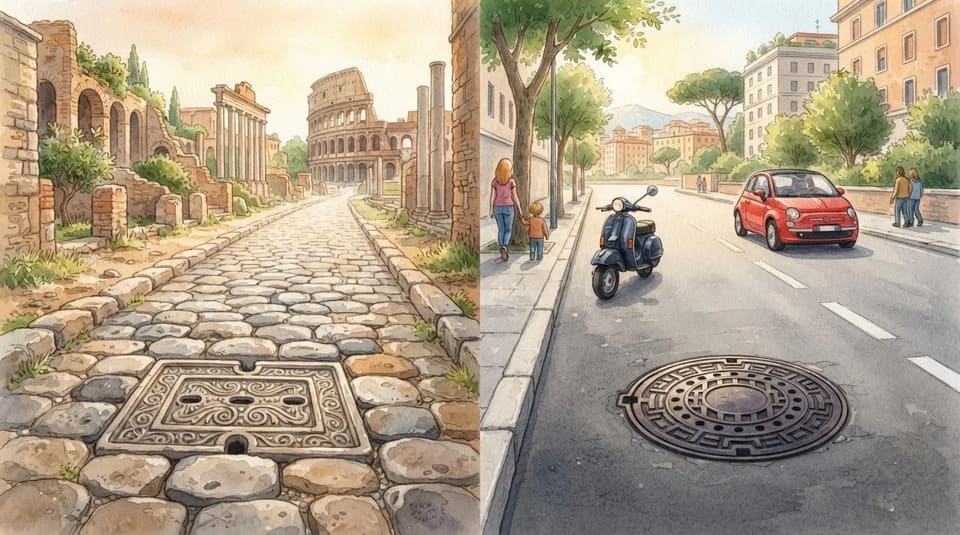
Manhole covers, from ancient Rome. A true how-it-works story for kids 5–9.
Yes. Ancient Rome had sewer grates made of stone, and one carved from lime sandstone, found at Vindobona (today's Vienna), dates to the 1st century AD. Many of today's manhole covers are round, and one reason often given is that a round lid can't fall through its own round hole. Cast iron covers can weigh 100 to 300 pounds.
Manhole cover at a glance
| Manhole covers go back to | At least the era of ancient Rome source |
|---|---|
| Roman sewer grates were made of | Stone source |
| A Roman grate found in Vienna | Lime sandstone, 1st century AD source |
| Covers today are often made of | Cast iron, concrete or both source |
| A cast iron cover can weigh | 100 to 300 pounds (45 to 135 kg) source |
The Manhole cover story, read aloud
Look at the city street under our car. See any round metal lids in the road? Those are manhole covers, heavy lids over holes that lead down to pipes and tunnels underground. So who do you think first put lids on holes like that? People in ancient Rome, more than a thousand years ago!
The Romans built sewers, stone tunnels that carried dirty water away from their city, and they covered the openings with stone grates so nobody would fall in. That same idea still keeps us safe today! Most covers now are round, and here's why. A circle can't slip through its own round hole, no matter how you turn it. A square lid could tip sideways and drop right in.
They're also super heavy, so cars can roll over them without them budging. Cast iron ones can weigh 100 to 300 pounds! So no sneaky raccoon is lifting one of those. Let's count how many round lids we can spot!
Quiz the back seat
What did ancient Romans use to cover their sewer openings?
Show the answer
Stone grates. Stone grates! Today many covers are made of cast iron or concrete instead, which makes them strong and heavy.
Manhole cover facts for kids
- Manhole covers date back at least to ancient Rome, which had sewer grates made from stone.
- Cast iron manhole covers can weigh 100 to 300 pounds.
- Their weight helps keep them in place when traffic drives over them.
Questions kids ask about Manhole cover
Did ancient Romans have sewer covers?
Yes, ancient Romans covered their sewer openings with stone grates so nobody would fall in.
Why are manhole covers round?
A round lid can't slip through its own round hole no matter how you turn it, while a square lid could tip and drop in.
Why are manhole covers so heavy?
Their weight keeps them from moving when cars drive over them.
For grown-ups
Written with AI from public sources, then checked claim by claim against the sources below before it was published; stories that don't pass stay off the app and this site. Narration is pre-recorded, and nothing you do on this page is tied to your kids.
Sources
- en.wikipedia.org/wiki/Manhole_cover
- en.wikipedia.org/wiki/Cloaca_Maxima
- theartnewbie.com/art-history/ancient-rome/roman-sewers
- historyguild.org/alking-heads-what-toilets-and-sewers-tell-us-about-ancient-roman-sanitation/?srsltid=AYCX9vIVRVffk2HQ5fQLrmLXh0cWFkDCxV59PCVBCiMnHpTRjKEW2Whe
- manholecoversdirect.com/why-are-manhole-covers-round/?srsltid=AYCX9vJCT7_tYjy1X3cQAd6kN7Xx3HN-I8Uua7eTVW-KPZ146ZyW6M3A
- blazeestimating.com/how-much-does-a-manhole-cover-weigh
More stories about how things work
 Cars and roads Signs That Talk Without Words
Look out the window! On this highway, signs stand by the lanes and hang high above us.
 Cars and roads The Road Builder Who Couldn't See
On this road under us, our wheels roll smooth and flat. Somebody had to build it!
 Inventors and firsts The Hills That Go Traveling
Look out the window. Can you see a hill?
 Long, long ago The Poems on the Island Walls
Here in California, out in San Francisco Bay, there is a green island called Angel Island. Long ago, it had a special station where people…
Build one with bricks
Between stories: 25 road trip games for kids · Road trip bingo cards · Road trip trivia · Christmas light scavenger hunt · Christmas trivia
Town and county names: GeoNames (CC BY 4.0).