Inventors and firsts
What was the first thing scanners bought?
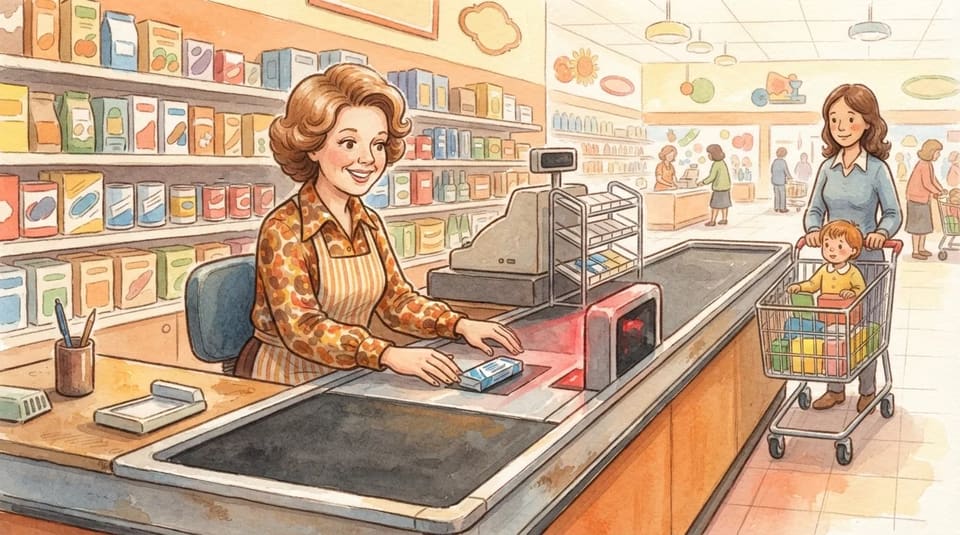
The first barcode scan, Ohio. A true how-it-works story for kids 5–11.
The Bernard Silver story, read aloud
See all those shops we're passing? At their checkouts, a little red light reads black stripes on every box. Those stripes are called a barcode. So here's a question. What was the very first thing ever bought with a barcode scanner at a grocery store? A giant cake? A shiny bike?
Nope! It was a pack of chewing gum! It happened at a supermarket in Ohio, about fifty years ago. A brand new, super fancy machine, and its very first job was gum! Here's how it works. The stripes are thick and thin, like a secret code. The scanner shines light on them.
White parts bounce the light back, and black stripes soak it up, like a sponge soaks up water. A computer reads that pattern like a name tag, and beep! It knows the price. People say the idea began with a man drawing dots and dashes in beach sand, then pulling them into long lines. Now look around the car. Can you find a barcode on a bottle, a bag, or a book? Count the stripes!
Quiz the back seat
What was the first thing ever scanned at a supermarket checkout?
Show the answer
A pack of gum. A pack of gum! And the barcode idea came from Morse code, a code made of dots and dashes.
Bernard Silver facts for kids
- The first product scanned at a supermarket checkout was a pack of chewing gum, in Ohio in 1974.
- The barcode was invented by Norman Joseph Woodland and Bernard Silver and patented in the US in 1952.
- The barcode idea was based on Morse code, stretched into thin and thick bars.
The Bernard Silver story, read aloud
On this drive past houses, hills and a gas station, there's a good chance that station's little shop has a scanner at the counter. A scanner reads barcodes, those rows of black and white stripes on almost everything you buy. So what do you think was the very first thing a store ever scanned? Hold your guess. Our story starts with an inventor named Norman Joseph Woodland, sitting on a beach. He knew Morse code, the old dots and dashes, and he drew them in the sand. Then he dragged his fingers down and stretched them into long lines, thin ones and thick ones.
Stripes that could hold a secret number! He and his partner, Bernard Silver, patented the idea in 1952. But there was a problem: no machine could read it yet. They waited more than twenty years. Here's how it finally worked. A laser shines on the stripes. White stripes bounce the light back, and black stripes soak it up, so the scanner sees a pattern of flashes.
The computer turns that pattern into numbers and looks up the price, faster than you can blink. Then, in 1974, at a supermarket in Troy, Ohio, a cashier slid the first item across the brand-new scanner, and it was a pack of Juicy Fruit chewing gum! All that brainpower, and the big test was gum. That little pack ended up in a museum. And now nearly everything in every store wears stripes, all thanks to lines in the sand.
Quiz the back seat
Where did Norman Joseph Woodland first draw his barcode idea?
Show the answer
In the sand on a beach. In the sand! He started with Morse code dots and dashes and stretched them into stripes, which is why barcodes have thin and thick bars.
Bernard Silver facts for kids
- The barcode was invented by Norman Joseph Woodland and Bernard Silver and patented in the US in 1952.
- The idea was based on Morse code extended into thin and thick bars.
- The first product scanned at a supermarket checkout was a pack of chewing gum in Troy, Ohio, in 1974.
Questions kids ask about Bernard Silver
What was the first item scanned with a barcode at a supermarket?
It was a pack of chewing gum, scanned at a supermarket in Ohio.
How does a barcode scanner work?
It shines light on thick and thin stripes, and a computer reads the pattern of light bouncing back to know what the item is.
Where did the idea for barcodes come from?
The barcode was based on Morse code, with its dots and dashes stretched into thin and thick lines.
For grown-ups
Written with AI from public sources, then checked claim by claim against the sources below before it was published; stories that don't pass stay off the app and this site. Narration is pre-recorded, and nothing you do on this page is tied to your kids.
Sources
- history.com/this-day-in-history/june-26/barcode-scanner-invention-first-use
- generalpapergoods.com/the-connection-between-a-pack-of-gum-and-barcodes
- si.edu/object/supermarket-scanner%3Anmah_892778
- iterator.com.ua/en/useful-info/203-50-years-since-the-first-barcode-was-scanned-in-a-supermarket-on-june-26-1974?srsltid=AYCX9vJCWkxBK-hUGOutGBUYmChdvZ71wjRyxV66uzLuoTKXILYOctGA
- netum.net/blogs/technology-explainers/how-barcode-scanners-work?srsltid=AYCX9vLa28OtRUP-5U6jLjw6mC-qw0WsP5QX65y3N2gWYEB5Mepwg9Wx
- drexel.edu/engineering/news-events/news/archive/2012/December/normanjosephwoodlandcoinventorofthebarcodepassesawayat91
- invent.org/blog/inventors/Joseph-Woodland-Bernard-Silver
- en.wikipedia.org/wiki/Bernard_Silver
More stories about how things work
 Who built that? The Bridge That Grows
Out the window is the highway, with bridges and overpasses carrying our road over rivers and other roads. And every bridge has a secret…
 Houses A House That Came by Train
Look at all the houses on this street! Every house is made of lots of pieces.
 Cars and roads The Car That Was a Tricycle
On this road, cars roll along all around us, and every one has wheels. But the very first real car, the kind people could buy, had only…
 Houses The Secret Skeleton in Your Walls
Look out the window at all the houses along the street. Every one of them was built in a special order, like a giant puzzle.
Between stories: 25 road trip games for kids · Road trip bingo cards · Road trip trivia · Christmas light scavenger hunt · Christmas trivia
Town and county names: GeoNames (CC BY 4.0).