Nature scavenger hunt for kids, sized by age and season
Kids take a nature walk with a list and mark each thing they spot, like a bird on a wire or a leaf with jagged edges. Here are free cards sized by age, one for each season and one for a sidewalk or backyard. Print them or tap them on a phone, with no email and no sign-up.
Pick your card
The ages are rough, so go by what your kid can do.
| Card | Who or when | Printed page |
|---|---|---|
| Picture hunt | Ages 3 to 5, any month | 1 |
| Explorer card | Ages 6 to 8, any month | 2 |
| Points list | Ages 9 and up, any month | 3 |
| Fall | September to November | 4 |
| Winter | December to February | 5 |
| Spring | March to May | 6 |
| Summer | June to August | 7 |
| Sidewalk and backyard | Any month | 8 |
The printable cards
No email, no sign-up. 8 pages, one card each.
On a phone, tap a square to mark it and tap again to clear it. To print one card, choose its page in the print window.
Picture hunt for ages 3 to 5
Four in a row, or the whole card. A grown-up reads the names.
Free from tumbly.ai/nature-scavenger-hunt
Explorer card for ages 6 to 8
Five in a row, then the whole card.
Free from tumbly.ai/nature-scavenger-hunt
Points list for ages 9 and up
Most points wins. A perfect score is 32.
1 point each
2 points each
3 points each
Free from tumbly.ai/nature-scavenger-hunt
Fall scavenger hunt
Four in a row, or the whole card.
Free from tumbly.ai/nature-scavenger-hunt
Winter hunt
Four in a row, or the whole card. Too warm for frost or foggy breath? Those two squares are free.
Free from tumbly.ai/nature-scavenger-hunt
Spring scavenger hunt
Four in a row, or the whole card.
Free from tumbly.ai/nature-scavenger-hunt
Summer hunt
Four in a row, or the whole card.
Free from tumbly.ai/nature-scavenger-hunt
Sidewalk and backyard hunt
Four in a row, or the whole card.
Free from tumbly.ai/nature-scavenger-hunt
How to size the hunt to your kid
- Ages 3 to 5 need pictures and a short walk. Read the names out and stop after 15 or 20 minutes.
- Ages 6 to 8 want to do it themselves. Give each kid a clipboard and a crayon, and allow half an hour.
- Ages 9 and up need something to prove. Ask for a sketch or photo of each find, set a time limit, and split into teams.
- You don’t need a forest. A city block has cracks, moss, pigeons and tree roots.
The rules for finding things outside
The National Park Service’s Leave No Trace list says to leave rocks, plants and other natural objects as you find them, and to watch animals from a distance. In national parks, federal rules prohibit removing plants, wildlife or minerals, apart from certain fruits, nuts or shells a park names.
Feathers are the surprise. The U.S. Fish and Wildlife Service says keeping feathers of native North American birds without a permit is prohibited, even ones a bird dropped on its own, with exceptions for legally hunted game birds and for Native Americans. Take a picture instead.
“Leaves of three, let it be” works for poison ivy and poison oak, but the CDC says it misses poison sumac, which usually has 7 to 13 leaves. If skin touches one, rinse it right away. Texas A&M describes stinging caterpillars that look like a tuft of cotton, so a fuzzy one is just for looking.
Nothing wild goes in a mouth. Poison Control’s rule is never to eat a wild mushroom an expert hasn’t identified. If a child eats one, or an unknown berry, call 1-800-222-1222.
Ticks live in grassy, brushy or wooded places, so the CDC’s advice is a full body check when you come in, even from your own backyard.
True things to look for
- In fall, the orange was hiding. Green chlorophyll breaks down and other colors show, like carotene. (National Park Service)
- In winter, count to six. A snowflake grows six arms as it falls. Where it snows, catch one on a dark sleeve. (NOAA)
- In spring, a dandelion checks the weather. Its parachute closes in rain or fog, so compare a wet day and a dry one. (University of Edinburgh)
- In summer, count a cricket. Add 40 to the chirps in 15 seconds for the temperature in Fahrenheit. (National Weather Service)
When a paper card or another app is better
For most walks the card is all you need. If your kid mostly wants the right name for a thing, Seek by iNaturalist names plants and animals from the camera with no registration, and Merlin Bird ID, from the Cornell Lab, names birds from a photo or a song. Both are free.
An app can be wrong about what it sees, so the rules above still apply.
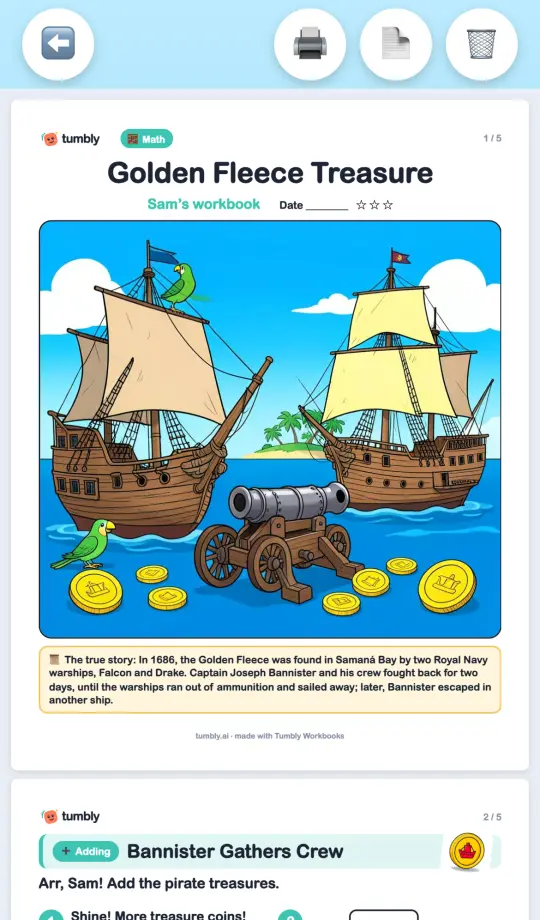
A workbook about what they found.
Birds, bugs or trees: Tumbly Workbooks sets sums, words and mazes in what your kid loves, at their level.


Scan with your iPhone camera
Questions parents ask
What’s a good outdoor scavenger hunt for a 4 year old or a preschool class?
The picture card has 16 things a child can find without reading. Read the names out and count four in a row as a win.
How do you make it harder for older kids?
Use the points list and ask for a sketch or a photo of each find. Some 3-point finds ask them to name a bird or three trees.
What can kids find on a winter scavenger hunt?
Bare branches make old nests and squirrel nests easy to see, and tracks show up in snow or mud. If it never gets cold where you live, count the frost and breath squares as free.
Can kids bring home what they find?
From your own yard that’s up to you, apart from the feathers, nests and eggs of native birds, which federal law covers. On a trail or in a park, leave things where they are.
Do we need an app?
No. The paper card needs no app, no phone and no signal. For a name for each find, Seek by iNaturalist (plants and animals) and Merlin Bird ID (birds) are free apps.
Sources
Each rule and fact on this page links to where it came from, opened November 10, 2026. Links checked November 20, 2026.
- National Park Service, Leave No Trace Seven Principles: www.nps.gov/articles/leave-no-trace-seven-principles.htm
- National Park Service, Why do leaves change color in the fall?: www.nps.gov/articles/why-do-leaves-change-in-the-fall.htm
- 36 CFR 2.1, Preservation of natural, cultural and archeological resources (Cornell LII): www.law.cornell.edu/cfr/text/36/2.1
- 16 U.S. Code § 703, Migratory Bird Treaty Act (Cornell LII): www.law.cornell.edu/uscode/text/16/703
- U.S. Fish and Wildlife Service, Feather Atlas: feathers and the law: www.fws.gov/lab/featheratlas/feathers-law.html
- CDC / NIOSH, Poisonous plants: www.cdc.gov/niosh/outdoor-workers/about/poisonous-plants.html
- CDC, Preventing tick bites: www.cdc.gov/ticks/prevention/index.html
- Poison Control, Mushroom poisoning: don’t invite “the death angel” to dinner: www.poison.org/articles/wild-mushroom-warning
- Poison Control, Fall berries only look edible: www.poison.org/articles/fall-berries-only-look-edible
- Texas A&M, Asps and other stinging caterpillars: citybugs.tamu.edu/factsheets/biting-stinging/others/ent-3010/
- NOAA, How do snowflakes form? Get the science behind snow: www.noaa.gov/stories/how-do-snowflakes-form-science-behind-snow
- University of Edinburgh, How the dandelion decides when to fly: biology.ed.ac.uk/news-events/news-2022/how-the-dandelion-decides-when-to-fly
- National Weather Service, Cricket chirp convertor: www.weather.gov/epz/wxcalc_cricketconvert
- Seek by iNaturalist on the US App Store: apps.apple.com/us/app/seek-by-inaturalist/id1353224144
- Merlin Bird ID by Cornell Lab on the US App Store: apps.apple.com/us/app/merlin-bird-id-by-cornell-lab/id773457673