Trains, ships and planes
Why did trains make towns change clocks?
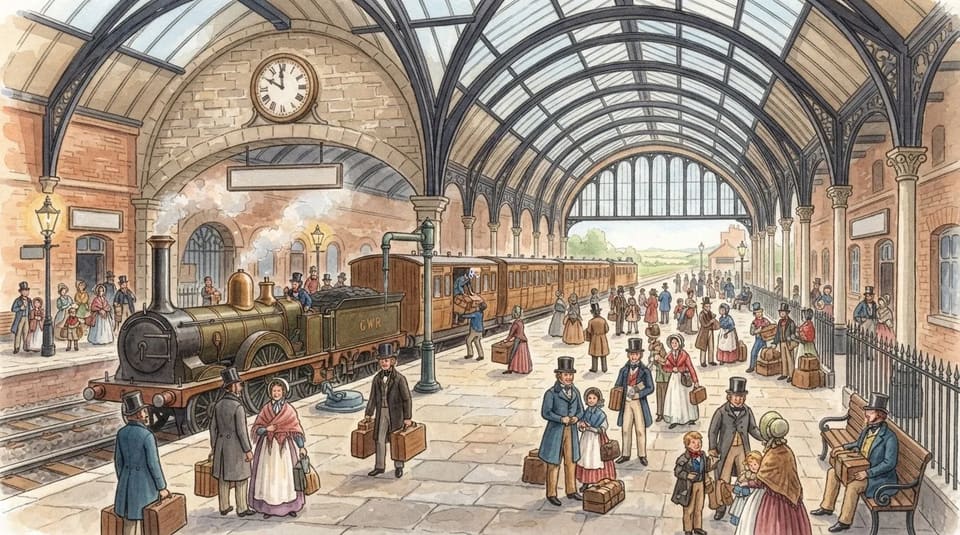
Railway time, England. A true how-it-works story for kids 8–13.
How things work stories
The Railway time story, read aloud
On this drive, past the shops and the train tracks, every clock you pass agrees with every other clock. But long ago, in England, they didn't. Railway time was the idea that train stations everywhere should share one time. Before it, each town set its clocks by the sun: noon was the moment the sun stood highest in the sky. Because the sun travels across the sky from east to west, noon reaches a western town a little later.
So when it was noon in London, Bristol's clocks said about ten minutes to twelve. When people traveled by horse, ten minutes hardly mattered. Then came the Great Western Railway, with trains zooming between London and Bristol. Suddenly a timetable was a puzzle, because every station's clock disagreed. Worse, trains share tracks, so if two crews trust two different clocks, they can end up in the same spot at the same moment.
Near misses were growing as more trains ran. So in November 1840, the Great Western Railway made a bold choice: every one of its station clocks would show London time, set at the Royal Observatory in Greenwich. Bristol was not about to give up its own minutes, so it got a clock with two minute hands, one for Bristol and one for the trains, like a phone showing two time zones at once. Within seven years, every railway in Britain had switched. And that idea of one shared time spread across the world, which is why the clocks in any town agree today.
Quiz the back seat
How did one famous clock in Bristol show both times at once?
Show the answer
It had two minute hands. Two minute hands! That clock on Bristol's Corn Exchange still has them today, about ten minutes apart.
Railway time facts for kids
- The Great Western Railway began using London time at its stations in November 1840.
- Bristol's local time was about ten minutes behind London's.
- All of Britain's railway companies took up railway time over the next seven years.
Questions kids ask about Railway time
What is railway time?
Railway time was the idea that every train station should set its clocks to the same time, London time, instead of its own local time.
Why did towns have different times?
Each town set noon by when the sun was highest, so western towns like Bristol were a few minutes behind London.
When did railway time start?
The Great Western Railway in England began using it in November 1840.
Why did trains need one shared time?
Mixed-up clocks made timetables confusing and caused near misses when trains shared the same tracks.
For grown-ups
Written with AI from public sources, then a second AI checked its main claims against the sources below before it was published. Stories that don't pass stay off the app and this site. Our about page explains who writes and checks our stories. Narration is pre-recorded, and nothing you do on this page is tied to your kids.
Sources
More stories about how things work
 Mountains, trees and weather The Mountains Made by Stretching
On this mountain road, high in the hills, here's a puzzle that sounds backwards. Out in the American West there's a giant region called…
 Inventors and firsts The Drop That Wouldn't Freeze
On this drive, we might pass salty water, the sea or the ocean. Seawater is water with salt mixed in, so much salt you can't even see it.
 Cars and roads The Road Made of Wood
On this road, our tires roll on something hard and smooth. But long ago, before there were cars, most roads were just dirt.
 Mountains, trees and weather The Valley That Became a Bay
On this drive along the water, there's a place where a river meets the sea. A spot where river water and salty sea water mix is called an…
Build one with bricks
Between stories: 25 road trip games for kids · Road trip bingo cards · License plate game · Road trip trivia · Christmas light scavenger hunt · Christmas trivia
Town and county names: GeoNames (CC BY 4.0).