Who built that?
Point Bonita Lighthouse for kids
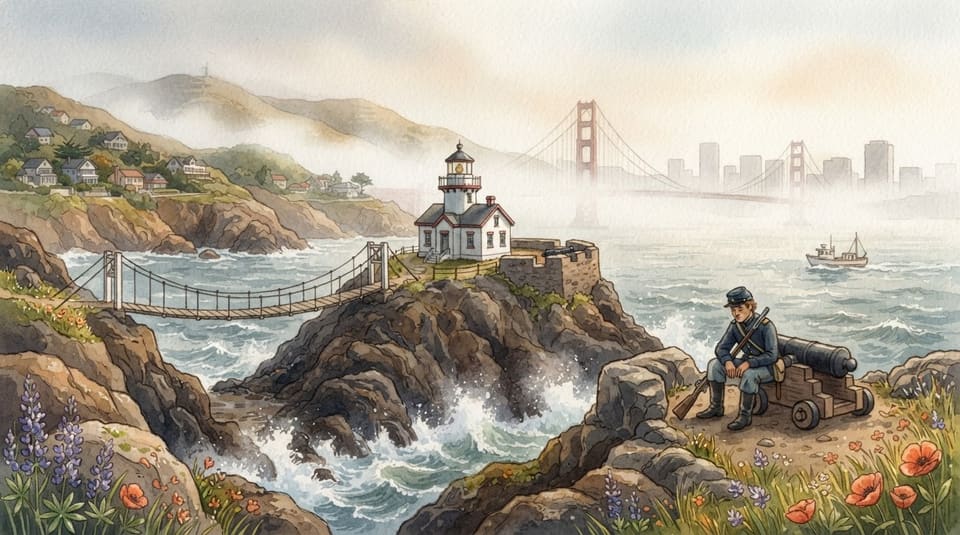
Point Bonita's fog cannon. A true story near Sausalito, CA, told for kids 5–9.
Stories from Sausalito
Point Bonita Lighthouse has guided ships into San Francisco Bay since it was first lit in 1855. It sits on a rocky point 124 feet above the sea. The way out to it runs through a 118-foot hand-carved tunnel and across a small suspension bridge. Before foghorns, a cannon was fired every half hour in fog.
Point Bonita Lighthouse at a glance
| First lit | May 2, 1855 source |
|---|---|
| Moved to its current spot | February 1, 1877 source |
| Light height above the sea | 124 feet source |
| Hand-carved tunnel | 118 feet long source |
| First fog signal | A cannon, fired every half hour in fog (1855) source |
| First suspension bridge built | 1954 (rebuilt in 2012) source |
| Last lighthouse keeper left | April 1981 source |
The Point Bonita Lighthouse story, read aloud
Way out at the tippy-tip of these cliffs is the Point Bonita Lighthouse. The path out to it goes through a tunnel dug into the rock by hand, and then across a tiny wobbly bridge. It looks like a baby Golden Gate Bridge! But here's the funny part.
Long ago, when the fog got super thick, ships couldn't even see the light. So the lighthouse got a fog cannon! A soldier had to fire the cannon every half hour, all night long, to warn the ships. Boom!
One soldier fired it for three whole days and nights, with hardly any sleep, and he got sooo tired. Later they got a big clanging bell, and after that, a giant foghorn. Much easier!
Quiz the back seat
What did they use to warn ships in thick fog, before the foghorn?
Show the answer
A cannon. A cannon! Boom, every half hour, all night long.
Point Bonita Lighthouse facts for kids
- First lit in 1855.
- Reached by a hand-dug tunnel and a small suspension bridge.
- Had the west coast's first fog signal: a cannon.
Questions kids ask about Point Bonita Lighthouse
Why did Point Bonita Lighthouse have a fog cannon?
Thick fog often hid the light, so in 1855 a retired army sergeant was hired to fire a cannon every half hour in fog. Once he stayed up three days and nights with only two hours of rest! Sailors said they could not hear it from the water, and a bell replaced it by 1856.
Why was Point Bonita Lighthouse moved?
The first lighthouse was built too high on the hill. California fog often sits up high, so the light got hidden. In 1877 a new lighthouse opened lower down, 124 feet above the sea, using the top of the old tower and its glass lens.
Can you visit Point Bonita Lighthouse?
Sometimes. On open days, a half-mile trail leads down to a viewing platform with a view of the lighthouse. The park closed the suspension bridge out to the lighthouse itself in 2024 for safety, so check the park's website before you go. Bring binoculars: harbor seals, whales and porpoises often visit.
Is Point Bonita Lighthouse still working?
Yes. It still shines through its original glass Fresnel lens from 1855, and the Coast Guard keeps the light and fog signal working. It was the last staffed lighthouse on the California coast; its last keeper left in 1981.
For grown-ups
One of the stories we launched with. Its sources are listed below. Our about page explains who writes and checks our stories. Narration is pre-recorded, and nothing you do on this page is tied to your kids.
Sources
More stories in Sausalito
 Cars and roads The Rainbow Tunnel
Look! Look up ahead!
 Mountains, trees and weather The Snowflake That Came to Sausalito
Here in Sausalito, the big water you can see is San Francisco Bay. A bay is like a giant bathtub of water hugged by land.
 Who built that? The Town Where Houses Float
Can a house float like a boat? In Sausalito, some houses do!
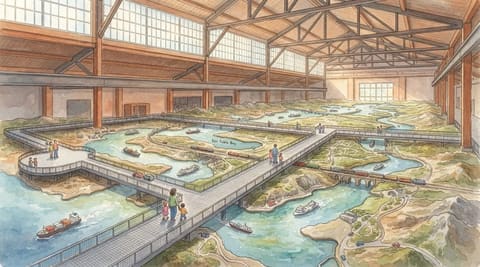 Inventors and firsts The Whole Bay in One Building
Look out the window! See that big, long building?
Build one with bricks
How things work: roads, bridges, oceans →All stories →
Between stories: 25 road trip games for kids · Road trip bingo cards · License plate game · Road trip trivia · Christmas light scavenger hunt · Christmas trivia
Town and county names: GeoNames (CC BY 4.0).