Who built that?
Why do skyscrapers need metal skeletons?
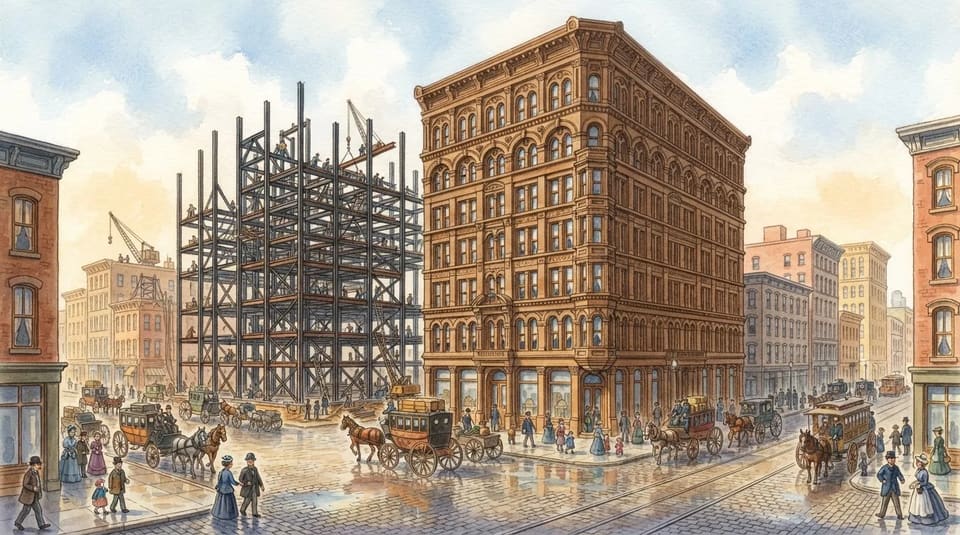
Skyscraper frames, Chicago. A true how-it-works story for kids 7–11.
How things work stories
The Home Insurance Building story, read aloud
On this drive past the skyline, every tall tower you see is hiding a secret inside its walls. Each one has a skeleton! A skyscraper frame is a set of metal beams that holds the whole building up, the way your bones hold you up. But why can't a tower just be made of bricks? About a hundred and forty years ago, in Chicago, a builder named William Le Baron Jenney was working on that very problem. Back then, the walls of a tall building carried all its weight.
So the taller you built, the thicker the bottom walls had to be, until the ground floor was mostly brick with tiny windows. That's because each brick has to hold up every brick stacked above it. Jenney tried something new for the Home Insurance Building. He built a fireproof metal frame that held up the building inside and out, so the walls just hung on it like skin. The building weighed only one third as much as a brick one! That sounded so strange that city officials actually stopped construction to make sure it wouldn't topple over.
Imagine being told your building is too light to be trusted! Count the floors on the tallest tower you can spot. Jenney's building had ten, and it was so sturdy that a few years later two more floors were stacked right on top. People often call it the world's first skyscraper. And every glittering tower around this car today still stands on Jenney's idea: a skeleton strong enough to reach the sky.
Quiz the back seat
Why did city officials stop work on the Home Insurance Building?
Show the answer
It was surprisingly light. It was surprisingly light! It passed the safety check and grew from ten floors to twelve.
Home Insurance Building facts for kids
- Chicago's Home Insurance Building, finished in 1885, is often called the world's first skyscraper.
- It was the first tall building held up inside and out by a fireproof metal frame, and it weighed one third as much as a brick building.
- Two floors were added in 1891, making it twelve stories tall.
For grown-ups
Written with AI from public sources, then a second AI checked its main claims against the sources below before it was published. Stories that don't pass stay off the app and this site. Our about page explains who writes and checks our stories. Narration is pre-recorded, and nothing you do on this page is tied to your kids.
Sources
- architecture.org/online-resources/buildings-of-chicago/home-insurance-building
- buildingtheskyline.org/jenney-myth-1
- architectuul.com/architecture/home-insurance-building
- en.wikipedia.org/wiki/Home_Insurance_Building
- pbs.org/wgbh/buildingbig/wonder/structure/home_insurance.html
- chicagoyimby.com/2024/04/lost-legends-12-the-home-insurance-building.html
More stories about how things work
 Mountains, trees and weather The Slow Push That Makes Mountains
On this road, the ground under our car feels still and solid. But it is moving, very slowly!
 Cars and roads Before Traffic Lights Blinked
Look out at the city around our car. See a traffic light?
 Cars and roads The Secret Tanks Under the Ground
As we drive around the city, we zoom past gas stations, where cars stop to get fuel. Fuel is the stuff that makes lots of cars go.
 Long, long ago A Name From a Storybook
Can a real place get its name from a pretend island? California did!
Build one with bricks
Between stories: 25 road trip games for kids · Road trip bingo cards · License plate game · Road trip trivia · Christmas light scavenger hunt · Christmas trivia
Town and county names: GeoNames (CC BY 4.0).