Mountains, trees and weather
Can Earth's giant puzzle pieces build mountains?
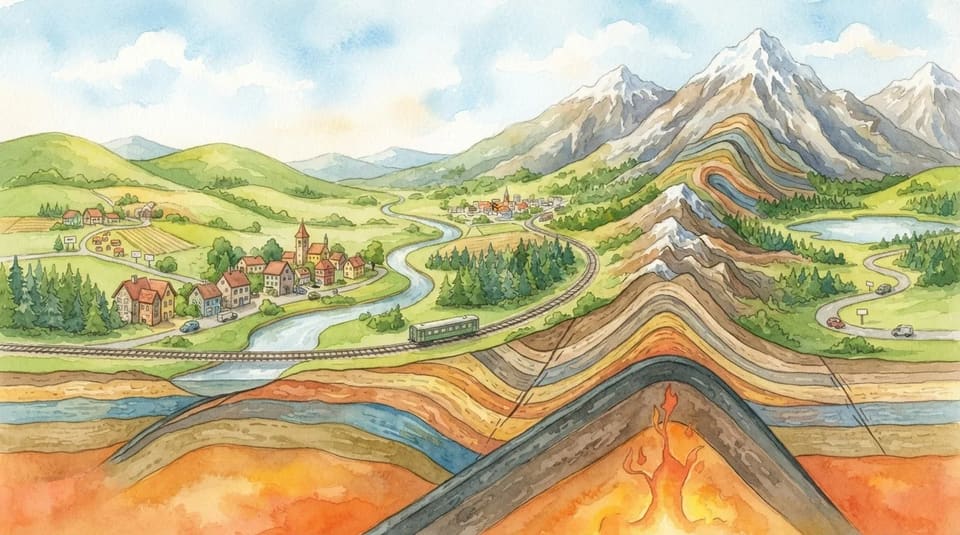
How Earth's plates build mountains. A true how-it-works story for kids 5–11.
How things work stories
The Plate tectonics story, read aloud
On this road, past the houses and the hills, the ground under us feels perfectly still. But it isn't! The whole outside of the Earth is a hard shell, cracked into giant puzzle pieces, and those pieces are always moving. Scientists call them plates, but not the kind you put your sandwich on. Nobody could fit one of these plates in the dishwasher! Let's follow one giant piece. Long, long ago, before there were any people at all, it was slowly sliding along.
How slow? About as slow as your fingernails grow. Then one day, it bumped into another giant piece. Uh oh! Neither piece could get out of the way. So they pushed, and pushed, for a very, very long time. When you push a rug against a wall, it bunches up into bumps.
The rocky ground did the very same thing. It crumpled and folded and climbed up, higher and higher. That's how mountains get built! While you ride, try counting the hills you can see. Some hills and mountains were pushed up by giant puzzle pieces bumping together. And those pieces are still moving under us right now, slowly building, even today.
Quiz the back seat
What happens when two of Earth's giant puzzle pieces push into each other?
Show the answer
The ground crumples up into mountains. Mountains! And where these pieces meet, the ground can also shake, which is called an earthquake.
Plate tectonics facts for kids
- Earth's hard outer shell is broken into seven or eight major plates and many smaller ones.
- The plates usually move between zero and about ten centimeters a year.
- Mountain-building, earthquakes and volcanoes happen where plates meet.
The Plate tectonics story, read aloud
On this road, the houses, the sidewalks, the hills and even the water are all riding on something enormous. Earth's hard outer shell is cracked into giant pieces called tectonic plates, like a broken eggshell, and those pieces are moving right now. So can puzzle pieces the size of continents build a mountain? About a hundred years ago, a German scientist named Alfred Wegener stared at a world map and noticed something odd. The bump of South America seemed to fit into the curve of Africa, like two pieces of a jigsaw puzzle. He found matching fossils and rocks on both sides of the ocean too.
So he announced that the continents had once been joined together and had slowly drifted apart! Most scientists shook their heads. Whole continents sliding around? That sounded about as likely as your house wandering off to the next street. Wegener didn't live to see it, but in the 1960s scientists discovered the seafloor spreading apart, and suddenly his idea made sense. Here's how mountains happen.
When two plates push into each other, the rock caught between them has nowhere to go, so it crumples upward, like a rug shoved against a wall. Plates move at most about ten centimeters a year, roughly the length of your hand, but over millions of years that slow shove can lift rock higher than any skyscraper. Count the hills you can spot from the car right now. The ground beneath every one of them is still slowly shifting, and the land around us is still being built.
Quiz the back seat
What did Alfred Wegener notice on the world map?
Show the answer
South America and Africa fit together like puzzle pieces. Puzzle pieces! He even found matching fossils on both sides of the ocean, a big clue that those lands were once joined.
Plate tectonics facts for kids
- Earth's rigid outer shell is broken into seven or eight major plates and many smaller ones.
- Plates move from zero to about 10 centimeters a year.
- Plate tectonics was accepted after seafloor spreading was confirmed in the 1960s.
For grown-ups
Written with AI from public sources, then a second AI checked its main claims against the sources below before it was published. Stories that don't pass stay off the app and this site. Our about page explains who writes and checks our stories. Narration is pre-recorded, and nothing you do on this page is tied to your kids.
Sources
- amnh.org/explore/ology/earth/plates-on-the-move2
- oceanservice.noaa.gov/facts/tectonics.html
- en.wikipedia.org/wiki/Plate_tectonics
- britannica.com/science/How-Are-Mountains-Formed
- nps.gov/subjects/geology/plate-tectonics-collisional-mountain-ranges.htm
- usgs.gov/faqs/how-fast-do-tectonic-plates-move
- usgs.gov/faqs/why-do-earthquakes-occur-middle-continent-far-plate-boundaries
- calacademy.org/explore-science/plate-boundaries-divergent-convergent-and-transform
More stories about how things work
 Inventors and firsts The Lamps That Know Bedtime
On this town street, tall poles stand along the road with lamps on top. Those are streetlights.
 Cars and roads The Car That Mostly Naps
On this road, past the houses and shops, cars sit along the curbs, and nearly every one of them is doing the exact same thing: absolutely…
 Cars and roads The Lines That Can Hum
On this road, there are lines painted right on the ground. They're called road markings, and they work like lines on a page that show you…
 Who built that? The Bridge That Gets a Hug
See those big concrete bridges that cars drive over, called overpasses? Here's a puzzle.
Between stories: 25 road trip games for kids · Road trip bingo cards · License plate game · Road trip trivia · Christmas light scavenger hunt · Christmas trivia
Town and county names: GeoNames (CC BY 4.0).