Inventors and firsts
Can pieces of hills travel thousands of kilometres?
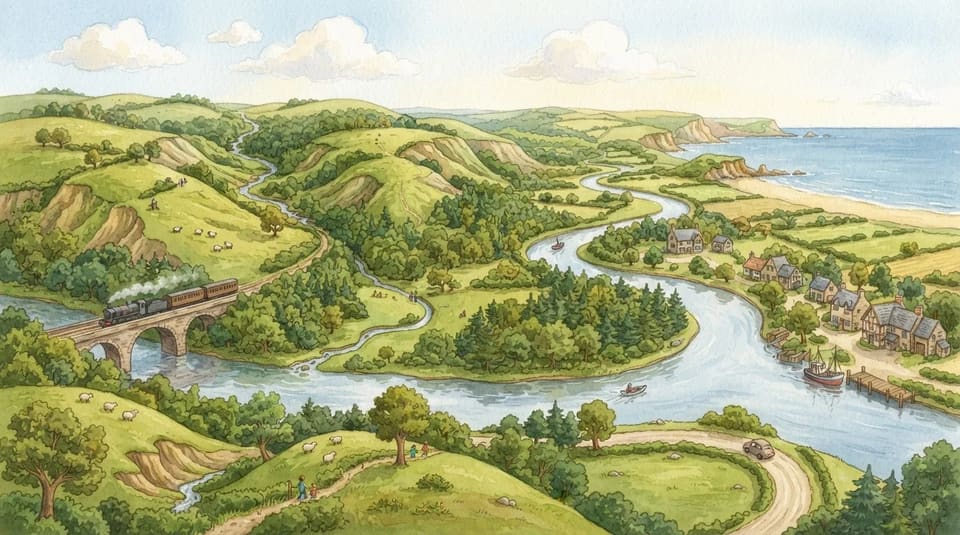
How erosion moves hills. A true how-it-works story for kids 5–10.
How things work stories
The Erosion story, read aloud
On this drive, we're rolling past hills. And those hills are slowly traveling! It's called erosion, a big word for when rain and wind carry little bits of rock and dirt away. Could a piece of a hill really go on a long trip? Let's follow one tiny grain of sand and find out. Our grain of sand sits high on a hill, snug against a rock. One rainy night, raindrops wiggle it loose.
The rainwater runs downhill and carries our grain along, like a kid on a water slide. Down it goes, into a little stream, then into a big river! Moving water pushes hard. Fast water can carry sand and even small pebbles. When the water slows down, it drops what it carried. Look out the window for a hill, or a river under a bridge. The river pushes our grain past forests and towns, day after day.
It travels farther than your family could drive in many days, and it never needs a snack stop! At last the river reaches the sea. Our grain settles on a beach made of little pieces of faraway hills! Wind does this too, blowing dust across whole oceans. So bits of one land help build another, one tiny grain at a time.
Quiz the back seat
What knocked the grain of sand loose from the hill?
Show the answer
Rain. Rain! Raindrops and running water are some of the strongest movers of dirt and rock on Earth.
Erosion facts for kids
- Erosion moves soil and rock from one place to another using water, wind, waves or ice.
- Eroded bits can travel just a tiny distance or thousands of kilometres.
- Erosion usually happens fastest on steep slopes.
The Erosion story, read aloud
On this drive, past the hills and the houses along the street, the ground is quietly on the move. It's called erosion: water and wind wearing away tiny pieces of rock and soil and carrying them somewhere else. So can a piece of a hill travel thousands of kilometres? Let's follow one grain of sand. We'll call her Grit. Grit starts as part of a rock high on a hillside, until one stormy day rain knocks her loose.
Now she's traveling! A trickle carries her into a gutter, the gutter feeds a creek, and the creek pours into a river. Fast water is strong, so it pushes and rolls her along. But when water slows down, it loses that strength and drops what it carries. That's why Grit stops and starts, resting on sandbars for years, bumping against pebbles until her sharp corners wear smooth. She's the slowest traveler on Earth, and she never once asks, are we there yet?
While we drive, count every stream, ditch or storm drain you spot, because each one is a road for traveling grains. At last Grit reaches the sea and sinks to the bottom, buried under more and more sand. Over millions of years, all that weight presses the layers into new rock called sandstone. And the Earth can push rock like that back up into brand new hills. So the hills around this car may be built from pieces of older hills that traveled a very long way. Grit's trip is longer than any road trip, and it still isn't finished.
Quiz the back seat
What makes a river drop the sand it's carrying?
Show the answer
The water slows down. The water slows down! That's why sand piles up where rivers go slow, like on the inside of a bend.
Erosion facts for kids
- Erosion moves soil and rock from one place to another, while weathering breaks rock without moving it.
- Eroded material can travel just a few millimetres or thousands of kilometres.
- Erosion is usually fastest on steep slopes.
For grown-ups
Written with AI from public sources, then a second AI checked its main claims against the sources below before it was published. Stories that don't pass stay off the app and this site. Our about page explains who writes and checks our stories. Narration is pre-recorded, and nothing you do on this page is tied to your kids.
Sources
- education.nationalgeographic.org/resource/erosion
- en.wikipedia.org/wiki/Erosion
- geolsoc.org.uk/ks3/gsl/education/resources/rockcycle/page3604.html?srsltid=AYCX9vJ_BGuOQz5k2iBcCNTrWe9wV5Wp0AmpyhSEXcJFMx9OFEETLK5X
- flexbooks.ck12.org/cbook/ck-12-fourth-grade-science/section/2.10/primary/lesson/erosion-and-deposition-by-flowing-water-%3A%3Aof%3A%3A-ms-erosion-and-deposition-%3A%3Aof%3A%3A-ck-12-earth-science-for-middle-school-scigr4
- interfaithsustain.com/what-is-the-most-common-and-powerful-agent-of-erosion
- science.nasa.gov/earth/earth-observatory/dust-storm-sweeps-from-africa-into-atlantic-519
- atmosphere.copernicus.eu/tracking-massive-dust-cloud-africa-america
- whoi.edu/ocean-learning-hub/ocean-facts/how-is-beach-sand-created
More stories about how things work
 Mountains, trees and weather The Puzzle Pieces That Build Mountains
On this road, past the houses and the hills, the ground under us feels perfectly still. But it isn't!
 Inventors and firsts The Lamps That Know Bedtime
On this town street, tall poles stand along the road with lamps on top. Those are streetlights.
 Cars and roads The Car That Mostly Naps
On this road, past the houses and shops, cars sit along the curbs, and nearly every one of them is doing the exact same thing: absolutely…
 Cars and roads The Lines That Can Hum
On this road, there are lines painted right on the ground. They're called road markings, and they work like lines on a page that show you…
Between stories: 25 road trip games for kids · Road trip bingo cards · License plate game · Road trip trivia · Christmas light scavenger hunt · Christmas trivia
Town and county names: GeoNames (CC BY 4.0).