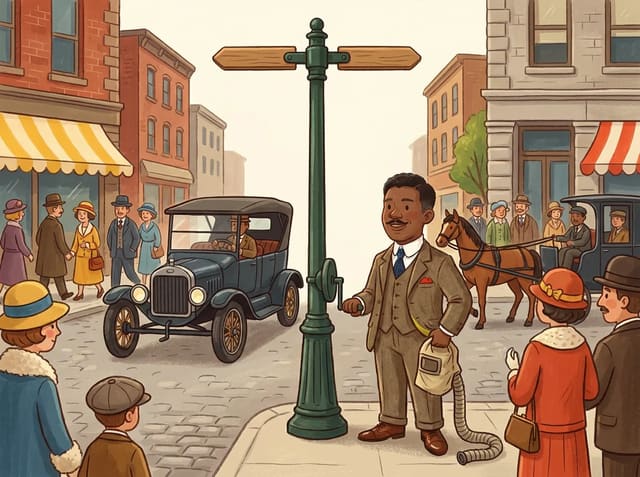
Garrett Morgan for kids: a true picture book
Garrett Morgan Keeps Us Safe. 10 pages, fact-checked, at three reading levels, read aloud.
Garrett Morgan (1877–1963)
The lesson: When you see people in danger, build something that keeps them safe, even when others doubt you.


Scan with your iPhone cameraor open it in your browser
Who was Garrett Morgan?
Garrett Morgan (1877–1963) was an American inventor and businessman in Cleveland, Ohio. The son of parents who had been enslaved, he invented a safety hood that let rescuers breathe in smoke and wore it in 1916 to rescue workers trapped in a tunnel under Lake Erie. In 1923 he patented a three-position traffic signal.
| Born | 1877 |
|---|---|
| Died | 1963 |
| Known for | inventor of the safety hood and a three-position traffic signal |
| The lesson | When you see people in danger, build something that keeps them safe, even when others doubt you. |
| Topics | Inventors, Cars and roads, Builders and engineers |
| The book | 10 pages, 3 reading levels, read aloud |
Read the first pages free
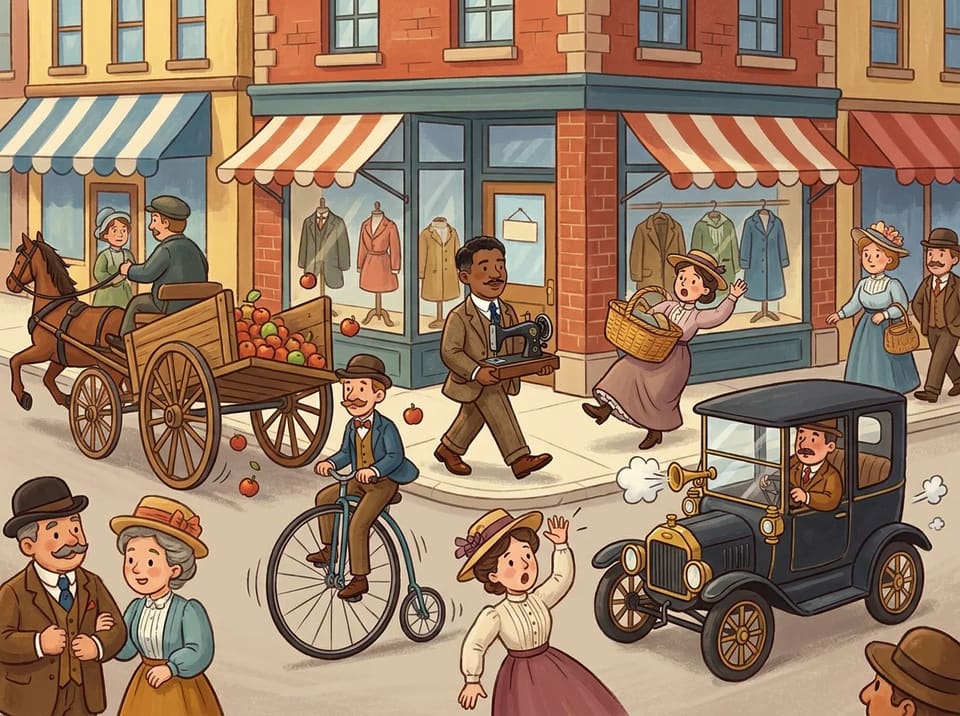
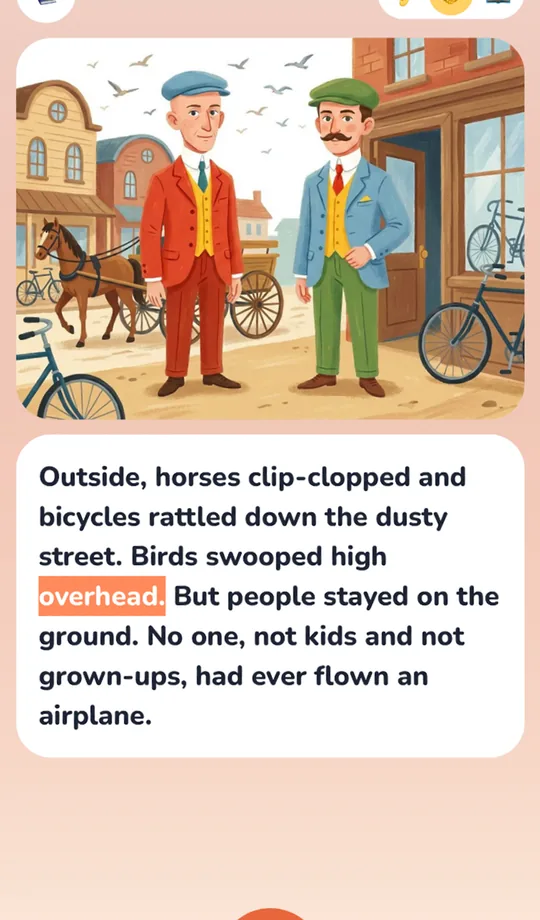
Long ago in Cleveland, in America, bikes, horses, cars and walkers all shared one street. Honk! Clop! Crash! Walking was hard.
In the 1910s, the streets of Cleveland, Ohio, were a jumble. Bikes, horse carts, brand-new cars and people on foot all shared the same road. Crashes happened all the time. Young Garrett Morgan carried sewing machines through the crowd, fixing them for clothing shops.
In Cleveland, Ohio, in the 1910s, cars were still new. Bicycles, horse-drawn carts, cars and people on foot all squeezed onto the same streets, and crashes between them were common. It was a risky place for anyone walking. Garrett Morgan had come to Cleveland in 1895 and fixed sewing machines for clothing makers. Word spread that he was very good at fixing things.
Page 1 of 10
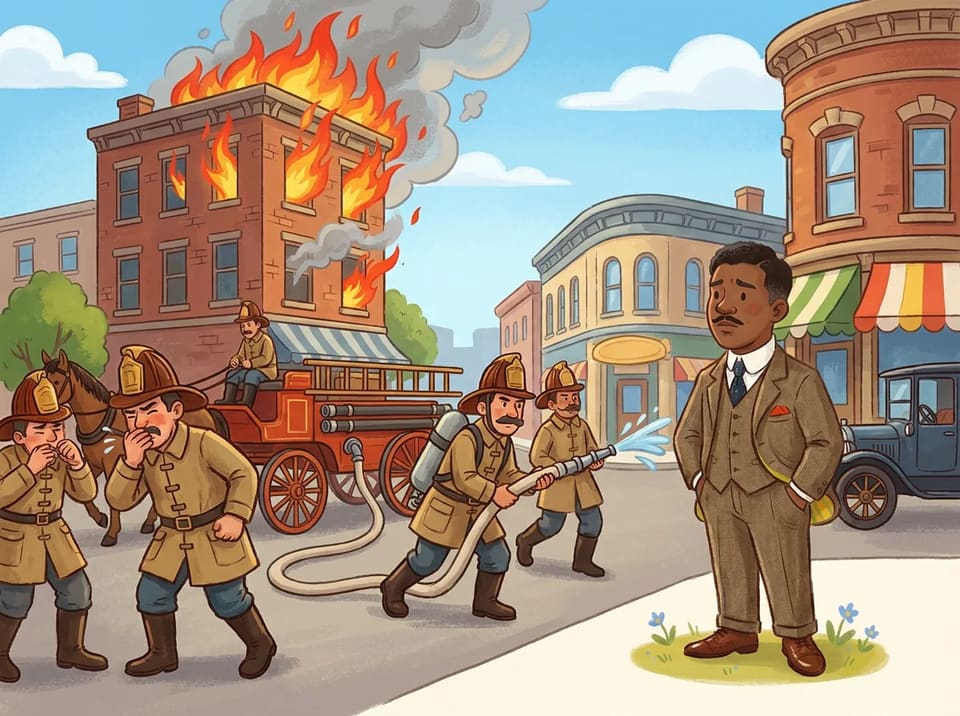
Long ago in Cleveland, firefighters ran into big gray smoke. Cough! Cough! Their masks were hard to wear.
Firefighters in Cleveland had a hard job too. They ran into thick, choking smoke and could barely breathe. Their breathing masks were hard to put on, too tricky to use, or did not work well.
In the Cleveland of the 1910s, firefighters faced another danger. Fires filled buildings with thick, choking smoke, and the firefighters struggled to breathe as they worked. The breathing devices of the day were no help: some were hard to put on, some were far too complicated, and some simply did not work well. Garrett saw firefighters struggling in the smoke.
Page 2 of 10
Garrett Morgan: a timeline of true facts
- 1910s In Cleveland, Ohio, in the 1910s, cars were still new: bicycles, horse-drawn carts, cars and people on foot all shared the same streets, and crashes between them were common. source
- 1910s Firefighters of the time struggled to breathe in the thick, choking smoke of the fires they fought, and the breathing devices of the day were hard to put on, too complicated, or did not work well. source
- 1877 Garrett Morgan was born in Paris, Kentucky, to parents who had been enslaved; he left school after sixth grade, and at 14 he moved to Cincinnati, Ohio, to find work, paying a tutor so he could keep learning. source
- 1895 In 1895 he moved to Cleveland and fixed sewing machines for clothing makers, and word spread that he was very good at fixing things. source
- 1912 Garrett spent his life making inventions that kept ordinary people safe; after seeing firefighters struggle in the smoke, he invented a safety hood, and in 1912 he asked for a patent on it. source
- 1912 Smoke rises and leaves a layer of cleaner air near the floor, so a tube dangled down from the hood to breathe that low air, and a wet sponge filtered out smoke and cooled the air. source
- 1914 Many tries to sell the hood failed because buyers did not want an invention made by a Black man, so in 1914 Garrett hired a white actor to pose as the inventor while he himself wore a disguise. source
- 1914 To show it worked, Garrett filled a closed tent with thick black smoke, walked in wearing the hood, stayed about 20 minutes and came out unharmed, and fire departments began to buy it. source
- 1916 Just before midnight on a hot summer night in 1916, workers digging a tunnel deep under Lake Erie to bring clean water to Cleveland hit a pocket of natural gas, and an explosion filled the tunnel with smoke and gas. source
- 1916 Two rescue teams went into the tunnel without the right gear for the smoke and fumes, and many of those rescuers did not come back out. source
- 1916 In the middle of the night a messenger came for Garrett, and he and his brother Frank rushed to the lake still in their pajamas, bringing four of his hoods. source
- 1916 Most rescuers there doubted the hood, so Garrett, Frank and two volunteers put on hoods and went into the tunnel themselves; Garrett came out carrying a man on his back, went into the tunnel four times in all, and others joined in after his team succeeded. source
- 1916 Newspapers and city officials left Garrett out when they praised the rescuers, and some southern cities canceled their orders for his hood when they saw photos showing that its inventor was Black. source
- 1920s Most traffic signals then had only two positions, Stop and Go, turned by hand with no pause in between, so cars often crashed at busy corners just as the signal switched. source
- 1922 By then Garrett owned a car and drove Cleveland's busy streets himself, and after he saw a crash between a car and a horse-drawn carriage at a street corner, he set out to make traffic safer. source
- 1923 His signal was a T-shaped pole that a worker turned with a crank, with three positions: Stop, Go, and a third that stopped traffic in every direction before the other road could go, which also let people on foot cross more safely. source
- 1923 At night, or when the streets were quiet, the signal's arms could be set halfway up to tell drivers to go through carefully, just like the flashing yellow and red lights of today. source
- 1923 On November 20, 1923, Garrett became the first person to get a U.S. patent for a three-position traffic signal, and he sold the rights to General Electric for $40,000. source
- today Signals like his were used across North America until the red, yellow and green lights we know today replaced them, and the U.S. Department of Transportation calls his signal the basis of the modern traffic signal. source
Questions kids ask about Garrett Morgan
Did Garrett Morgan invent the traffic light?
Not the first one. Traffic signals already existed, but most had only two positions, Stop and Go. In 1923 Morgan became the first person to get a U.S. patent for a three-position signal, which added a position that stopped traffic in every direction before the other road could go. He sold the rights to General Electric for $40,000. source
What was Garrett Morgan's safety hood?
It was a hood that let a person breathe in smoke. Smoke rises, so a tube hung down near the ground to draw the cleaner air there, and a wet sponge filtered smoke and cooled the air. Morgan patented it in 1914 and sold it to fire departments around the country. source
How did Garrett Morgan save lives in 1916?
On July 24, 1916, workers digging a water tunnel under Lake Erie in Cleveland hit a pocket of natural gas, and an explosion trapped them. Morgan, his brother Frank and two others wore his breathing hoods into the gas-filled tunnel and rescued two men. source
What else did Garrett Morgan do?
He ran a sewing machine shop, a tailoring shop with 32 workers that made suits, dresses and coats, and a hair-care products company. In 1920 he founded the Cleveland Call, a weekly newspaper, and in 1908 he helped found the Cleveland Association of Colored Men. source
3 reading levels
- Read to me (ages 3–5)
- Read together (ages 6–8)
- I'll read (ages 9–12)
The same true story, written three ways. Little kids hear short, bouncy lines; big kids get the details and the numbers.
Quiz time
Where is the cleaner air when there is smoke?
Show the answer
Down low near the floor.
Try this at home
- Build your own T-shaped traffic signal from cardboard and a paper-towel tube, with signs for Stop, Go and Everybody Stop, and spin it to direct toy cars and walkers on a floor road.
- Play Garrett's signal game: one person is the signal and calls Go, Stop or Everybody Stop, and everyone else drives, rides or walks only when it is their turn.
- Take a walk with a grown-up to a crosswalk and watch the lights change. Count how many cars wait while people cross, then draw what you saw.
More true heroes



Read the whole book tonight.
Free to start on iPhone, iPad and Android, and in any web browser.
Scan with your iPhone cameraor open it in your browser
Inventors for kids · Cars and roads for kids · Builders and engineers for kids · Black inventors for kids · All heroes