
Emily Warren Roebling for kids: a true picture book
Emily's Bridge. 10 pages, fact-checked, at three reading levels, read aloud.
Emily Warren Roebling (1843–1903)
The lesson: If the job needs doing and you can learn it, learn it.


Scan with your iPhone cameraor open it in your browser
Who was Emily Warren Roebling?
Emily Warren Roebling (1843–1903) helped finish building the Brooklyn Bridge in New York. When her husband, the chief engineer, became too sick to visit the bridge, she studied engineering and carried his instructions to the workers every day. When the bridge was finished in 1883, she was the first to cross it in a carriage.
| Born | 1843 |
|---|---|
| Died | 1903 |
| Known for | Brooklyn Bridge engineer |
| The lesson | If the job needs doing and you can learn it, learn it. |
| Topics | Bridges, Builders and engineers |
| The book | 10 pages, 3 reading levels, read aloud |
Read the first pages free
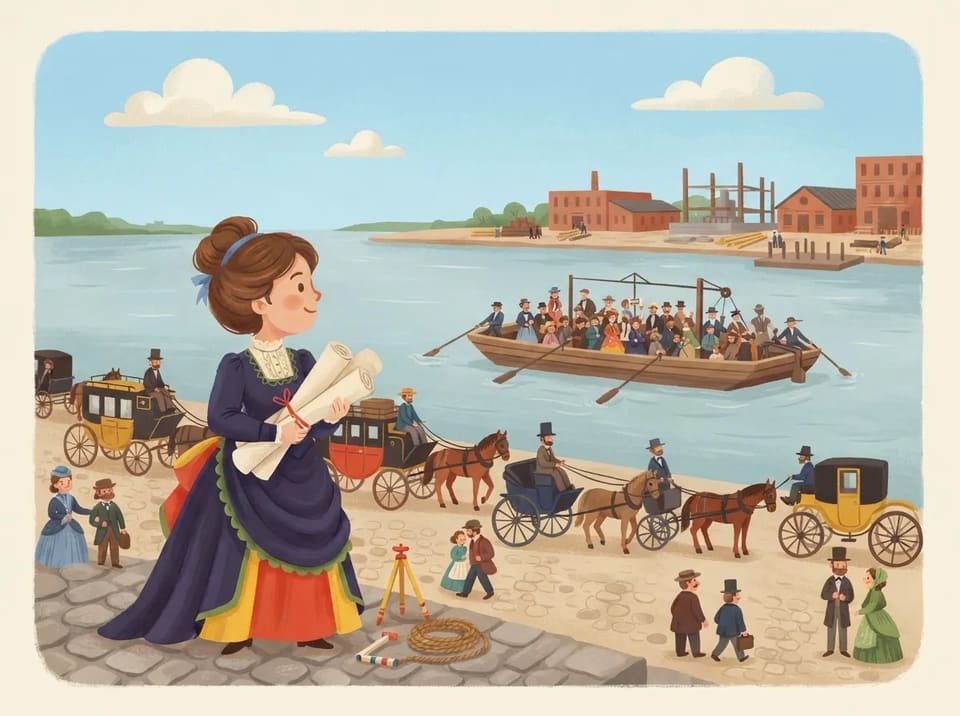
Long ago, the only way across the busy river between two cities was a ferry boat. People drew plans for bridges over it, but none got built. The river was too busy!
More than 140 years ago, the only way to travel between Brooklyn and New York was by ferry boat. Engineers drew plans for bridges, but none were built, because building one high enough over such a busy river was too hard. Tunnels under the river would cost too much.
In the 1860s, when this story begins, the only way to travel between Brooklyn and New York was by one of several ferry lines across the East River. Engineers had tried: they drew up designs, chain bridges and link bridges among them, but none was ever built, because putting a fixed span high enough over such an extremely busy river was too difficult. Others proposed tunnels under the river, but those were considered far too expensive.
Page 1 of 10
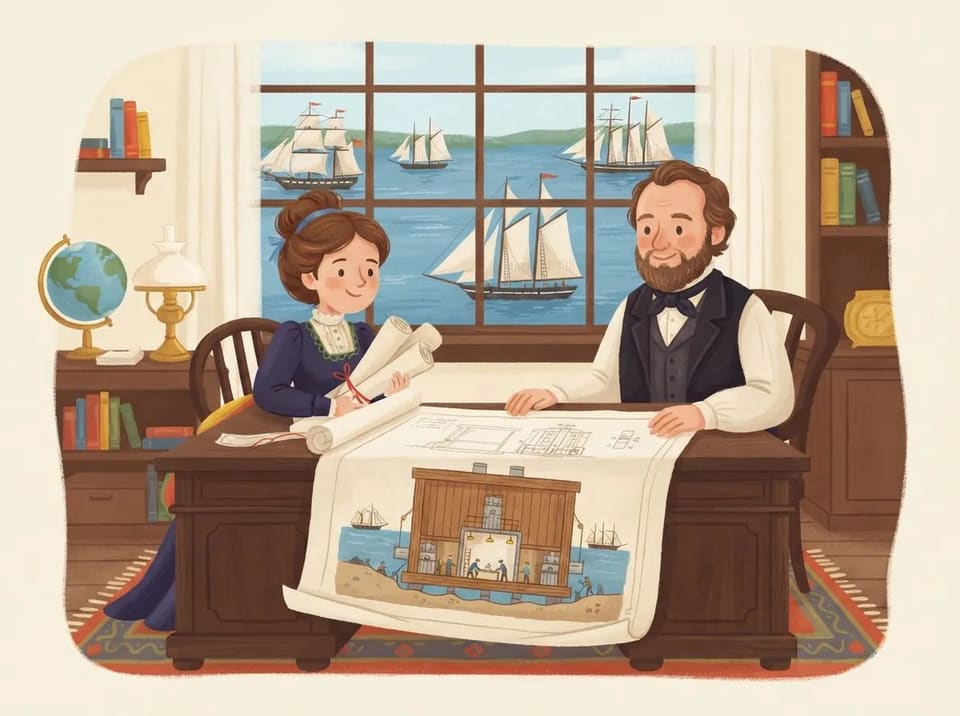
Emily married an engineer. His father designed a giant bridge for the river. Emily and her husband went far away to learn how giant boxes could help build it.
Emily Warren married Washington Roebling, an engineer whose father, John Roebling, designed a bridge to cross the river. Emily and Washington went to Europe to study how caissons could help build it: giant boxes set upside down on the river bottom and pumped full of air, so workers could dig underneath.
Emily Warren married Washington Roebling, a civil engineer and the son of John A. Roebling, designer of a bridge meant to cross the East River. While John began the preliminary work, the newlyweds traveled to Europe to study how caissons could be used to build it. Caissons were brand new in the United States: huge boxes placed open-side-down on the river bottom and pressurized, so that workers inside could dig out the earth and stone beneath and slowly sink them.
Page 2 of 10
Emily Warren Roebling: a timeline of true facts
- Before the bridge, people traveled between Brooklyn and New York on ferries. source
- Workers dug beneath the river inside big pressurized boxes called caissons. source
- As each caisson sank, a bridge tower rose above it. source
- Engineers had suggested different bridge designs, but none had been built across the busy river. source
- People also proposed tunnels under the river, but they thought tunnels would cost too much. source
- 1867 Bridge designer John Roebling had already built a long suspension bridge over the Ohio River. source
- 1864 Emily met Washington Roebling, a civil engineer and the bridge designer’s son, at a soldiers’ ball. source
- 1865 Emily and Washington married in Cold Spring, New York. source
- Emily devoted herself to finishing the Brooklyn Bridge. source
- 1869 Washington’s father died after an accident at the bridge site, and Washington became chief engineer. source
- Working deep in the caissons made Washington so sick that he could not visit the bridge site. source
- Before construction, Emily and Washington traveled to Europe to study caissons. source
- 1870 A fire broke out inside a caisson, and Washington directed the effort to put it out. source
- Emily carried information between Washington and his assistants and brought him news of the work. source
- When Washington could not see well enough to write, Emily wrote down his instructions. source
- Emily learned about materials, stresses, cables, and curves from Washington. source
- 1882 When Washington’s job was in danger, Emily spoke to engineers and politicians to defend his work. source
- Emily took on much of the chief engineer’s work, supervising and managing the project day by day. source
- 1882 After Emily defended Washington’s work, politicians allowed him to remain chief engineer. source
- 1883 Before the bridge officially opened, Emily crossed first in a carriage, carrying a rooster for victory. source
- 1883 The bridge opened on May 24, and thousands came to the ceremony. source
- Emily and Washington planned the bridge’s continued construction together. source
- Emily handled technical details and helped people reach agreements. source
- 1883 On opening day, 1,800 vehicles and 150,300 people crossed the bridge. source
- 1883 Soon after the bridge opened, fewer people were riding the ferries across the river. source
- Today a plaque on the bridge remembers Emily, Washington, and John Roebling. source
Questions kids ask about Emily Warren Roebling
Why did Emily Roebling carry a rooster?
The rooster was a sign of victory. Before the Brooklyn Bridge officially opened in 1883, Emily rode across it in a carriage holding a rooster. She was the first person to cross the finished bridge by carriage. source
What happened to Emily Roebling's husband?
Her husband, Washington Roebling, was the bridge's chief engineer. He went deep underwater to study the bridge's foundations and came up too fast, which gave him decompression sickness, then called caisson disease. He became so sick that he had to stay in bed. source
How did Emily Roebling help build the Brooklyn Bridge?
Emily learned about strength of materials, stress analysis and cable construction. Every day she went to the bridge to pass on her husband's instructions and answer questions. She also kept records and answered the mail. Many people even suspected she was the brains behind the bridge. source
Who designed the Brooklyn Bridge?
Emily's father-in-law, John A. Roebling, designed the Brooklyn Bridge. In 1869 he died of tetanus after an accident at the bridge site. His son Washington, Emily's husband, then became the chief engineer. source
3 reading levels
- Read to me (ages 3–5)
- Read together (ages 6–8)
- I'll read (ages 9–12)
The same true story, written three ways. Little kids hear short, bouncy lines; big kids get the details and the numbers.
Quiz time
Before the bridge, how did people cross the river?
Show the answer
By ferry boat.
Try this at home
- Hang a string or a necklace between two chairs and look at the curve it makes. That curve is the shape Emily learned to calculate for the bridge's giant cables.
- Turn a clear cup upside down and push it straight down into a bowl of water. See how the air inside keeps most of the water out? Workers dug inside giant upside-down boxes like that under the river.
- Play messenger: one person explains how to build a block tower without touching the blocks, and another person builds it. Then switch. That's how Emily and Washington worked on the bridge together.
More true heroes


Build one with bricks
How it works
Read the whole book tonight.
On iPhone, iPad and Android, and in any web browser.
Scan with your iPhone cameraor open it in your browser
Bridges for kids · Builders and engineers for kids · Women inventors for kids · All heroes