Types of bridges for kids: how beam, arch, suspension and cantilever bridges work
Most bridges are one of four types. A beam bridge is a flat deck resting on supports at each end. An arch bridge curves, so its weight pushes out and down into strong ends. A suspension bridge hangs its road from cables draped over tall towers. A cantilever bridge reaches out from its piers in arms that meet over the gap. Each one carries its load across and sets it down on the ground.
Engineering projects at home
By the Tumbly team. Every fact is from the source linked under it, checked on November 16, 2026.
Two forces: a squeeze and a stretch
Every part of a bridge is being squeezed or stretched, and often both. Engineers call the squeeze compression and the stretch tension. Each type of bridge is a way of giving each material the job it’s good at.
Try it with a sponge. Draw lines across the side of a long kitchen sponge with a marker, a finger apart. Lay it across two stacks of books and press the middle. The lines on top crowd together, because the top is squeezed. The lines on the bottom spread apart, because the bottom is stretched. The middle barely changes. A real beam does the same, only too little to see.
Stone, brick and concrete are strong when squeezed but crack when pulled. Steel cable is the opposite: strong when pulled, and like any rope, it can’t push at all. Keep those two facts in mind and every bridge below makes sense.
Sources: Wikipedia on beams, Wikipedia on arch bridges.
The four types at a glance
| Type | What holds it up | Good for | A real one |
|---|---|---|---|
| Beam | A stiff beam on a support at each end: top squeezed, bottom stretched | Short gaps, one after another | Most highway overpasses |
| Arch | A curve that’s squeezed all the way around, pushing on strong ends | Stone, brick and concrete, where the ground can push back | The Alcántara Bridge, Spain (built 104–106 AD) |
| Suspension | Stretched cables over squeezed towers, anchored in the ground | The longest gaps | The Golden Gate Bridge (built 1933–1937) |
| Cantilever | Arms reaching out from piers, each balanced by an arm on the land side | Long, hard crossings: the arms reach out with nothing holding them up from below | The Richmond–San Rafael Bridge (opened 1956) |
Beam bridges
A beam bridge is the simplest kind: a stiff beam resting on a support at each end, like a plank across a creek. A load in the middle bends it a tiny bit, squeezing its top and stretching its bottom. The longer the beam, the more it bends, so a long beam bridge stands on many piers, with a short span between each pair. Most highway overpasses are beam bridges.
A real one. Many overpasses are concrete beams with steel cables inside, pulled tight before the beam ever carries a car. The cables keep the concrete squeezed, so when a heavy truck tries to stretch the bottom of the beam, it doesn’t crack. The French engineer Eugène Freyssinet patented this idea, called prestressing, in 1928. Hear it in the car: Why squeeze concrete before cars drive over it?
Try it at the table. Lay a sheet of paper across two stacks of books a hand apart, and set a coin in the middle. It sags and falls. Fold the same sheet into a zigzag, like a fan, and try again. Now it holds coin after coin, because the folds make the beam deeper, and a deeper beam bends less.
Sources: Wikipedia on beams, beam bridges, the University of Manchester on span and depth, Eugène Freyssinet.
Arch bridges
An arch turns the weight on it into a push that runs around the curve and down into the ground at both ends. In a good stone arch, every stone is squeezed and none is pulled, which is why stone and brick, which crack when pulled, make such good arches. The ends, called abutments, have to push back. If they slide apart, the arch flattens and falls.
A real one. The Romans built the six stone arches of the Alcántara Bridge in Spain, over the Tagus River, between 104 and 106 AD. With repairs, it still stands more than 1,900 years later.
Try it at the table. Bend a strip of thin cardboard into an arch between two books and press the top. The ends slide out and it flattens. Now push a heavy book against the outside of each end and press again. It holds, because now the ends push back.
Sources: Wikipedia on arch bridges, the Alcántara Bridge.
Suspension bridges
A suspension bridge hangs its road from thin cables called suspenders, which hang from two huge main cables. The main cables drape over tall towers and are tied into heavy anchors in the ground at each end. The cables are stretched, the towers are squeezed straight down, and the anchors keep the cables from pulling the towers in. Suspension bridges are the kind built for the longest gaps.
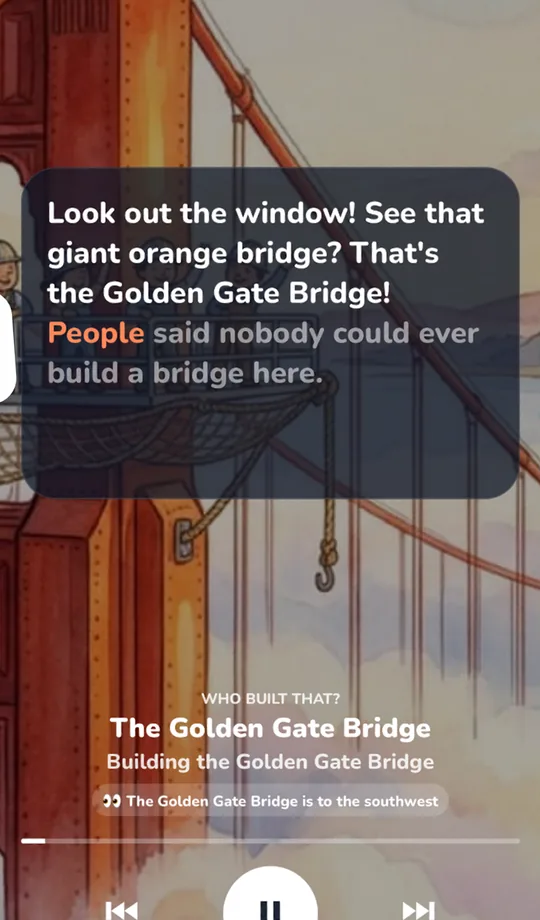
A real one. The Golden Gate Bridge has 4,200 feet between its two towers, and each tower rises 746 feet above the water. Its two main cables hold 80,000 miles of wire, 27,572 wires in each cable. Hear how it was built: The Golden Gate Bridge. When the Brooklyn Bridge opened in New York in 1883, it was the longest suspension bridge in the world, and Emily Warren Roebling had carried the chief engineer’s instructions to its builders for years. Read her story: Emily Warren Roebling for kids.
Try it at the table. Tie one end of a string to a chair and hold the other end so the string sags a little. Have someone hang a paper cup from the middle with a paper clip and add coins one at a time. Feel the string tug harder with every coin. Pull it tighter and it sags less, but you have to pull harder still. That pull is why a real bridge ties its main cables into the ground.
Suspension or cable-stayed? From the car, look at the cables. Two big cables that swoop in a curve from tower to tower, with thin ones dropping straight down to the road: a suspension bridge. Straight cables that run from the tower right to the road, in a fan or in parallel lines like harp strings: a cable-stayed bridge, used for gaps a little shorter than a suspension bridge’s.
Sources: Wikipedia on suspension bridges, the Golden Gate Bridge District’s numbers, the Brooklyn Bridge, cable-stayed bridges.
Cantilever bridges
A cantilever is a beam held at only one end, like a diving board. A cantilever bridge reaches an arm out from a pier on each side of the gap, and the two arms meet in the middle, sometimes with a short span hung between them. Each arm is balanced by another arm reaching back toward land. Builders can reach the arms out over a deep river or a gorge without propping them up from below while they work. In a steel cantilever, the top of each arm is stretched and the bottom is squeezed.
A real one. The Richmond–San Rafael Bridge crosses the north end of San Francisco Bay for 5.5 miles. It opened on September 1, 1956, with two separate cantilever spans raised high so ships can pass through two channels, and two decks, one for each direction. Hear why it rises and dips: The Richmond–San Rafael Bridge. In Scotland, the Forth Bridge, a cantilever railway bridge, had the longest cantilever span in the world when it opened.
Try it at the table. Lay a ruler on a table with half of it sticking out past the edge, and hold the table end down with a book. Hang a binder clip from the far end, then slide the ruler out a little at a time. When it tips, the book wasn’t heavy enough. That’s why a cantilever bridge balances each arm with another arm on the land side.
Sources: Wikipedia on cantilever bridges, Caltrans on the Richmond–San Rafael Bridge, the Forth Bridge.
Why every bridge has gaps in the road
A bridge grows on a hot afternoon and shrinks on a cold night, because warm steel and concrete take up a little more room. A bridge held tight at both ends would push until it cracked, so builders leave gaps called expansion joints. On big bridges they’re often steel plates with fingers that slide between each other as the gap opens and closes. Next time you drive onto a bridge, listen for the thump as the tires cross one. Hear the story: Why do bridges need room to wiggle?
Sources: Wikipedia on expansion joints.
Build a brick bridge
Tumbly’s brick bridge takes 45 pieces in 3 steps: river and walls, arch and road and railings, for ages 4 to 9. Its gray walls step in over a blue-brick river until they meet. Builders call that a corbel arch: each layer reaches a little farther over the gap than the one below, so the weight stays over the walls instead of pushing out on them like a curved stone arch. When it’s done, roll a toy car across and press on the road.

For more bridges with a test to pass, try the toy car bridge, the shoe bridge and the two-chair bridge in the building challenges, or the reindeer bridge in the Christmas STEM activities.
Hear the true stories in the car
Tumbly Drive reads these aloud through the car speakers, then asks the back seat a question. Each one lists its sources.
Turn the next bridge into a story.
Tumbly Drive tells kids the true story of the bridges, roads and towns outside the window, read aloud through the car speakers, then quizzes the back seat.


Scan with your iPhone cameraor open it in your browser
Questions parents ask
What are the 4 types of bridges?
Beam, arch, suspension and cantilever. A beam bridge rests on supports at each end, an arch pushes its weight out into strong ends, a suspension bridge hangs from cables draped over towers, and a cantilever bridge reaches out from its piers in arms that meet in the middle. A cable-stayed bridge, with straight cables from tower to road, is a cousin of the suspension bridge.
What is the strongest type of bridge?
No type is strongest at everything. Each suits a different gap: beams for short ones like overpasses, arches where the ground at each end can push back, and suspension bridges for the longest, like the Golden Gate Bridge’s 4,200 feet between towers. Engineers pick the type that fits the gap, the ground and what has to cross.
Why do bridges have gaps in the road?
Steel and concrete grow a little when they warm up and shrink when they cool. A bridge held tight at both ends would push until it cracked, so builders leave gaps called expansion joints for it to move.
How do you explain how a bridge works to a 5 year old?
Show it. Lay a sheet of paper across two stacks of books and set a coin on it: it falls. Fold the paper like a fan and it holds. A bridge’s job is to carry the weight across the gap and set it down on the ground at the ends, and its shape is how it does that.