Christmas STEM activities for kids: 14 challenges and experiments
Christmas STEM activities are science, tech, engineering and math projects with a holiday twist: a brick sleigh that carries 10 presents around a corner, a candy cane race in warm water, cold water and oil, a card whose star lights up. Here are 14 for ages 4 to 12, with what you need, a test and why each works.
Christmas activities
Pick a project by age
Each one has a test to pass. Kids guess first, build or set it up, test it, change one thing and test again. That loop is the engineering.
Christmas STEM activities by ages, minutes and kind
Ages and minutes are rough guides. S is science, T technology, E engineering, M math.
The list on one page
No email, no sign-up. All 14 on one page.
14 Christmas STEM activities
Guess first, build or set it up, test, change one thing and test again.
The cargo sleigh (ages 5–9, 15 min). You need: About 30 bricks, 10 more loose bricks as presents, a piece of string. Test: Pull it around a corner, and no present falls off.
The tallest tree that stands (ages 4–9, 15 min). You need: 30 to 80 bricks. Test: Knock twice on the table, and it’s still standing at ten.
The chimney Santa fits through (ages 6–10, 20 min). You need: About 40 bricks and a small toy to be Santa. Test: Santa drops through, and it lifts by the top in one piece.
A bridge for the reindeer (ages 6–12, 25 min). You need: 40 to 100 bricks, two stacks of books, a toy reindeer or any small toy. Test: The reindeer stands in the middle for a count of ten.
The gumdrop tower (ages 4–10, 20 min). You need: 30 gumdrops and 50 toothpicks, or mini marshmallows and pretzel sticks, and a candy cane. Test: As tall as your hand, holding a candy cane for ten.
The snowball catapult (ages 6–12, 25 min). You need: 8 craft sticks, 4 or 5 rubber bands, a plastic spoon, mini marshmallows, a bowl. Test: A marshmallow snowball lands in the bowl from three big steps.
The ornament parachute (ages 5–10, 20 min). You need: A coffee filter or a square cut from a plastic bag, 4 strings as long as a ruler, tape, 2 ornaments that can’t break. Test: It lands after the same ornament with no parachute.
The balloon sleigh (ages 8–12, 20 min). You need: A balloon, a drinking straw, string as long as the room, tape, a paper sleigh. Test: The sleigh reaches the far chair.
The candy cane race (ages 4–10, 20 min). You need: 3 clear cups, 3 mini candy canes, warm tap water, cold water, cooking oil. Test: Guess first: warm water, cold water or oil?
The ice melt race (ages 5–10, 30 min). You need: 2 ice cubes on 2 plates, a spoonful of salt. Test: Which cube is a puddle first?
Keep the snowman cold (ages 5–12, 15 min). You need: 3 ice cubes in zip bags, a mitten, kitchen foil. Test: Which cube melts last?
The six-sided snowflake (ages 5–12, 15 min). You need: Square paper and scissors. Test: Six arms that match.
The light-up card (ages 7–12, 30 min). You need: Card stock, a 3-volt coin battery (CR2032), one LED, copper tape with conductive glue or strips of kitchen foil and tape. Test: Press the corner, and the star lights.
The binary bead ornament (ages 7–12, 20 min). You need: A pipe cleaner, red and green pony beads, one white bead. Test: A friend reads your letter back from the chart.
Free from tumbly.ai/christmas-stem-activities
🧱 Brick engineering challenges
Any LEGO® or compatible bricks from a mixed bin work. Each challenge has a test to pass, and when a build fails, the shape failed, so change the shape. Each one links a Tumbly build to start from: its page lists every part and shows the first step.
🛷 The cargo sleigh
Ages 5–915 minE
You need: About 30 bricks, 10 more loose bricks as presents, a piece of string.
Build a sleigh with a flat floor and tie a string to the front. Load 10 loose bricks as presents, then pull it across the table and around a book. You pass if no present falls off. If presents slide off when you stop, add walls. If it tips on the corner, make it wider and lower.
Build a Christmas tree as tall as you can, standing right on the table with no baseplate. Knock on the table twice. You pass if it’s still standing after a count of ten. If it falls, make the bottom wider and put the big bricks low.
You need: About 40 bricks and a small toy to be Santa.
Build a hollow chimney at least 8 bricks tall. Drop a small toy in at the top: it has to reach the bottom without getting stuck. Then lift the chimney by its top row. You pass if it comes up in one piece. If the walls split apart, overlap the bricks at the corners.
Older: Measure the toy first and make the inside one stud wider than it, with as few bricks as you can.
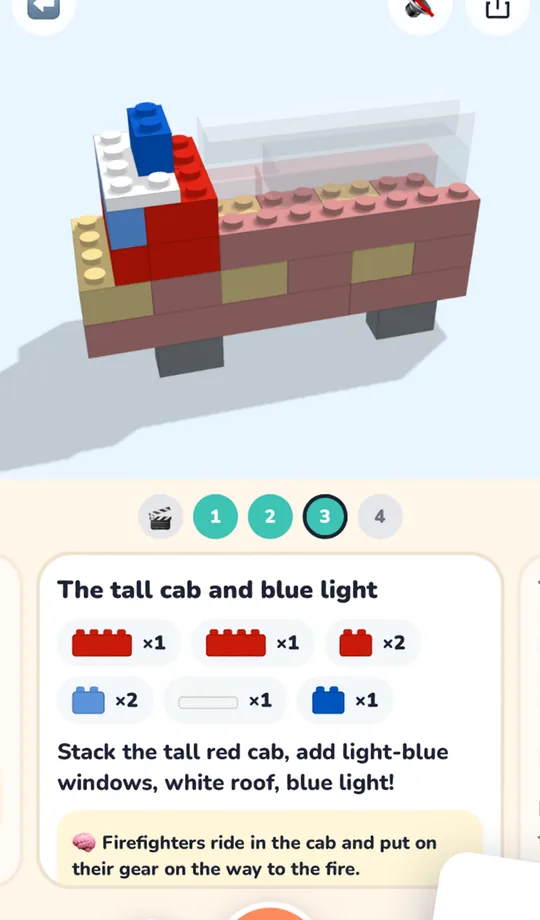
For a big build, make Tumbly’s brick Santa Claus (43 pieces, 4 steps) first, then a chimney he fits.
🦌 A bridge for the reindeer
Ages 6–1225 minE
You need: 40 to 100 bricks, two stacks of books, a toy reindeer or any small toy.
Set two stacks of books a hand apart and build a bridge across. Stand the reindeer in the middle. You pass if it holds for a count of ten. If it sags, add a layer under the deck and overlap the seams. If it slips, rest the ends farther onto the books.
Older: A ruler-long gap. How much deeper does the bridge have to be?
Tumbly’s brick reindeer (26 pieces, 4 steps) makes a good load. Then meet the engineer who helped finish the Brooklyn Bridge, in the true book about Emily Warren Roebling, and see how arches and suspension bridges work in types of bridges for kids.
🍬 Kitchen-table engineering
Candy, craft sticks and a coffee filter. Guess first, build, test, change one thing and test again.
🍬 The gumdrop tower
Ages 4–1020 minE
You need: 30 gumdrops and 50 toothpicks, or mini marshmallows and pretzel sticks, and a candy cane.
Push toothpicks into gumdrops to build a tower as tall as your hand, then lay a candy cane on top. You pass if it holds for a count of ten. If it leans, add a toothpick from corner to corner across each square.
Younger: Toothpicks are sharp, so use pretzel sticks. Build one triangle and one square and press on each. Which one squishes?
Older: Twenty gumdrops, no more. The tallest tower that holds the candy cane wins.
🎯 The snowball catapult
Ages 6–1225 minS · E
You need: 8 craft sticks, 4 or 5 rubber bands, a plastic spoon, mini marshmallows, a bowl.
Stack 6 craft sticks and band them tight at both ends. Band the other 2 together at one end only, slide the stack between them, and band the spoon to the top stick. Set a bowl, Santa’s sack, three big steps away. You pass if a marshmallow snowball lands in it. Aim at the bowl, never at a face.
Younger: Skip the bowl. Count big steps to where each snowball lands.
Older: Slide the stack closer to the band, then farther away. Shoot three times from each spot. Which spot sends it farthest?
🪂 The ornament parachute
Ages 5–1020 minS · E
You need: A coffee filter or a square cut from a plastic bag, 4 strings as long as a ruler, tape, 2 ornaments that can’t break.
Tape a string to each corner of the canopy and tie the four ends to one ornament. A grown-up holds it up high, beside the second ornament with no parachute, and lets go of both at once. You pass if yours lands second. No chairs or stairs: a raised hand is high enough.
Younger: Just watch the two fall and say which landed first.
Older: Try three canopy sizes. Time three drops of each and keep the middle time.
🎈 The balloon sleigh
Ages 8–1220 minS · E
You need: A balloon, a drinking straw, string as long as the room, tape, a paper sleigh.
Thread the string through the straw and tie it tight between two chairs. Blow up the balloon, pinch it shut and tape it to the straw, with a paper sleigh in front. Let go. You pass if the sleigh reaches the far chair.
Why it works:Every push has an equal push back. The balloon pushes air out the back, and the air pushes the balloon forward, the way a jet engine pushes a plane.
Older: Tape on paper clips as presents. How many can it pull all the way? Then tilt the string uphill.
❄️ Christmas and winter science
Guess, then watch. The last three have nothing Christmas about them, so they work all winter.
🍭 The candy cane race
Ages 4–1020 minS
You need: 3 clear cups, 3 mini candy canes, warm tap water, cold water, cooking oil.
Fill one cup with warm tap water, one with cold water and one with cooking oil. Guess which candy cane disappears first, then drop one in each cup. Look every five minutes. The first cup with no candy cane left wins.
Why it works: Candy canes are mostly sugar, and water molecules grab on to sugar and pull it apart. In warm water they move faster, so the cane dissolves faster. Oil can’t grab sugar, so the cane in oil barely changes.
Younger: Just warm and cold. Watch the red stripes spread into the water.
Older: Time each cup to the minute, then race a stirred cup against a still one. Make a chart.
Younger: Use a big ice cube and lots of salt, and watch the little holes it makes.
Older: Add a third cube with a spoonful of sugar. Guess first, then see.
⛄ Keep the snowman cold
Ages 5–1215 min, then an hour to waitS · E
You need: 3 ice cubes in zip bags, a mitten, kitchen foil.
Put one bagged ice cube in a mitten, wrap one in foil and leave one bare. Guess which melts last, then check after an hour. Most kids guess the mitten melts it first, because mittens are warm.
Younger: Just the mitten and a bare cube, side by side.
Older: Build a snowman shelter from scraps: a cup, cotton balls, cardboard. Whose cube is biggest after an hour?
❄️ The six-sided snowflake
Ages 5–1215 minM
You need: Square paper and scissors.
Most paper snowflakes come out with 4 or 8 points. Real ones have 6. Fold the paper the six-sided way below, then cut. You pass if yours has six arms that match.
Make a triangle. Fold a square sheet of paper corner to corner.
Fold it again. Fold the triangle in half to make a smaller triangle. The corner where the folds meet is the middle of your snowflake.
Fold it in thirds. From that middle corner, fold the right third over the front and the left third over the back, so the edges line up and the three parts match.
Trim the top. Cut the wide end straight across or in a point, so the uneven tails come off.
Cut shapes. Snip small notches and curves into both long sides. Don’t cut all the way across.
Open it. Unfold it slowly. Six arms, each one the mirror of the one beside it.
Why it works:Snowflakes have six sides because of the order water molecules lock into as they freeze. Folding the paper into 12 equal slices gives six arms, each a mirror of its neighbors.
Younger: A grown-up folds, and the kid cuts.
Older: Count the mirror lines: a six-armed snowflake has six. Then work out how to fold one with five arms.
💡 Circuits and code
The T and the M: a card that lights up and an ornament that spells.
💡 The light-up card
Ages 7–1230 minT
You need: Card stock, a 3-volt coin battery (CR2032), one LED, copper tape with conductive glue or strips of kitchen foil and tape.
Draw a tree on the front of the card and poke the LED’s legs through the star. Inside, run one strip from the short leg to where the battery will sit, and lay the battery on it with its + side up. Run a second strip from the long leg onto a corner flap that folds down onto the battery. You pass if the star lights when you press the corner.
Why it works: Electricity needs a full loop, from the battery through the light and back. An LED only lets it through one way, long leg to the + side, so if it stays dark, flip the battery. A coin battery can’t push enough to hurt the LED, so it needs no other parts.
Younger: Under 7, a grown-up builds it and the kid presses the corner. Then the grown-up flips the battery: why is it dark now?
Older: Add a second LED beside the first, on the same two strips, so both light.
A grown-up keeps the batteries. A swallowed coin battery can cause severe damage in just 2 hours. If one might have been swallowed, call the National Battery Ingestion Hotline at 1-800-498-8666 right away.
Who invented Christmas lights? Edward H. Johnson, who lit the first electric Christmas tree in December 22, 1882. Here’s the story.
🔴 The binary bead ornament
Ages 7–1220 minT · M
You need: A pipe cleaner, red and green pony beads, one white bead.
Computers store letters as ones and zeros. Find your first initial in the chart, where each letter is 8 digits long. Thread a red bead for each 1 and a green bead for each 0. Add the white bead and twist the pipe cleaner into a loop. You pass if a friend can read your letter back.
Why it works: Inside a computer, everything is a pattern of 1s and 0s. The code computers use for letters gives each one a number: capital A is 65, which is 01000001 in 8 binary digits.
Younger: Make a pattern ornament instead: red, green, red, green, or red, red, green. What comes next?
Older: Spell your whole name, or a word for a friend to decode.
The letter chart, A to Z
A01000001
B01000010
C01000011
D01000100
E01000101
F01000110
G01000111
H01001000
I01001001
J01001010
K01001011
L01001100
M01001101
N01001110
O01001111
P01010000
Q01010001
R01010010
S01010011
T01010100
U01010101
V01010110
W01010111
X01011000
Y01011001
Z01011010
In a classroom: 25 kids, 20 to 40 minutes
Pick one activity and run it in teams. A 40-minute lesson goes 5 minutes to show the challenge and its test, 25 to build and test, and 10 for each team to say what broke and what they changed. In 20 minutes, the snowflake or the candy cane race fits.
Christmas STEM activities for a class of 25: minutes, teams and materials
15 ice cubes in zip bags, 5 mittens or socks, kitchen foil. Set up at the start, check at the end.
Write the test on the board before anyone builds, and test every team the same way.
Grades K to 2 do well with the snowflake, the gumdrop tower and the candy cane race. Grades 3 to 5 can take the catapult, the parachute, the light-up card and the binary ornament.
Keep score if you like: three points for a pass on the first try, two after one fix, one after more, and a bonus point for saying why the fix worked. There are more tests like these in the building challenges, with cards to print.
What are easy Christmas STEM activities for preschool and kindergarten?
Try the candy cane race, the tallest tree that stands and the gumdrop tower, with mini marshmallows and pretzel sticks in place of gumdrops and toothpicks. Each takes 15 to 20 minutes, and a 4-year-old only has to guess, watch and build.
What are good Christmas STEM activities for elementary school?
For kindergarten to grade 2: the six-sided snowflake, the gumdrop tower and the candy cane race. For grades 3 to 5: the snowball catapult, the ornament parachute, the light-up card and the binary bead ornament. The classroom plan on this page gives the materials for 25 kids and a 20- or 40-minute version.
What is a Christmas STEM challenge?
A build with a test it can pass or fail: a sleigh that keeps 10 presents on around a corner, a tree that survives a knock on the table, a catapult that lands a marshmallow in a bowl. Kids build, test, change one thing and test again.
What winter STEM activities work after Christmas?
the ice melt race, Keep the snowman cold and the six-sided snowflake work all winter, and so do the brick bridge and the catapult. For a walk outside, there’s a winter card in the nature scavenger hunt.
Do I need LEGO® bricks?
Only for the four brick challenges, and any LEGO® or compatible bricks work, from a mixed bin. The other 10 use things from the kitchen and the craft drawer.
Are these safe for young kids?
Yes, with a grown-up close by and four things to watch. Keep coin batteries away from young kids, since a swallowed one can do severe damage in 2 hours. The CPSC says to keep balloons away from kids under 8. Toothpicks are sharp, so little ones use pretzel sticks. Regular bricks are small parts, so kids under 3 stay with DUPLO® big bricks. Here’s which bricks fit each age.
Is there a printable list?
Yes. Press Print the list for one page with all 14: the ages, the minutes, what you need and the test. No email and no sign-up.
Who invented Christmas lights and candy canes?
Edward H. Johnson lit the first electric Christmas tree we know of, in December 22, 1882. Nobody knows who invented the candy cane. Here’s who invented the rest of Christmas.