Building challenges for kids with LEGO® bricks
A good LEGO® challenge has a test a kid can pass or fail: a tower that holds a book for ten seconds, a bridge that holds a shoe, a boat that floats with cargo. Here are 10 by age with bricks and minutes, one-minute rounds, games for a group, and cards to print with no sign-up.
Brick building guides
How a challenge works
A test turns building into engineering. A kid builds, tests it, sees what broke, changes one thing and tests again.
The bricks are almost never what gives up. In a test at the UK’s Open University, a 2×2 brick took about 950 pounds of squeezing on average, and the researcher said a tower would fail as a structure long before a brick did. When a build falls, the shape failed, and a kid can change the shape.
These start at about age 4. Regular bricks are small parts, so a kid under 3 stays with DUPLO® big bricks. Here’s which bricks fit each age.
Pick one by age
| Try this | Ages | Pieces | Minutes |
|---|---|---|---|
| The book tower A wide tower | 4–5 | 25 | 10 |
| The toy car bridge Strong ends | 4–5 | 15 | 10 |
| The car ramp A higher start | 4–5 | 10 | 5 |
| The shoe bridge Thick beams | 6–8 | 40 | 20 |
| The tennis ball wall Overlap and feet | 6–8 | 40 | 15 |
| The farthest car A fair test | 6–8 | 30 | 20 |
| The cargo boat Hollow shapes float | 6–8 | 40 | 15 |
| The two-chair bridge Span and depth | 9–12 | 100 | 45 |
| The beam off the table Weight and reach | 9–12 | 60 | 20 |
| The frame test Triangles | 9–12 | 10 | 10 |
Ages, pieces and minutes are rough guides.
The challenge cards
No email, no sign-up. One card a page.
Challenges for ages 4 to 5
Big DUPLO® bricks work for all of these.
The book tower
Build a tower as tall as your hand and lay a picture book on top. You pass if it holds for a count of ten. If it falls, make the whole tower wider. A wide tower is harder to tip.
The toy car bridge
Set two books a hand apart and build a bridge between them. You pass if a toy car crosses and the bridge stays up. If it drops, let the ends sit farther onto the books. Both ends need a good place to rest.
The car ramp
Lean a book on a stack of bricks and put tape two big steps from the bottom. Let a toy car go from the top with no push. You pass if it rolls past the tape. If not, add bricks under the ramp. A higher start sends the car farther.
Free from tumbly.ai/blocks/building-challenges
Challenges for ages 6 to 8
Test each build the same way.
The shoe bridge
Stack two piles of books a shoe-length apart and build a bridge across. Set your shoe on the middle. You pass if it holds for a count of ten. If it bends, add a layer and overlap the seams. A thick bridge bends less than a flat one.
The tennis ball wall
Build a wall as tall as your fist and as long as your hand. Roll a tennis ball at it three times. You pass if no bricks come off. If it splits, overlap every row. If it tips, add short walls at the back. Overlaps tie the stacks together, and short walls work like feet.
The farthest car
Build a car with wheels and let it go from the top of a book ramp. Mark where it stops, change one thing and run it again. You pass when it beats your first mark. If it slows or curves, check that every wheel spins freely. Change one thing at a time, so you know what helped.
The cargo boat
With a grown-up beside you, run a few inches of water into a sink. Build a wide boat with a flat bottom and low walls, then load five bricks. You pass if it’s still afloat after a minute, and a little water inside is fine. If it sinks, press every brick tight and add a layer across the seams. A hollow boat pushes aside lots of water, and the water pushes back.
Free from tumbly.ai/blocks/building-challenges
Challenges for ages 9 to 12
Write down what broke before you try again.
The two-chair bridge
Put two chairs a ruler apart and bridge them. Stand a full plastic water bottle in the middle and keep feet out from under it. You pass if it holds for ten seconds. If it sags, make it deeper before you make it wider. If it slips, sit the ends farther onto the seats. A longer gap makes a weaker bridge, and depth stops a sag better than width.
The beam off the table
Build a beam that sticks out past a table edge, held down only by bricks on the table end. You pass if it reaches out a full hand with a small toy at the tip for ten seconds. If it tips, add bricks to the table end. Weight turns a beam harder the farther out it sits.
The frame test
Pin four same-size LEGO® Technic beams into a square and push a corner until it leans. Pin a fifth same-size beam across the diamond’s short way, with long pins where three meet. You pass if it won’t lean now. Cardboard strips and paper fasteners work too. A triangle holds its shape where a square leans over.
Free from tumbly.ai/blocks/building-challenges
One-minute challenges
Give each one a minute on a timer. All of them make a perfect score of 18.
1 point each
2 points each
3 points each
Free from tumbly.ai/blocks/building-challenges
Why things stay up, in kid words
- Wide and low is hard to tip. A thing topples when its balance point isn’t over its base.
- Overlaps join the stacks. Bricklayers keep the up-and-down seams from lining up. A brick only grips what’s above and below it, so a brick across two stacks is what joins them.
- Deep beats wide. A beam gets weaker the farther apart its supports are, and to bend less, deeper beats wider. Arches and suspension bridges carry weight in other ways: here are the types of bridges, explained for kids.
- Triangles keep their shape. A square’s corners turn easily, and a triangle changes shape less. Bricks joined by more than one stud can’t turn, so the frame test uses pins.
- Far out pulls harder. A weight’s turning effect is its weight times its distance from the pivot. A popsicle stick catapult is that kind of lever, tipping over its fulcrum.
- Hollow boats float. Water pushes up as hard as the weight of the water pushed aside.
Challenges for two kids or a group
- Build back to back. One kid builds from six bricks in secret and describes it out loud. The other copies it without looking.
- Engineer and builder. One kid can only talk and the other can only touch the bricks.
- Same pile, two teams. Give each team 30 matching bricks and ten minutes, and build on the floor. The tower that holds the most picture books wins.
A way to keep score
Give three points for a pass on the first try, two after one fix and one after more, plus a bonus point if a kid can say why the fix worked. Test everyone the same way.
When a challenge makes them want to build something
A challenge card needs no app. Sometimes, though, a kid beats the ramp and wants a real race car, or floats a boat and asks for a tugboat, or gets a toy car across a bridge and wants a brick bridge to build step by step. Tumbly Blocks has 73 free step-by-step builds. The app designs one from the bricks on your table, sized for ages 2 to 13.
When something else is the better pick
- Your kid likes a story to build to. Berwick Public Library’s archive in Maine has a bank safe, a Bigfoot trap and more.
- You only have big bricks. The LEGO Foundation’s Six Bricks cards are short games with six DUPLO® bricks.
- You want a team and a robot. FIRST® LEGO® League’s Founders Edition has Explore for ages 6 to 10 and Challenge for 9 to 16, which varies by country, and Challenge teams program a robot. FIRST says the 2026–27 season is the program’s last.
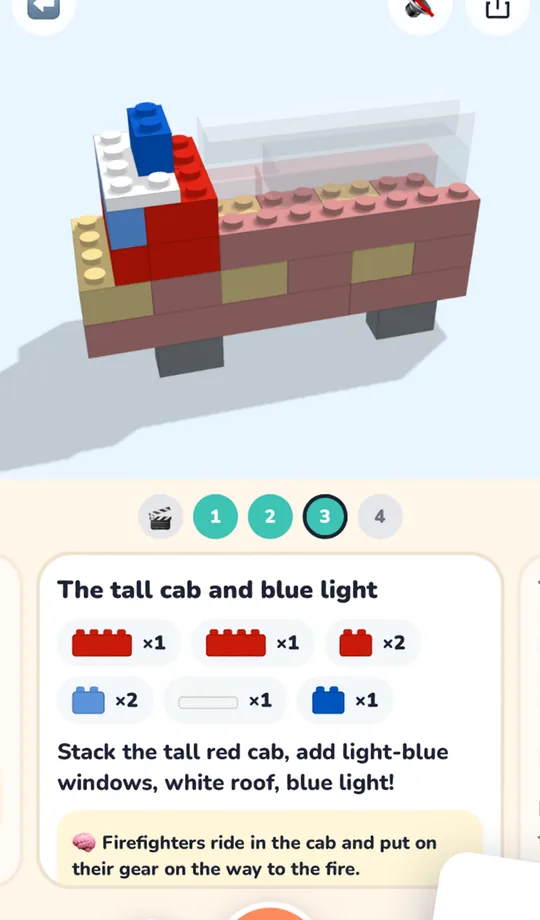
Ready for a build with steps?
Tumbly Blocks designs it from the bricks on your table, with every step in 3D.


Scan with your iPhone cameraor open it in your browser
Questions parents ask
What are good LEGO® challenges for a 7, 8 or 9 year old?
At 7 and 8, try the shoe bridge, the tennis ball wall, the farthest car and the cargo boat. At 9, try the two-chair bridge, the beam off the table and the frame test.
What is an easy challenge for a 4 or 5 year old?
Start with the book tower, as tall as their hand with a picture book on top.
Can we do these at home with the bricks we have?
Yes. They take about 10 to 100 pieces from a mixed pile, plus things like books or a shoe. The farthest car needs wheels, and the frame test needs LEGO® Technic beams or cardboard strips.
Are the cards free, and is there a PDF?
Yes, with no email and no sign-up. For a PDF, press Print the challenge cards and choose Save as PDF.
Are these STEM activities?
They’re engineering. A kid builds, tests, changes one thing and tests again. In December, try the Christmas STEM activities, from a brick sleigh to a candy cane race.