How to clean LEGO® bricks
Wash LEGO® bricks by hand in warm water, no hotter than 104°F (40°C), with a little mild detergent. Rinse them well in clear water and let them dry in the air, out of direct sun. That’s the LEGO Group’s own advice. No dishwasher or washing machine, and wipe motors and battery boxes with a damp cloth instead.
If you’re here with a used bin from a garage sale, a thrift store or a cousin’s attic, this page covers that too: what to pull out first, when soap is enough, and what the CDC says if you want them disinfected. Each rule from the LEGO Group, LEGO Education or the CDC links to where it came from, read on November 15, 2026.
Brick building guides
How do you clean LEGO® bricks, step by step?
Sort, wash in warm soapy water, rinse, dry in the air, and wipe the few pieces that can’t get wet. A kid can do the swishing.
- Sort out what can’t go in the water. Pull out motors, battery boxes, hubs, sensors, light bricks and anything with a wire or metal in it. Those get wiped, not soaked (step 6). Set aside pieces with stickers too. Then take every model and minifigure apart: LEGO Education’s hygiene guidelines say joined pieces won’t get properly clean.
- Fill a sink or tub with warm, soapy water. Keep it no hotter than 104°F (40°C), the LEGO Group’s limit, and add a little mild detergent, like dish soap. Warm on your hand is right; hot from the kettle is too hot. Put the bricks in a mesh laundry bag or a colander first, so you can lift them all out at once and nothing goes down the drain.
- Swish, soak and scrub. Swish the bricks around and let them sit while the dirt loosens. Go over the grubby ones with a soft cloth, a sponge or a soft toothbrush, around the studs and inside the tubes underneath.
- Rinse in clear water. The LEGO Group says to rinse them well with clear water afterwards. Rinse until no suds are left.
- Air-dry on a towel, out of the sun. Spread them on a towel in one layer, open side down so the water runs out. No oven, microwave or hair dryer, and not in direct sunlight: those are the LEGO Group’s rules. Let them dry all the way before they go back in the bin. Hollow pieces hold water, so give those a shake.
- Wipe the pieces you set aside. Unplug motors and sensors from any power source and take out the batteries. Then wipe them with a cloth moistened with water and a mild detergent without perfume or oil, the LEGO Group’s method. Never put them under water or spray them. For stickered pieces, use a dry brush or a toothbrush, as Toypro, a shop for LEGO® parts, suggests.
- Check for cracks. LEGO Education recommends checking toys for cracks and removing any cracked pieces. With a used bin, don’t skip it.
What does the LEGO Group say about cleaning bricks?
Wash by hand, keep it warm and not hot, and keep heat away while they dry. Its help page on cleaning bricks says to clean them “by hand using water no hotter than 104°F / 40°C and a soft cloth or sponge,” because “higher temperatures may affect the quality of the bricks.” A mild detergent is fine if you rinse well afterwards.
The warning is about heat: “When the bricks get really hot they may change shape, which means they won’t work anymore!”
| Feature | Plain bricks and DUPLO® | Motors, battery boxes and lights |
|---|---|---|
| Wash by hand in warm, soapy water (up to 104°F / 40°C) | ✓ | — |
| Wipe with a damp cloth and mild detergent | ✓ | ✓ |
| Dishwasher or washing machine | — | — |
| Boil or steam (over 140°F / 60°C) | — | — |
| Dry in the oven, microwave or with a hair dryer | — | — |
| Dry in direct sunlight | — | — |
From the LEGO Group’s cleaning page and LEGO Education’s Hygiene Guidelines (a one-page PDF from 2020), both read on November 15, 2026. The 140°F limit is LEGO Education’s and the sunlight rule is the LEGO Group’s; the rest is on both.
Can you put LEGO® bricks in the dishwasher or washing machine?
No. The LEGO Group says “please don’t put your LEGO pieces in the washing machine or dishwasher,” and the reason is the same heat warning: bricks that get really hot may change shape.
You’ll still find fans who wash theirs in a pillowcase or laundry bag on a rinse cycle. Toypro’s guide explains how and says plainly that it’s at your own risk. If what you want is the easy lift-out, a mesh laundry bag in a sink gives you that by hand, with water you can feel.
How hot can the water be?
No hotter than 104°F (40°C). That’s the LEGO Group’s number for washing. LEGO Education’s Hygiene Guidelines add an outer limit: bricks “shouldn’t be exposed to temperatures greater than 140°F/60°C.” So no boiling, no steaming and no hot cycle.
If you don’t have a thermometer, run the tap until it’s warm on your hand and stop there. Too cool only means a longer soak; too hot can’t be undone.
How do you disinfect or sanitize LEGO® bricks?
Most of the time you don’t need to: soap and water is enough. The CDC’s page on cleaning and disinfecting your home says “cleaning alone removes most harmful viruses or bacteria from surfaces,” and to disinfect when someone is sick or at higher risk of getting sick.
When you do want more, say after an illness or for big bricks a toddler chews on, here is what the two official sources say:
- The CDC (its guide for child care settings, which it calls early care and education, dated April 19, 2024) says to sanitize toys that touch children’s mouths, and to clean them first. For hard, nonporous toys it lists boiling, steaming or a weakened bleach solution, and says to check with the item’s maker which one to use. Its weakened bleach solution is 1 tablespoon of unscented bleach per gallon (16 cups) of water. Put the items all the way under, soak them at least 2 minutes, and don’t rinse: the CDC says what’s left breaks down as it dries and won’t hurt children. Then let them air-dry completely on a clean towel.
- LEGO Education (Hygiene Guidelines, 2020) says to follow your local health guidance on disinfecting, and warns that disinfectants “can potentially damage decorations, create haziness on transparent LEGO elements, or create cracks and crazes” (fine surface cracks). It recommends checking for cracks and removing cracked pieces.
Put together: boiling and steaming are out, because of the heat limit above. The CDC says to ask the maker, and the LEGO Group’s cleaning page names only water and a mild detergent; it doesn’t mention bleach. If you still use the CDC’s bleach soak, it’s a grown-up job: wash with soap first, leave out printed, see-through and stickered pieces, and look the bricks over for cracks afterwards. Follow the CDC’s safety rules for these products: mix the bleach with water only and never with another cleaner (it warns that bleach and ammonia cleaners together can cause serious injury or death), follow the label, wear gloves, open a window or run a fan, store and use it out of kids’ reach, and wash your hands afterwards. For electronic pieces, LEGO Education says to wipe the outside with disposable wipes or a microfiber cloth moistened with disinfectant, and never to soak or spray them.
How do you clean secondhand LEGO® bricks?
The same way, with more sorting first and a closer look at the end. You don’t know where a bin from a garage sale or a thrift store has been, so give it the full wash before it meets your kids.
- Dump it out on an old sheet. Pick out what isn’t a brick, and everything electronic, stickered or printed that needs gentler care (below).
- Take everything apart. Old builds are where the dirt hides, and LEGO Education says joined pieces won’t get properly clean.
- Wash in batches. One sink of water per batch. If the water turns gray, change it and wash that batch again.
- Check for cracks. Throw out anything cracked, as LEGO Education recommends.
- Sanitize if you want to. Soap and water is enough for most bins. For more, see the CDC’s bleach soak above, with its cautions.
A used bin can mix tiny pieces in with big ones. If a kid under 3 is around, regular bricks are small parts, so here’s which bricks fit each age. Once everything is dry, here are ways to store and sort LEGO® bricks so they stay clean.
How do you clean motors, battery boxes and lights?
Wipe them; never soak them. The LEGO Group says to clean electronic pieces, and any piece with metal in it, “with a cloth moistened with water and a mild detergent without perfume or oil.”
LEGO Education adds two rules: unplug all sensors and motors and any power source before you clean, and don’t submerge or spray them with any liquid. Wipe them gently instead. We’d take the batteries out of a battery box first and leave it open to dry.
What about stickers, printed pieces and minifigures?
Printed pieces can go in the warm, soapy water with the rest; stickered ones are better kept dry. The LEGO Group’s page makes no exception for printed pieces, but don’t scrub a face or a pattern hard, and keep disinfectants off them: LEGO Education warns they can damage decorations.
We’d keep stickered pieces out of the soak. Toypro’s guide says pieces with prints or stickers are best cleaned with a dry brush or toothbrush.
Minifigures come apart into head, torso, legs, hair and accessories. Pull them apart so the water reaches every joint, then wash the printed torsos and faces gently by hand.
How do you dry LEGO® bricks?
In the air, on a towel, out of the sun. The LEGO Group says not to dry them in the oven, the microwave or with a hair dryer, and not to leave them in direct sunlight.
Spread them in one layer, open side down, so water runs out of the tubes. Give hollow pieces like cones and round bricks a shake, and turn the pile over once. Wait until they’re dry all the way through before you put them away; the CDC says the same about toys it sanitizes.
How do you clean yellowed, sticky or dusty bricks?
Dusty: a soft, dry paintbrush or makeup brush gets dust off a built model without taking it apart. Save the full wash for when it really needs it.
Sticky: wash those bricks again, then rinse longer in clear water so no soap is left on them.
Yellowed: soap won’t fix it, because it isn’t dirt. The Brothers Brick explained in 2009 that yellowing is a change in the plastic’s surface caused by UV light. When a fan wrote to the LEGO Group in 2021, the reply, posted on The Brick Blogger, named direct sunlight, temperature changes and extremes, and cigarette smoke as some of the reasons bricks can change color slightly over time.
Fans whiten old bricks with a hydrogen peroxide soak, a method called Retr0bright. The LEGO Group’s cleaning page doesn’t mention it, and the fan who wrote to LEGO said a peroxide bath “worked indeed, but only for a while”: the bricks yellowed again, even stored in a cool, dark room. We’d leave that to collectors and keep a yellowed brick in the play bin. To slow yellowing, store bricks out of the sun.
What about DUPLO® bricks?
Same rules: warm, soapy water by hand, no hotter than 104°F (40°C), then rinse and air-dry. LEGO Education’s Hygiene Guidelines are written for “LEGO® and DUPLO® elements” alike, and the LEGO Group’s DUPLO® page has a video on how to clean them.
Big bricks are the ones toddlers chew on. The CDC’s child care guidance says to sanitize toys that come in contact with children’s mouths, so DUPLO® bricks are the set most worth the extra step above, with its cautions. Pieces with a motor, sound or light get wiped, like any other electronics.
The bricks are clean. Now what?
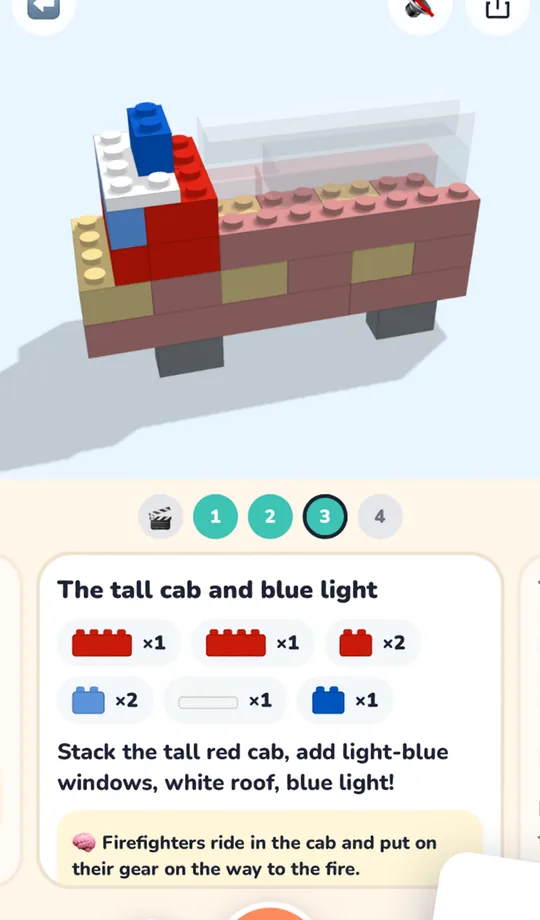
While they dry on the towel, they’re already spread out the way Tumbly Blocks asks for. Your kid says what they want, a fire truck or a castle, you snap a picture of the pile, and it designs that from only the bricks in the photo, sized for ages 2 to 13, with every step in 3D. It works with LEGO® bricks, DUPLO® bricks and wooden blocks.
No app needed for these: free step-by-step builds from plain bricks most bins have, and ideas for what to build with LEGO® bricks at each age.
Give the clean bricks a job.
Your kid says what they want, and you get a build made from only the bricks on your towel, sized for their age, with every step in 3D.


Scan with your iPhone cameraor open it in your browser
Questions parents ask
Can you put LEGO® bricks in the dishwasher?
No. The LEGO Group says not to put them in the dishwasher or the washing machine, because really hot bricks may change shape and then won’t work anymore. Wash them by hand in warm water, no hotter than 104°F (40°C), with a little mild detergent.
Can you wash LEGO® bricks in the washing machine?
The LEGO Group says no. Some fans do it anyway in a laundry bag, and Toypro’s guide, which describes how, calls it your own risk. A mesh laundry bag in a sink of warm, soapy water gets you the same easy lift-out without the drum.
How hot can the water be to wash LEGO® bricks?
No hotter than 104°F (40°C), the LEGO Group says, because hotter water may affect the quality of the bricks. LEGO Education’s hygiene guidelines add that bricks shouldn’t be exposed to more than 140°F (60°C) at all, so don’t boil or steam them.
Can you boil LEGO® bricks to sanitize them?
No. Boiling water is far past the 140°F (60°C) that LEGO Education says bricks shouldn’t go above. The CDC lists boiling, steaming or a weak bleach solution for sanitizing hard toys and says to check with the maker which one to use. For these bricks, heat is out.
How do you disinfect LEGO® bricks after someone was sick?
Wash them with soap and water first. The CDC says that alone removes most harmful germs, and to disinfect when someone is sick. For hard toys, its step is sanitizing: a weakened bleach soak of 1 tablespoon of unscented bleach per gallon of water, at least 2 minutes, no rinse, then air-dry. It also says to check with the maker, and the LEGO Group’s cleaning page names only water and a mild detergent. If you use the soak, it’s a grown-up job: bleach and water only, never mixed with another cleaner, with gloves and fresh air, out of kids’ reach. LEGO Education warns that disinfectants can damage prints, cloud clear pieces and cause cracks, so check the bricks afterwards.
Can you use vinegar on LEGO® bricks?
The LEGO Group’s cleaning page names only water and a mild detergent, so that’s what we’d use. Toypro, a shop for LEGO® parts, suggests a little vinegar in the water for 10 minutes for musty smells. If you try it, rinse well and keep it to plain bricks.
How do you dry LEGO® bricks fast?
Spread them in one layer on a towel, open side down, and give hollow pieces a shake. Skip the heat: the LEGO Group says not to dry them in the oven, the microwave, with a hair dryer or in direct sunlight.
How do you clean DUPLO® bricks?
The same way: by hand in warm, soapy water, no hotter than 104°F (40°C), then rinse and air-dry. LEGO Education’s hygiene guidelines are written for LEGO® and DUPLO® pieces alike. Big bricks a toddler chews on can be sanitized now and then: the CDC’s child care guidance says to sanitize toys that come in contact with children’s mouths.
How do you clean a built LEGO® set without taking it apart?
For dust, brush it off with a soft, dry paintbrush or makeup brush. A real wash means taking it apart, since LEGO Education says joined pieces won’t get properly clean.
Is Tumbly connected to the LEGO Group?
No. Tumbly is made by Winding AI, Inc., which has no connection to the LEGO Group or to any site quoted on this page.