Storage ideas for LEGO® bricks, and how to sort them
Keep LEGO® bricks in shallow boxes or drawers, not deep bins, and sort them into a few big groups your kid can name: bricks, flat plates, wheels, people and odd bits. Under 5, one shallow bin is plenty. Label each box with a picture, park half-built models on a shelf, and spend ten minutes putting it back after each session.
That’s the short version, for a mixed pile that keeps growing. The goal isn’t a tidy shelf. It’s a kid who can find the wheel they want, build, and put it back without you. The LEGO Group’s own help page on sorting says there’s no right or wrong way, so what follows is our pick and why.
Brick building guides
What’s the best way to store LEGO® bricks with kids?
The best storage is the one your kid can use alone: shallow, open, at their height, with a picture on the front. Five habits matter more than which boxes you buy.
- Shallow beats deep. In a deep bin, the piece your kid wants is always at the bottom, so they tip the whole thing out. In a box a few inches deep, they can see most of what’s there and pick it out with one hand. Deep is fine for DUPLO® and other big pieces.
- A few groups beat many. A kid can keep a handful of boxes straight. A wall of little drawers turns cleanup into a job for you.
- Pictures beat words. Tape a photo or a drawing of what goes inside on the front of each box, or stick a spare piece to it. A 4-year-old who can’t read can still put the wheels away.
- Store it where they build. Storage across the room from the table means bricks get carried, dropped and left on the way.
- Keep it cool, dry and out of the sun. The LEGO Group says to store bricks somewhere dry and away from any heat source, and not in direct sunlight or where it gets above 104°F (40°C), as this may make them brittle or discolor them over time. So skip the sunny windowsill, and think twice about an attic or garage that gets hot in summer.
Should you sort LEGO® bricks by color, type, size or set?
For most kids with a growing pile, sort by type in a few big groups. Sort by color while the pile is small or your kid is little, keep sets apart only while they’re still being rebuilt, and use size as a quick first pass on a big pile. The LEGO Group says most fans sort by color, set, size or type.
| Feature | By type | By color | By set | One bin |
|---|---|---|---|---|
| Fits ages | 6 and up | 3 to 6 | Any age | Under 5 |
| Fits a pile that’s | Big and growing | Small | A few favorite sets | Small, or DUPLO® |
| Finding one piece | Quick | Slow once it grows | Quick, if you know the set | Slow |
| A kid can put it back alone | ✓ | ✓ | — | ✓ |
| Good for making things up | ✓ | ✓ | — | ✓ |
| Good for building a set again | — | — | ✓ | — |
A dash means that way of sorting makes it hard. The ages are our rough guide, not a rule.
By type means bricks, plates, slopes, wheels and car parts, people and animals, and one box for odd bits. A kid building a car hunts for wheels, not for “red,” so this matches how they look for things. It also grows well. When one box gets too full to dig through, split it, say into big bricks and small bricks.
By color is a game in itself at 3 to 5, and it looks lovely on a shelf. It breaks down as the pile grows, because the red box holds every red shape and the wheel your kid wants could be in any of six boxes. Older kids who build mosaics, where color is the whole point, are the exception.
Wondering which boxes will fill first? We counted the most common LEGO® colors and the most common LEGO® pieces across every set.
By set keeps a set ready to build again, but every piece has exactly one right home. That’s too strict for most kids, and it keeps the pieces out of new builds. Bag the few sets your kid still rebuilds, and mix the rest into the main sort.
One bin is right for toddlers and for DUPLO®, as long as it’s wide and shallow enough to see into.
What should you sort by at each age?
Start simple and add groups as your kid and the pile grow. Two things matter more than the birthday: how big the pile is, and who’s putting it away.
Our rough guide, not a rule.
| Age | How to sort | What to keep it in | Who puts it away |
|---|---|---|---|
| Under 3 | DUPLO® big bricks only, all in one place | A wide basket or bin. Deep is fine for big bricks | You, with them helping |
| 3 to 5 | One shallow bin, or a few boxes by color | A low, shallow box, or a play mat that pulls up into a bag | Them, with you beside them |
| 6 to 8 | A few big groups by type | Shallow boxes or drawers with a picture on each | Them, with a reminder |
| 9 to 12 | By type, split finer as the pile grows. Sets they still rebuild stay in bags | Drawers, plus a box with small compartments for tiny pieces | Them |
If you’re not sure which bricks fit your kid yet, here’s which bricks fit each age, from DUPLO® to the small ones.
How do you sort a big mixed pile of LEGO® bricks?
In rough passes. Don’t try to sort it perfectly in one go. Get it into a few groups your kid can use today, then split a group later only when hunting in it gets slow.
- Wash it first if it’s a hand-me-down or a yard-sale tub. Here’s how to clean LEGO® bricks.
- Pull out people and wheels. They’re easy to spot, and a kid who can find them can start building right away.
- Sort the rest into your few groups on a big tray, a sheet or a play mat, not straight on the carpet.
- Stop when the timer goes. A big tub is a job for several short sessions, and half-sorted is already useful.
- Split a group later, only when finding things in it gets slow.
Little kids can help. “Find all the wheels” or “every blue brick in this box” is a good game at 3 to 5, and it teaches them where things live.
What about sorting trays? People mean two things. Stacked sieve trays sort by size: you pour bricks into the top tray, shake, and smaller pieces fall through the holes until they reach a tray they can’t pass. One free design uses three stackable drawers, with a 3D-printed mesh in two of them. They’re a fast first pass on a big pile, and shaking the stack is a fun job for a kid. But they sort by size only, so the big tray still holds every color and shape of big piece, and you’ll sort by type after. The other kind is a flat tray with compartments, which is great for tiny pieces and sits in a drawer.
What containers work best for LEGO® bricks?
Shallow boxes or drawers for the main groups, a box with small compartments for tiny pieces, and zip bags for sets. The LEGO Group’s help page lists fans’ favorites, among them clear bins, tool or craft boxes, sandwich bags, plastic drawers and food storage containers.
- Shallow boxes or drawers, one per group. Clear or open, so your kid can see in without pulling everything out. As one example, IKEA’s TROFAST boxes, which the LEGO Group’s storage ideas page also suggests, come in different depths that fit the same frames. On November 15, 2026, IKEA’s US site listed the 4-inch-deep box (16½ × 11¾ inches) at $4.00 and the 9-inch-deep one at $6.00. We’d use the shallow ones for small bricks and the deep ones for DUPLO®.
- A box with small compartments for tiny pieces: 1×1s, minifigure hands and hats, flowers, studs. A tackle, craft or tool organizer works. IKEA also lists a 2-inch-deep tray with compartments that fits the same frames, at $4.00 on November 15, 2026.
- Zip bags for sets, with the set number written on each one in marker.
- Deep, lidded tubs for the bricks nobody is using this month. Put them in a closet and swap a tub in when things get stale.
What we’d skip for everyday small bricks: toy chests, big totes and anything else deep. They look tidy for a day and then turn into a dump bin. Prices change, so check before you buy.
Is a LEGO® table with storage worth it?
Sometimes. A table helps a kid who builds big things and wants them to stay put. It’s not worth it if the storage is one deep bin under a lift-off top, or if your kid builds on the floor anyway.
If you buy one, look for three things. It should be the right height for your kid sitting down, have an edge so pieces don’t roll off, and have storage underneath that’s shallow drawers or boxes, not one deep well. A baseplate top is optional. It holds models in place, but a flat top is easier for sorting.
A low table you already own, with a shallow tray on top and boxes beside it, does the same job. Under 5, a play mat on the floor is often better: it opens flat for building and pulls up into a bag at cleanup, and the LEGO Group’s storage ideas page lists one.
Where do sets, half-built models and instructions go?
Give each its own spot: a shelf or tray for builds in progress, bags for sets your kid still rebuilds, and one binder or an app for instructions.
- Half-built models get a parking spot. A shelf or a tray where builds can wait, so cleanup never means breaking something up. A model left out is a reason to come back to it tomorrow.
- Sets while they’re being built. The LEGO Group’s building tips suggest emptying a set’s bags into shallow bowls, keeping a small container for the spare pieces every set comes with, and deciding beforehand which numbered bags to build in each session.
- Sets after they’re built. If your kid takes it apart to build it again, bag it with the set number on the bag. If it’s been apart for good, let it join the main sort, where the pieces can become something else. Here are other things to build from a set’s pieces.
- Instructions. A binder with sheet protectors, or file folders, both of which the LEGO Group suggests. Or keep just the set number: the LEGO Group’s instructions help page says its Builder app has hundreds of instructions for old and new sets, which you can look up by set number, and the number is printed on the box. Here’s how the LEGO® Builder app works.
What’s a quick cleanup routine kids can actually do?
Ten minutes, the same order every time, with a timer. A kid can’t “clean up the LEGO®,” but they can put the wheels in the wheel box.
- Park the builds they want to keep on the shelf or tray.
- Sweep the loose pieces onto the mat or into one tray.
- People and wheels first. They’re the easiest to spot, so it starts with a quick win.
- Everything else into its group. Rough is fine. A piece in the wrong box is better than a piece on the floor.
- Hands and feet sweep under the table, then lids on if there’s a baby or toddler at home.
The LEGO Group’s own building tips say the same thing more briefly: spend a couple of minutes at the end of each session putting bricks away, so they don’t get lost.
How do you keep small bricks away from a baby or toddler?
Keep the small bricks in their own spot that the little one can’t reach, and give the little one DUPLO® bricks of their own. Small parts are a choking risk for kids under 3.
In the US, the CPSC’s small-parts ban covers toys and other children’s products meant for kids under 3: if they have small parts that could be choked on, inhaled or swallowed, they’re banned. It decides what’s small with a test cylinder about the size of the fully expanded throat of a child under 3: anything that fits entirely inside, without squeezing, counts. That’s why the toddler gets the big bricks.
- Older kids build at a table, or in a room with a door or gate, not on the playroom floor.
- Small-brick boxes have lids and live where the little one can’t reach them.
- Do the cleanup routine before the little one is back on the floor, and finish with a hands-and-feet sweep.
When the toddler is ready for small bricks is a separate question. Here’s which bricks fit each age.
Do the bricks need to be sorted to build something new?
No. A sorted collection is quicker to build from, but a mixed pile has plenty of builds in it.
That’s how Tumbly Blocks works. Your kid taps Show me your bricks, and the app asks them to spread their bricks out and snap a picture. It counts the bricks it can see, sorted or not. Then your kid says what they want, and it designs that thing from only those bricks, sized for their age from 2 to 13. If your bricks live in drawers, tip one onto a tray, snap it and tap Use these bricks, then snap the next and tap Add to my pile, so the app keeps both.
It keeps a list of the bricks you’ve snapped so it can design from them, but it isn’t a catalog of your whole collection and won’t tell you which drawer a part is in. For that, look at Pileometer by Brickit, which its App Store page calls “both an app and a storage system,” with a digital catalog of the parts you own and help knowing “where to find the exact shape and color you need” (read November 15, 2026). Here’s how it compares with the other scanner apps for LEGO® bricks.
No app needed for these: what to build with LEGO® bricks has free picture instructions, by age, for plain bricks most bins have.
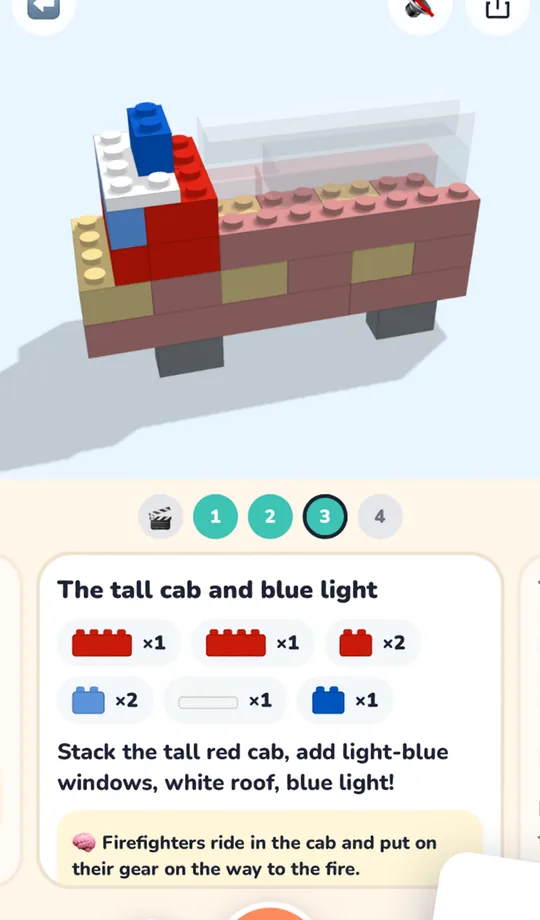
Sorted or not, it’s enough to build with.
Snap a picture of the bricks on your table and say what your kid wants. Tumbly Blocks designs it from what’s there, sized for their age, with every step in 3D.


Scan with your iPhone cameraor open it in your browser
Questions parents ask
What is the best way to organize LEGO® bricks for kids?
Sort them into a few big groups your kid can name, like bricks, plates, wheels, people and odd bits, and keep each group in a shallow box with a picture on the front. Under 5, one shallow bin is enough.
Is it better to sort LEGO® bricks by color or by type?
By type, once the pile grows. Color is easy for little kids and works for a small pile, but a red box holds every red shape, so finding one wheel means digging through every color. The LEGO Group says there’s no right or wrong way, and that most fans sort by color, set, size or type.
What should I store LEGO® bricks in?
Shallow boxes or drawers for the main groups, a box with small compartments for tiny pieces, and zip bags for sets. Keep deep bins and toy chests for DUPLO® bricks or for bricks nobody is using.
Do LEGO® sorting trays work?
Stacked sieve trays sort a big pile by size quickly: you pour bricks in the top, shake, and smaller pieces drop through. They don’t sort by shape or color, so treat them as a first pass before sorting by type.
Should I keep LEGO® sets together?
Only while your kid still rebuilds the set. Keep it in a bag with the set number written on it. Once it’s been apart for good, let the pieces join the main sort so they get used in new builds.
Where shouldn’t I store LEGO® bricks?
Somewhere hot, damp or sunny. The LEGO Group says to store bricks somewhere dry and away from any heat source, and not in direct sunlight or where it gets above 104°F (40°C), as this may make them brittle or discolor them over time.
Do my bricks need to be sorted to use Tumbly Blocks?
No. Spread some bricks out and snap a picture, sorted or not. If they live in drawers, snap one drawer’s worth and tap Use these bricks, then snap the next and tap Add to my pile, so the app keeps both.
Is Tumbly connected to the LEGO Group, IKEA or Brickit?
No. Tumbly is made by Winding AI, Inc., which has no connection to the LEGO Group, IKEA, Brickit or any other company named on this page.
Sources
Read on November 15, 2026. Which way to sort, which boxes to skip and the age table are our own judgment. Prices and products change, so check before you buy.
- The LEGO Group, Sorting and storing your LEGO® bricks: www.lego.com/en-us/service/help-topics/article/sorting-and-storing-your-lego-bricks
- The LEGO Group, 5 tips for your LEGO® build experience: www.lego.com/en-us/adults-welcome/article/lego-building-tips
- The LEGO Group, The best LEGO® storage ideas: www.lego.com/en-us/categories/storage/best-lego-storage-ideas
- The LEGO Group, Building instructions help page: www.lego.com/en-us/service/building-instructions
- US Consumer Product Safety Commission, Small parts for toys and children’s products: www.cpsc.gov/Business--Manufacturing/Business-Education/Business-Guidance/Small-Parts-for-Toys-and-Childrens-Products
- IKEA US, TROFAST storage box, 16 ½×11 ¾×4": www.ikea.com/us/en/p/trofast-storage-box-white-50582072/
- IKEA US, TROFAST storage box, 16 ½×11 ¾×9": www.ikea.com/us/en/p/trofast-storage-box-white-40582100/
- IKEA US, TROFAST storage tray with compartments: www.ikea.com/us/en/p/trofast-storage-tray-with-compartments-white-70581788/
- A free sieve design for sorting bricks by size (GitHub): github.com/pbkhrv/lego-sorting-sieve-model
- Pileometer by Brickit on the US App Store: apps.apple.com/us/app/id6590601507