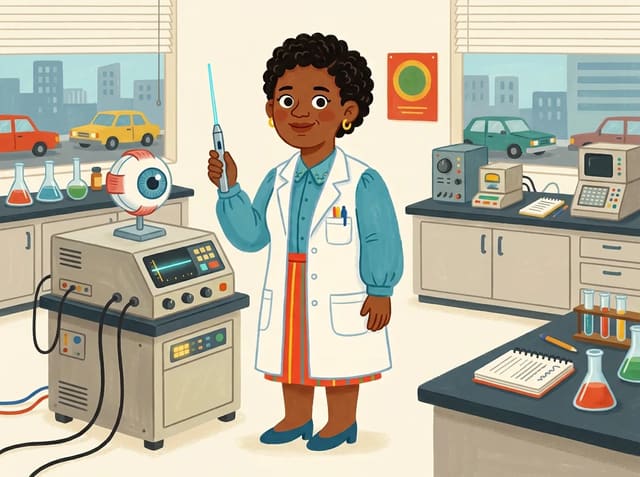
Patricia Bath for kids: a true picture book
Patricia Bath and the Light That Helped People See. 10 pages, fact-checked, at three reading levels, read aloud.
Patricia Bath (1942–2019)
The lesson: If one door is closed, find another, and keep working until you can help.


Scan with your iPhone cameraor open it in your browser
Who was Patricia Bath?
Patricia Bath (1942–2019) was an American eye doctor, laser scientist and inventor from Harlem, New York. She invented the laserphaco probe, a laser tool for removing cataracts, and in 1988 became the first Black woman doctor to receive a patent for a medical invention. She also started community ophthalmology, which brings eye care to people who could not get it.
| Born | 1942 |
|---|---|
| Died | 2019 |
| Known for | inventor of the laserphaco cataract probe |
| The lesson | If one door is closed, find another, and keep working until you can help. |
| Topics | Medicine, Scientists, Inventors |
| The book | 10 pages, 3 reading levels, read aloud |
Read the first pages free

Long ago, in Harlem, New York, Doctor Patricia came home. Up the steps she went. Step, step, step!
In 1968, in Harlem, New York City, a young doctor named Patricia Bath came home. She walked up the steps of Harlem Hospital. Many of her neighbors could not get care for their eyes.
In 1968, Patricia Bath finished medical school at Howard University and came home to Harlem, in New York City. She climbed the steps of Harlem Hospital in a white coat, past brownstones and the busy subway entrance. She was starting work as a young doctor in a neighborhood where many people could not get care for their eyes.
Page 1 of 10
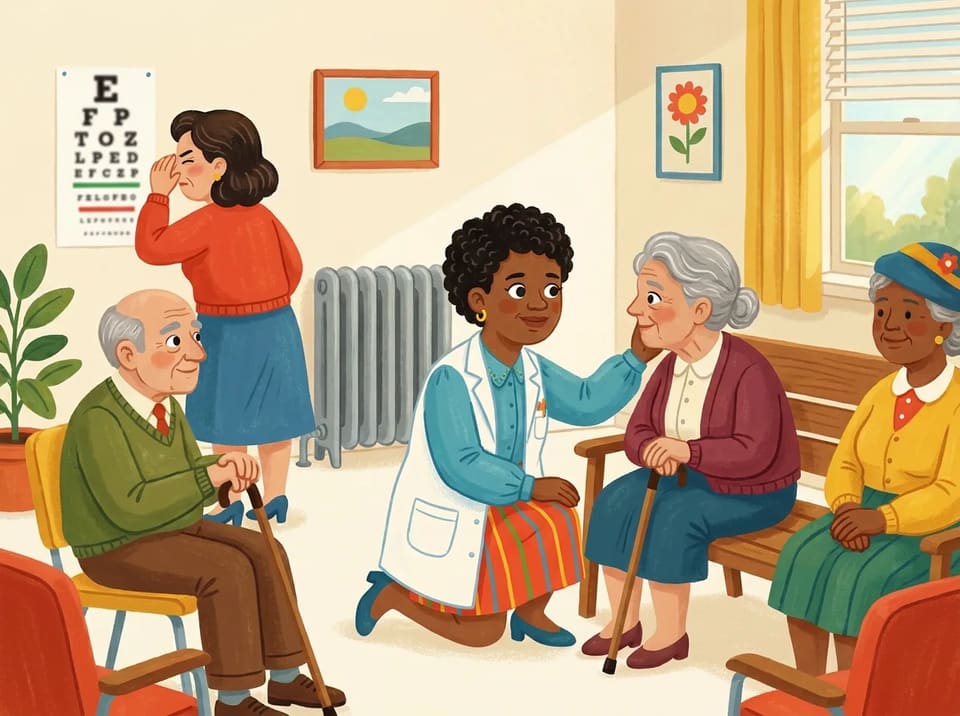
So many people could not see! Blurry signs. Blurry faces. Doctor Patricia looked closely. Look, look, look.
The Harlem eye clinic was crowded. About half the people who came in were blind or losing their sight. Grandmothers could not see faces. Neighbors could not read signs. Patricia knelt down and looked into their eyes.
At the Harlem eye clinic, about half the patients were blind or losing their sight. At Columbia University's eye clinic, where Patricia also worked, there were very few blind patients. Her study showed that blindness among Black people was double that among white people, and she found the reason: many could not get eye care. The Harlem clinic did no eye surgery at all.
Page 2 of 10
Patricia Bath: a timeline of true facts
- 1950s When Patricia was a girl in Harlem, New York City, there were no women doctors she knew of, surgery was mostly a job for men, and Black students were kept out of many medical schools. source
- 1942 Patricia Bath was born in Harlem in 1942; her mother bought her a first chemistry set when she was 12, and her father was the first Black man to work as a motorman on the New York City Subway. source
- 1968 After medical school at Howard University, Patricia came home in 1968 to work as a young doctor at Harlem Hospital. source
- 1968 At the Harlem eye clinic, about half the patients were blind or losing their sight, while at Columbia University's eye clinic, where she also worked, there were very few blind patients. source
- 1969 Her study showed that blindness among Black people was double that among white people, and she found the reason: many could not get eye care. source
- 1969 Harlem Hospital's eye clinic did no eye surgery, so Patricia persuaded her professors at Columbia to operate on blind patients there for free, and she helped as an assistant surgeon. source
- 1970s A cataract is a cloudy area in the lens of the eye, the clear part that focuses light; it makes the world look blurry and faded, and surgery is the only way to get rid of it. source
- 1976 In 1976 she started a new kind of eye care, community ophthalmology, in which trained volunteers visit senior centers and day care programs to test people's eyes, and she co-founded a group built on the idea that eyesight is a basic human right. source
- 1975 At UCLA she became the first woman eye doctor on the faculty of the Jules Stein Eye Institute, but she was offered an office in the basement next to the lab animals; she refused it and got a proper office. source
- 1981 In 1981 Patricia had the idea for a tool that would use a laser to remove cataracts, but her idea was ahead of the technology of the time. source
- 1980s She faced sexism and racism at work, and U.S. research agencies turned down her requests for grants and resources. source
- 1986 So in 1986 she took her research to Europe, to eye and laser centers in Paris, Berlin and England, where her work was judged on its merits. source
- 1986 At the Laser Medical Center in Berlin she ran her first laser experiments on human eyes donated to an eye bank, and after nearly five years of research and testing, her tool worked. source
- 1986 Her laserphaco probe makes a tiny opening in the eye, breaks up the cloudy lens with laser light and vacuums out the pieces, so a clear new lens can be put in. source
- 1988 On May 17, 1988, she received a patent for it and became the first Black woman doctor to receive a patent for a medical invention. source
- 1990s The laserphaco probe was safer and more accurate than earlier ways of removing cataracts, it came to be used around the world, and with it Patricia restored sight to people who had been unable to see for decades. source
- later On a trip to North Africa she gave a woman who had been blind for 30 years her sight back with an artificial cornea, a new clear front window for the eye, and she called it her personal best moment. source
Questions kids ask about Patricia Bath
What did Patricia Bath invent?
She invented laserphaco, a device and technique for removing cataracts. It makes the incision, destroys the clouded lens and vacuums out the pieces. She had the idea in 1981, published her first paper on it in 1987 and received her first U.S. patent in 1988. source
Why was Patricia Bath important?
As a young doctor in Harlem she found that blindness among Black people was double that among white people, mostly because they could not get eye care. She started community ophthalmology, which brings eye tests and care to underserved communities, and she was the first woman to chair an ophthalmology residency program in the United States. source
What is a cataract?
A cataract is a cloudy area in the lens of the eye, the clear part that helps focus light. Over time it can make vision blurry, hazy or less colorful. Cataracts are very common as people get older, and surgery is the only way to get rid of one. source
Was Patricia Bath the first Black woman to get a medical patent?
Yes. With her laserphaco probe, patented in 1988, she became the first African-American woman doctor to receive a patent for a medical purpose. In 2021 she was named one of the first two Black women inducted into the National Inventors Hall of Fame. source
3 reading levels
- Read to me (ages 3–5)
- Read together (ages 6–8)
- I'll read (ages 9–12)
The same true story, written three ways. Little kids hear short, bouncy lines; big kids get the details and the numbers.
Quiz time
What made the world look blurry?
Show the answer
A cloudy spot in the eye.
Try this at home
- Blurry and clear: Look at a picture book through wax paper, then without it. Talk about how a cloudy spot changes what you see.
- Light that bends: Fill a clear glass with water and shine a flashlight through it onto a wall. Watch how the water moves the light, a little like the clear lens in your eye.
- Find another door: Build a block tower. If it falls, try a new way to build it. Count how many tries it takes, just like Patricia did.
More true heroes




Read the whole book tonight.
Free to start on iPhone, iPad and Android, and in any web browser.
Scan with your iPhone cameraor open it in your browser
Medicine for kids · Scientists for kids · Inventors for kids · Women inventors for kids · Black inventors for kids · All heroes