Cars and roads
Why would cars switch sides?
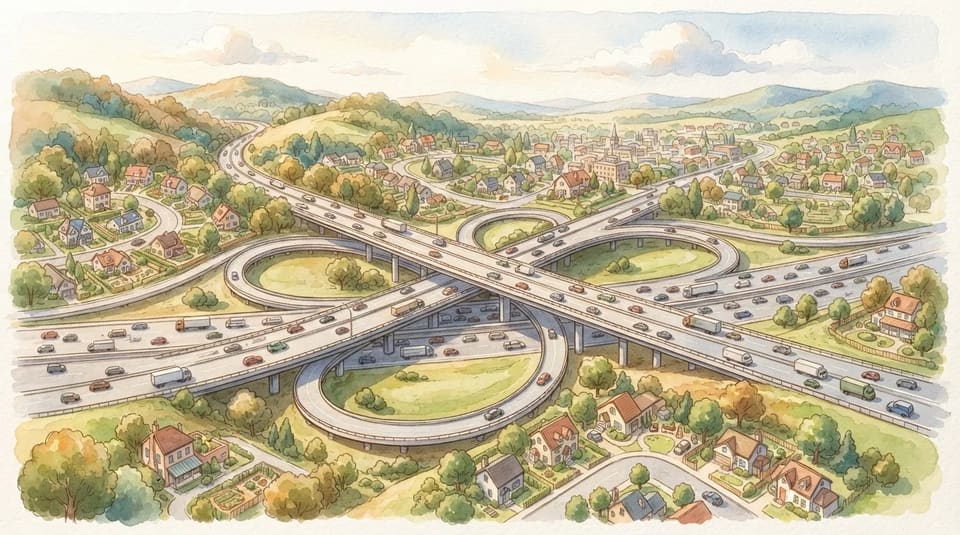
Diverging diamond interchanges. A true how-it-works story for kids 6–10.
How things work stories
The Diverging diamond interchange story, read aloud
On this highway drive, we pass interchanges, the places where ramps loop off and on the big road. Some interchanges do something very surprising. Cars switch to the other side of the road, on purpose! Why would anyone do that? Let's follow one little blue car to find out. While we do, count the ramps you can spot looping off the highway. The blue car wants to get onto the highway.
To reach the ramp, it has to turn left. But turning left is tricky. You wait and wait while cars come straight toward you. It's like waiting to cross the playground while kids race past. So engineers, the people who plan roads, had a clever idea. Before the bridge, a traffic light lets the blue car cross over to the other side. Now the ramp is right next to it.
The blue car just turns, with nobody coming its way, and zooms up onto the highway. It's like the road does a little dance, swapping partners and then swapping back! A few of these were built in France when your grandparents were young. Now these clever roads help cars move along faster and more safely. So switching sides, just for a moment, gets everyone where they're going.
Quiz the back seat
Why does the blue car switch to the other side of the road?
Show the answer
So it can turn onto the ramp without waiting. That's right! And after the bridge, the cars switch right back to their usual side.
Diverging diamond interchange facts for kids
- In a diverging diamond interchange, traffic crosses to the opposite side of the road over or under the freeway, then crosses back.
- This kind of interchange was used in France as early as the 1970s.
- Popular Science named it one of the best engineering innovations of 2009.
Questions kids ask about Diverging diamond interchange
What is a diverging diamond interchange?
It is a highway interchange where cars cross to the other side of the road for a moment, then cross back.
Why do cars switch sides in a diverging diamond?
On the other side, the highway ramp is right next to them, so they can turn without waiting for oncoming cars.
Where were diverging diamonds first used?
A few were built in France about fifty years ago, when today's grandparents were young.
For grown-ups
Written with AI from public sources, then a second AI checked its main claims against the sources below before it was published. Stories that don't pass stay off the app and this site. Our about page explains who writes and checks our stories. Narration is pre-recorded, and nothing you do on this page is tied to your kids.
Sources
- epg.modot.org/index.php/234.6_Diverging_Diamond_Interchanges
- iowadot.gov/modes-travel/roads-highways/highway-safety-features/diverging-diamond-interchange
- storymaps.arcgis.com/stories/7e982ecf3c344e2ab4f1e6669acb8dca
- npr.org/2009/11/24/120403340/diverging-diamond-traffic-flow-way-of-the-future
- gaiconsultants.com/diverging-diamond-interchange-going-expectations
- wiki.aaroads.com/wiki/Diverging_diamond_interchange
- en.wikipedia.org/wiki/Diverging_diamond_interchange
More stories about how things work
 Cars and roads Turn Right to Go Left
On this highway, ramps curl off the road and back on again. Those curly roads are part of an interchange, a place where big roads meet…
 Cars and roads Roads Stacked Like Pancakes
On this highway, roads sometimes pile up on top of each other, like pancakes on a plate. That pile is called a stack interchange.
 Trains, ships and planes The Islands Called Devil's Teeth
Out in the Pacific Ocean, about 30 miles past the Golden Gate bridge in San Francisco, sit the Farallon Islands. They are a row of pointy…
 Cars and roads The Two-Month Truck Trip
Look at our road! It is smooth and flat, and we zoom along.
Build one with bricks
Read a true book
Between stories: 25 road trip games for kids · Road trip bingo cards · License plate game · Road trip trivia · Christmas light scavenger hunt · Christmas trivia
Town and county names: GeoNames (CC BY 4.0).