Cars and roads
Why do roads stack like pancakes?
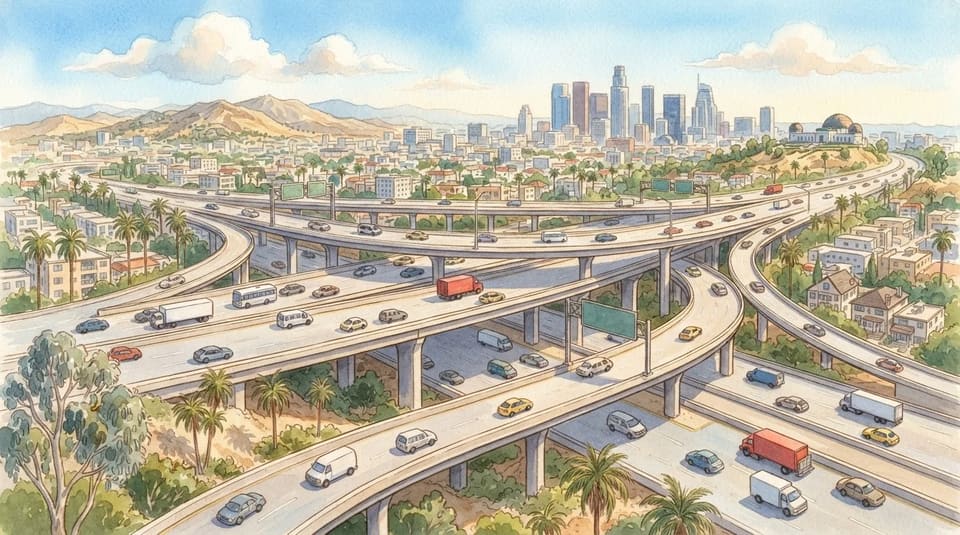
Stack interchanges, Los Angeles. A true how-it-works story for kids 5–9.
How things work stories
The Stack interchange story, read aloud
On this highway, roads sometimes pile up on top of each other, like pancakes on a plate. That pile is called a stack interchange. It's where two big highways meet, so cars can switch from one to the other. But why stack roads at all? Picture one little red car. It wants to turn onto a different highway. If the roads crossed flat, like a plus sign, the red car would have to stop.
Cars going the other way would be right in its path. Everyone would wait, like a long line for the slide at recess. So engineers, the people who plan and build big things, had an idea. Put the roads at different heights! The red car rolls onto a ramp, a road that curves up and away. The ramp carries it over the other lanes like a bridge. Then it sets the car down on the new highway.
Nobody crosses in front of anybody, so nobody stops. It's a giant playground slide, just for cars! The first one was built in Los Angeles about seventy-five years ago, when your great-grandparents were young. Next time we pass a stack, try counting the roads above us. That first stack in Los Angeles had four levels of roads piled up! Stacked roads let cars change highways without having to stop.
Quiz the back seat
Why do engineers stack roads on top of each other?
Show the answer
So cars don't have to stop. Right! The curvy ramps carry each car over or under the other lanes, so nobody has to cross in front of anybody.
Stack interchange facts for kids
- A stack interchange lets traffic move to and from all directions without stopping.
- The world's first one was the Four Level Interchange in Los Angeles, built in 1949.
- It was put into full use in 1953.
Questions kids ask about Stack interchange
What is a stack interchange?
It is a place where two highways meet and their roads go over and under each other, so cars can switch highways.
Why do roads stack on top of each other?
Stacking lets each car take its own curvy ramp over or under the other lanes, so nobody has to stop.
Where was the first stack interchange built?
The first one was built in Los Angeles, and it had four levels of roads.
For grown-ups
Written with AI from public sources, then a second AI checked its main claims against the sources below before it was published. Stories that don't pass stay off the app and this site. Our about page explains who writes and checks our stories. Narration is pre-recorded, and nothing you do on this page is tied to your kids.
Sources
More stories about how things work
 Trains, ships and planes The Islands Called Devil's Teeth
Out in the Pacific Ocean, about 30 miles past the Golden Gate bridge in San Francisco, sit the Farallon Islands. They are a row of pointy…
 Cars and roads The Two-Month Truck Trip
Look at our road! It is smooth and flat, and we zoom along.
 Houses A House Made of Grass
Look at the houses outside. Their walls are made of wood, or bricks, or stone.
 Cars and roads The Road Is Made of Rocks
Hey, what is this road under our tires made of? Here's a surprise.
Build one with bricks
Read a true book
Between stories: 25 road trip games for kids · Road trip bingo cards · License plate game · Road trip trivia · Christmas light scavenger hunt · Christmas trivia
Town and county names: GeoNames (CC BY 4.0).