Mountains, trees and weather
Can a river build its own banks?
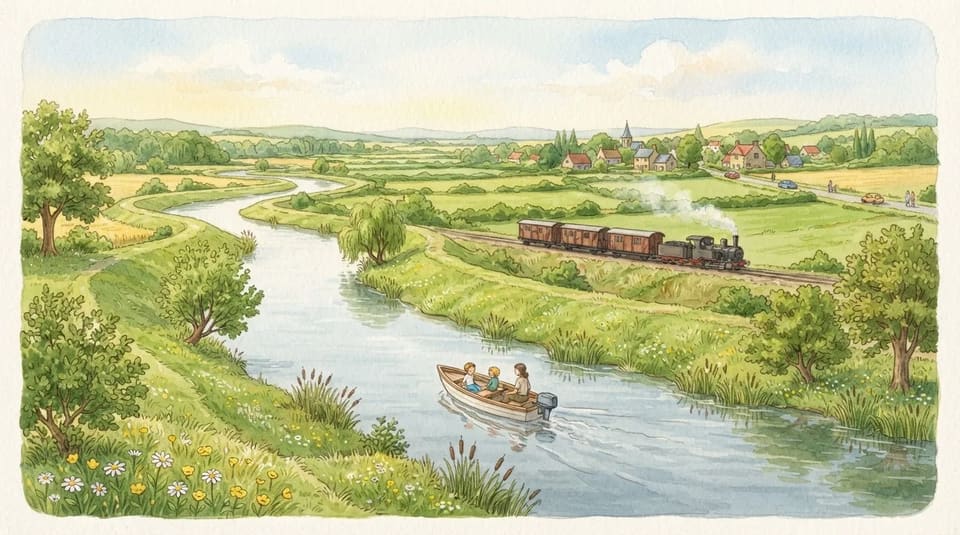
How rivers build natural levees. A true how-it-works story for kids 5–11.
How things work stories
The Levee story, read aloud
We're riding near a river. Some rivers build their own walls, called levees! A levee is a long, low hill along a river's side. Let's follow one tiny grain of sand to see how. Our grain rides along in the river.
Then a big rain comes. The river spills over its sides, like a bathtub running over! The water spreads wide and slows way down. Slow water can't carry heavy things. So the heavy grain drops first, right beside the river.
Our grain just got off the river bus at the very first stop! Flood after flood, more grains pile up there. They make tall banks along the river. The river built its own walls, one tiny grain at a time.
Quiz the back seat
Which bits drop first, right next to the river?
Show the answer
Heavy sand. Heavy sand! The light mud floats farther away, so the banks slope gently down.
Levee facts for kids
- Natural levees form on river floodplains after floods.
- Coarser sediment drops right beside the channel as floodwater slows; finer sediment settles farther away.
- People in ancient Egypt, Mesopotamia, China and the Indus Valley built levees too.
The Levee story, read aloud
On this drive along the river, the water might look calm and lazy. But a river is secretly a builder. A natural levee is a raised bank, a long, low ridge of sand and mud that a river piles up beside itself, all on its own. So how does water with no hands build a wall? Let's follow one flood, and one grain of sand riding in it. Picture a huge rainstorm upstream. The river swells brown and fast, stuffed with sand, silt, and fine clay, like a delivery truck crammed with packages.
Our grain of sand tumbles along in the middle, where the current is strongest. Then the water rises over the bank and spills onto the flat land beside it, called the floodplain. Here's the trick. The moment the water leaves the deep channel, it spreads out and slows down. Slow water can't carry heavy things, so the biggest bits drop first, right at the river's edge. Our grain of sand lands there. Lighter mud travels farther, and the finest clay drifts farthest of all.
It's a river that dumps its heaviest suitcases right by the front door. Here's a guess for the car: in moving water, would a pebble or a pinch of dust sink first? Flood after flood, the heavy bits stack up, until the river flows between raised banks it built itself. People noticed this trick, too. Long ago, ancient Egypt, Mesopotamia, China and the Indus Valley all built levees of their own. Long before anyone picked up a shovel, rivers were building their own banks, and every big flood still adds a little more.
Quiz the back seat
When a river floods, what drops first, right beside the river?
Show the answer
The heaviest sand. The heaviest sand! And people copied the river's idea long ago: ancient Egypt, Mesopotamia, China and the Indus Valley all built levees of their own.
Levee facts for kids
- Natural levees form when floodwater slows and drops coarse sediment right beside the river channel.
- Finer sediment settles farther out on the floodplain, giving levees a gentle slope on each side.
- Ancient civilizations in the Indus Valley, Egypt, Mesopotamia and China built artificial levees.
Questions kids ask about Levee
What is a natural levee?
A natural levee is a long, low hill along a river's side that the river builds itself.
How does a river build a levee?
When floodwater spills out and slows down, heavy sand drops right beside the river and piles up into banks.
Where does the lighter mud go?
Lighter mud floats farther away before it settles, so the banks slope gently down.
For grown-ups
Written with AI from public sources, then a second AI checked its main claims against the sources below before it was published. Stories that don't pass stay off the app and this site. Our about page explains who writes and checks our stories. Narration is pre-recorded, and nothing you do on this page is tied to your kids.
Sources
- en.wikipedia.org/wiki/Levee
- americanrivers.org/threats-solutions/restoring-damaged-rivers/benefits-of-restoring-floodplains
- profession.americangeosciences.org/collections/visual-explainers/floods/why-floodplains-exist
- pmc.ncbi.nlm.nih.gov/articles/PMC7780550
- agupubs.onlinelibrary.wiley.com/doi/full/10.1029/2025JF008642
- pubs.geoscienceworld.org/sepm/jsedres/article/78/1/16/145162/Anatomy-and-Dynamics-of-a-Floodplain-Powder-River
- brainly.com/question/54669852
- masterymind.co.uk/blog/how-are-levees-formed
More stories about how things work
 Animals The Rock That Remembered
On this road, we're driving past hills and houses. And inside some hills are rocks.
 Inventors and firsts The Dad Who Pumped Up Wheels
On this road, every car, bus and bike is rolling along on a secret cushion. Hidden inside nearly every tire is squeezed-up air.
 Cars and roads The Car That Was a Tricycle
On this road, cars roll along all around us, and every one has wheels. But the very first real car, the kind people could buy, had only…
 Mountains, trees and weather The River With Braids
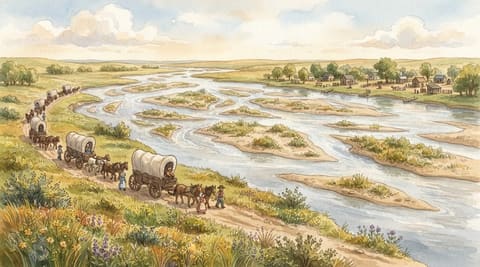
Have you ever seen a river that looks like a braid? In Nebraska, there is one!
Between stories: 25 road trip games for kids · Road trip bingo cards · License plate game · Road trip trivia · Christmas light scavenger hunt · Christmas trivia
Town and county names: GeoNames (CC BY 4.0).