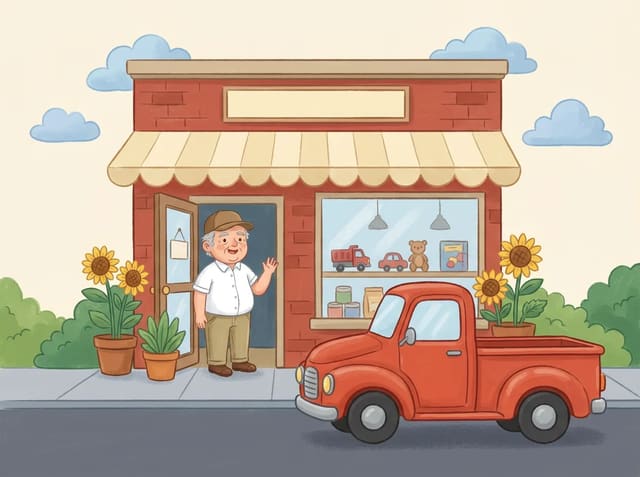
Sam Walton for kids: a true picture book
Sam Walton Brings Low Prices Home. 10 pages, fact-checked, at three reading levels, read aloud.
Sam Walton (1918–1992)
The lesson: Make things cheaper for people, and they will come back.


Scan with your iPhone cameraor open it in your browser
Books about business and makers
Who was Sam Walton?
Sam Walton (1918–1992) was a store owner who started Walmart. He opened the first Walmart store in Rogers, Arkansas, in 1962. His big idea was to sell things at the lowest prices he could, so more people would shop at his stores.
| Born | 1918 |
|---|---|
| Died | 1992 |
| Known for | founder of Walmart |
| The lesson | Make things cheaper for people, and they will come back. |
| Topics | Business and makers |
| The book | 10 pages, 3 reading levels, read aloud |
Read the first pages free

Long ago, five-and-dime stores lined American town streets. Things there once cost a nickel or a dime! But discount stores, which sold things very cheaply, were mostly in big cities.
In the middle 1900s, five-and-dime stores lined the shopping streets of American towns. Many things in them once cost just a nickel or a dime. But discount stores, the chains with the lowest prices of all, were mostly found in big cities, not small towns.
In the early and middle 1900s, the shopping streets of American towns were lined with five-and-dimes, variety stores from chains like Woolworth's. They had started out selling items for 5, 10 or 25 cents. Discount stores worked differently: they sold vast amounts of goods at heavily discounted prices, for a small profit on each item. But discount chains usually put their stores in larger cities, not small towns.
Page 1 of 10
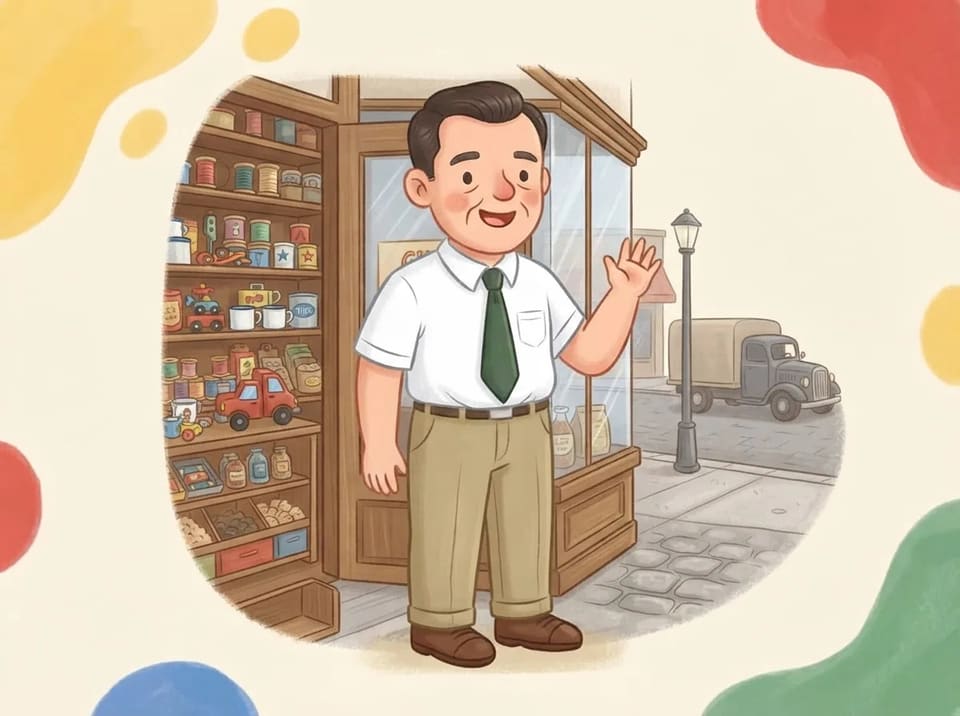
Sam was a soldier. In the army, he found out what he wanted: a store of his own! He used his army savings, plus money borrowed from his wife's dad, and bought one.
While Sam Walton served in the army, he figured out what he wanted: a store of his own. In 1945, he bought a Ben Franklin store, a five-and-dime, in Newport, Arkansas. He paid with his army savings and money borrowed from his wife's father.
While serving in the Army, Sam Walton realized he wanted to go into retailing and into business for himself. In 1945, at 26 and out of the military, he bought a Ben Franklin variety store, a five-and-dime, in Newport, Arkansas. He paid with $5,000 he had saved in the Army and a $20,000 loan from his father-in-law, Leland Robson.
Page 2 of 10
Sam Walton: a timeline of true facts
- In the early and middle 1900s, Americans often called variety stores five-and-dimes. source
- Variety-store chains lined the shopping streets of American towns and suburbs. source
- Some chains first sold things for five, ten, or twenty-five cents, then began selling goods at a range of prices. source
- A discount store can make a small profit on each item add up by selling lots of goods. source
- Discount stores buy goods in bulk and distribute them efficiently to keep costs down. source
- American discount chains usually put their stores in larger cities rather than small towns. source
- 1945 After leaving the military in 1945, Sam Walton took charge of his first variety store. source
- 1945 Sam bought a Ben Franklin store in Newport, Arkansas, using a family loan and his Army savings. source
- While serving in the Army, Sam decided he wanted to run his own retail business. source
- 1945 Sam focused on low prices, hoping to sell more even though he would make less profit on each sale. source
- 1945 Buying and renting the Newport store cost Sam an unusually high amount. source
- Sam found cheaper suppliers, so he could charge less than competing stores. source
- Sam thought people would shop close to home if his prices were as good as those in distant cities. source
- Sam kept his shelves filled with many kinds of goods. source
- After the Newport store succeeded, its landlord refused to renew Sam’s lease because he wanted the store for his son. source
- 1950 Sam, his wife Helen, and her father negotiated for a new location in Bentonville. source
- The owner of the neighboring shop refused Sam six times before Helen’s father secured the lease. source
- 1950 Sam’s new Bentonville store opened with a one-day remodeling sale on May 9, 1950. source
- 1962 Sam and his brother Bud grew their business to sixteen stores in three states. source
- 1962 The first Walmart opened in Rogers, Arkansas, on July 2, 1962. source
- 1967 Within five years, Walmart had grown to eighteen Arkansas stores. source
- Sam kept Walmart stores within a day’s drive of regional warehouses and used the company’s own trucks. source
- Buying lots of goods and delivering them efficiently helped Walmart sell well-known brands at discounts. source
- Studies have found Walmart’s prices are often lower than its competitors’ and linked its presence with lower food prices for households. source
- Shoppers say low prices are their most important reason for shopping at Walmart. source
- 2025 As of 2025, Walmart had 4,605 stores in the United States. source
Questions kids ask about Sam Walton
When and where did the first Walmart open?
Sam Walton opened the first Walmart store on July 2, 1962, in Rogers, Arkansas. His plan was built on the lowest prices, anytime, anywhere. The company grew quickly: by 1967, the Walton family owned 24 stores. source
What was Sam Walton's first store?
In 1945, after leaving the military, Sam Walton bought a Ben Franklin variety store in Newport, Arkansas. He was 26. He paid for it with $5,000 he had saved from his time in the Army and a $20,000 loan from his father-in-law. source
Where did Sam Walton grow up?
Sam Walton was born in Kingfisher, Oklahoma, and grew up mostly in small towns in Missouri. During the Great Depression he milked the family cow, delivered newspapers and sold magazine subscriptions to help his family. He became the youngest Eagle Scout in Missouri's history. source
Did Sam Walton fly a plane?
Yes. Sam Walton bought a small second-hand airplane and became a skilled pilot. He and his son John flew thousands of hours looking for good places to open new stores and grow the family business. source
3 reading levels
- Read to me (ages 3–5)
- Read together (ages 6–8)
- I'll read (ages 9–12)
The same true story, written three ways. Little kids hear short, bouncy lines; big kids get the details and the numbers.
Quiz time
What did Sam want the prices in his store to be?
Show the answer
Low.
Try this at home
- Set up a pretend store with a grown-up. Sell 10 snacks for 1 penny of profit each, then 2 snacks for 3 pennies each. Count which way earned more.
- Pick one thing your family buys and, with a grown-up, compare its price at two stores or two websites. Which is lower?
- Draw a map with one warehouse in the middle and stores around it. Use a toy truck to deliver to each store and see which ones are close enough for one trip.
More true heroes

Read the whole book tonight.
On iPhone, iPad and Android, and in any web browser.
Scan with your iPhone cameraor open it in your browser