Who built that?
How can builders work underwater without getting wet?
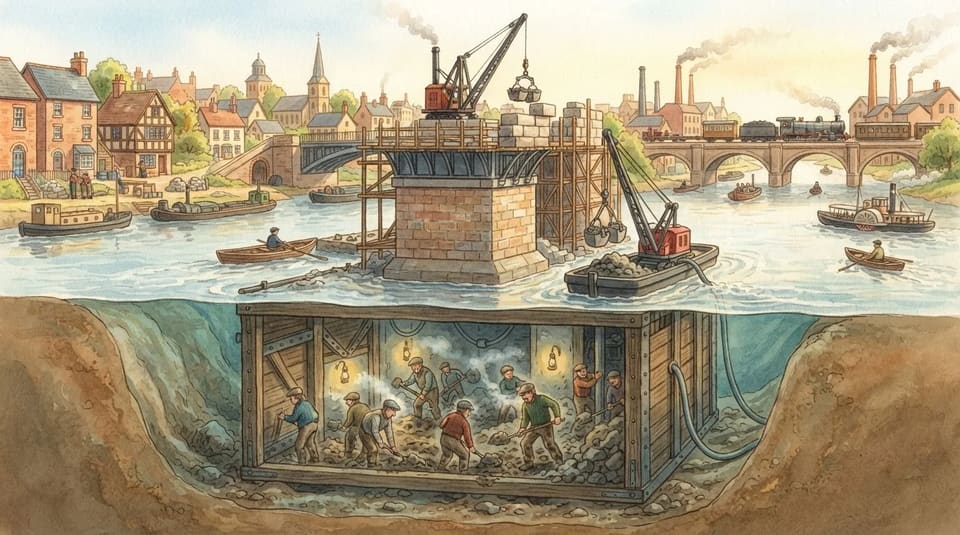
How bridge foundations are built. A true how-it-works story for kids 5–9.
How things work stories
The Caisson story, read aloud
On this drive along the water, big bridges stand with their legs right in it. Each leg sits on a strong bottom called a foundation. It's like the bottom block of a tall block tower. But how do builders make it underwater without getting soaked? Let's follow one giant box and find out. Builders make a box as big as a house. It's called a caisson, a French word that just means box.
They float it out and sink it, all the way down to the mud. Then comes the clever part. Big pumps push all the water out of the box. The walls are made so tight that the river can't sneak back in. So the water stays outside, and the inside stays dry. That makes a dry room at the bottom of the river! Workers climb down inside and dig the mud.
Imagine working under a river and coming home with dry socks! As they dig, the heavy box slides deeper, until it reaches hard ground. Out the window, try counting the legs of the next bridge you see. Long, long ago, even the Romans used boxes like this. Then the box gets filled with stone and concrete, and it stays down there for good. Big bridges, like the famous Brooklyn Bridge, still stand on giant boxes like that, hidden under the water.
Quiz the back seat
How did workers stay dry at the bottom of the river?
Show the answer
They worked inside a giant box with the water pumped out. Yes! The giant box is called a caisson, and when the work is done, it gets filled with stone and concrete.
Caisson facts for kids
- Caisson comes from a French word meaning box.
- Caissons are built so the water can be pumped out, keeping the work space dry.
- The Brooklyn Bridge, finished in 1883, was built using caissons.
Questions kids ask about Caisson
What is a caisson?
A caisson is a giant watertight box that builders sink into water to make a dry place to work.
How do bridge builders keep water out?
They sink a box with tight walls and pump the water out so the inside stays dry.
Did old bridges use caissons?
Yes, the famous Brooklyn Bridge stands on giant boxes like these, and even the Romans used the idea long ago.
For grown-ups
Written with AI from public sources, then a second AI checked its main claims against the sources below before it was published. Stories that don't pass stay off the app and this site. Our about page explains who writes and checks our stories. Narration is pre-recorded, and nothing you do on this page is tied to your kids.
Sources
More stories about how things work
 Mountains, trees and weather The Dust Pile Taller Than Buildings
On this drive, look at the hills and houses going by. Some land on Earth is made of dust that the wind carried there.
 Cars and roads Signs That Talk Without Words
Look out the window! On this highway, signs stand by the lanes and hang high above us.
 Long, long ago The Island Nobody Could Swim From
Here in California, out in San Francisco Bay, there is a rocky island called Alcatraz. Its name comes from an old word for a seabird.
 Cars and roads The Road Builder Who Couldn't See
On this road under us, our wheels roll smooth and flat. Somebody had to build it!
Build one with bricks
Read a true book
How it works
Between stories: 25 road trip games for kids · Road trip bingo cards · License plate game · Road trip trivia · Christmas light scavenger hunt · Christmas trivia
Town and county names: GeoNames (CC BY 4.0).