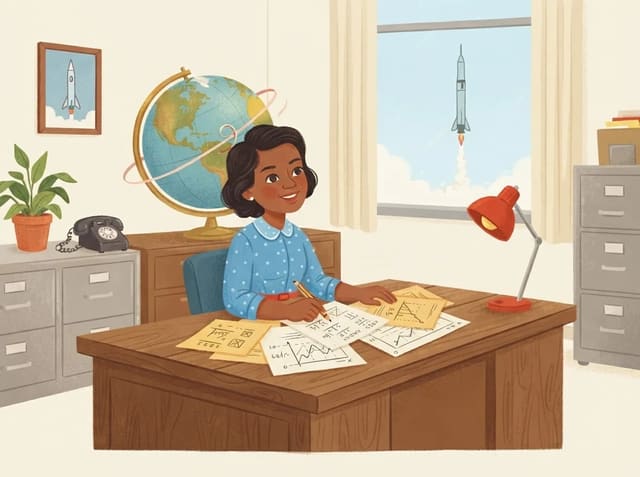
Katherine Johnson for kids: a true picture book
Katherine Checks the Numbers. 10 pages, fact-checked, at three reading levels, read aloud.
The lesson: Check your work with care, and when you have earned a place at the table, ask for it.


Scan with your iPhone cameraor open it in your browser
Books about space and rockets
Who was Katherine Johnson?
Katherine Johnson was a mathematician who worked out the flight paths for America's first human spaceflights at NASA. She started in 1953 in a pool of African-American women who did math for the agency, and her skill with geometry soon kept her on a team that studied flight. In 1962, astronaut John Glenn refused to fly around Earth until she had checked the electronic computer's numbers.
| Known for | NASA mathematician who calculated spaceflight paths |
|---|---|
| The lesson | Check your work with care, and when you have earned a place at the table, ask for it. |
| Topics | Space and rockets, Scientists, History |
| The book | 10 pages, 3 reading levels, read aloud |
Read the first pages free
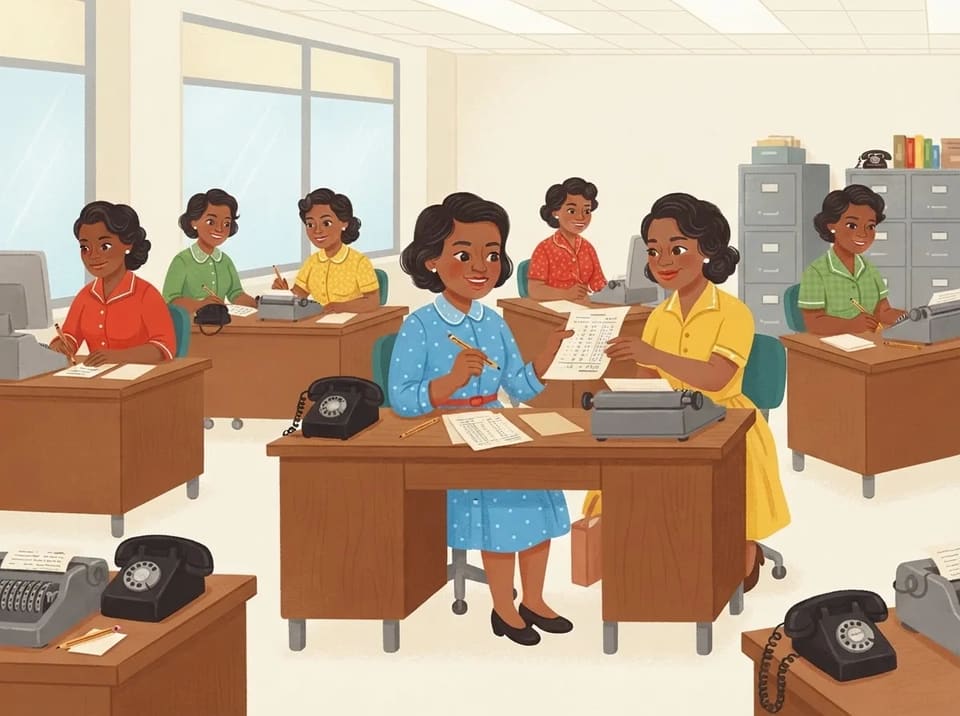
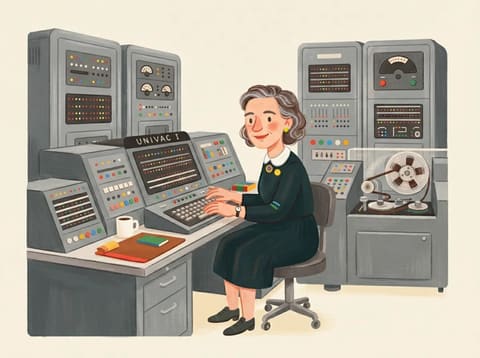
Long ago in America, a computer was not a machine. It was a person who did math! Katherine got a job doing math, in a room with other Black women.
In 1953, a computer was not a machine. It was a person who did math. Teams of women split long problems into parts and checked each other's answers. Katherine Johnson joined them. In those days, she and the other Black women computers had to work and eat apart from white coworkers.
In 1953, the word computer did not mean a machine. Before electronic calculators, it meant a person who did math, and teams of women split long calculations into parts and checked one another's answers. That June, Katherine Johnson took a job at the agency that later became NASA. She joined a pool of women doing calculations, women she later called computers who wore skirts. She and the other African-American women computers had to work, eat and use restrooms apart from their white colleagues, in an office labeled Colored Computers.
Page 1 of 10
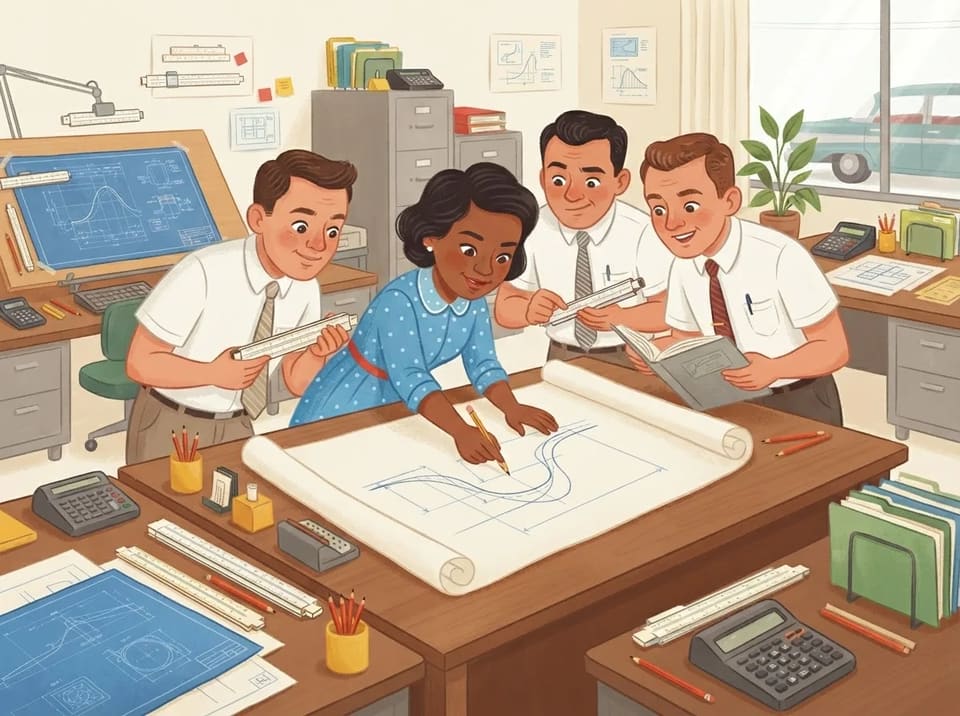
Katherine was very, very good at math. Soon she was helping a team of men who studied flying. She was so good, they forgot to send her back to the other women!
In college, Katherine had taken every math class there was, and a professor made new ones just for her. Now she was helping a team that studied flight. Her math of lines and curves was so good that the team forgot to send her back to the pool!
Back in 1937, in college, Katherine had taken every mathematics course offered, and one of her professors, W. W. Schieffelin Claytor, added new courses just for her. Now she was working with a team that studied flight. Her knowledge of analytic geometry, the math of lines and curves, made quick allies of her male bosses and colleagues, so quick that they forgot to return her to the pool.
Page 2 of 10
Katherine Johnson: a timeline of true facts
- Before electronic calculators, a computer could mean a person who did math. source
- Teams of people, often women, shared long calculations and checked one another’s answers. source
- 1953 At Katherine’s workplace, Black women computers had to work and eat separately from white colleagues. source
- 1957 The Soviet Union’s first satellite shocked Americans and began the Space Race. source
- 1961 Soviet cosmonaut Yuri Gagarin became the first person to orbit Earth. source
- NASA’s Mercury team planned to use small rockets to bring a spacecraft out of orbit. source
- 1937 Katherine took every math course her college offered, and a professor added courses just for her. source
- 1953 Katherine accepted a job at the agency that later became NASA. source
- 1958 Project Mercury’s goal was to send a person around Earth and bring him home safely. source
- Katherine asked to attend meetings because she had done the work and believed she belonged there. source
- Spaceflight posed dangers, including weightlessness, radiation, and tiny flying rocks. source
- Women in Katherine’s division had not been allowed to put their names on reports. source
- 1953 Katherine first worked with a group of women doing calculations. source
- 1953 Katherine’s geometry skills helped her stay with a team that studied flight. source
- 1958 Katherine kept asking until she was allowed into editorial meetings. source
- 1960 Katherine finished a report she had worked on and became the first woman in her division to have her name on one. source
- 1961 Katherine calculated the path and launch window for Alan Shepard’s flight. source
- 1962 John Glenn asked Katherine to check the electronic computer’s numbers before he would fly. source
- 1962 On February 20, 1962, John Glenn became the first American to orbit Earth. source
- 1962 Glenn’s mission made three planned orbits and landed at the expected time. source
- Katherine calculated flight paths, launch times, and emergency ways home. source
- Katherine made backup navigation charts in case electronics failed. source
- 1963 Mercury’s success helped prepare the way for later Moon landings. source
- 1969 Katherine also helped calculate the path for Apollo 11’s flight to the Moon. source
- 1970 When Apollo 13’s Moon mission was stopped, Katherine’s backup work helped its crew find a safe way home. source
Questions kids ask about Katherine Johnson
What did Katherine Johnson do at NASA?
She calculated flight paths, launch windows and emergency return paths for Project Mercury spaceflights, including those of Alan Shepard, the first American in space, and John Glenn, the first American in orbit. She plotted backup navigation charts in case the electronics failed, and she helped calculate the path for the 1969 Apollo 11 flight to the Moon. source
Did John Glenn really ask for Katherine Johnson?
Yes. When NASA first used electronic computers to work out Glenn's orbit around Earth, officials asked Katherine Johnson to check the computer's numbers. Glenn had asked for her by name and refused to fly unless she did. source
What was Katherine Johnson the first woman to do?
She was the first woman in her division to have her name on a report. Women there had not been allowed to put their names on reports, but in 1960 she finished one she had worked on, and her name went on it. She also asked to join editorial meetings, where no women had gone before, telling people she had done the work and belonged. source
3 reading levels
- Read to me (ages 3–5)
- Read together (ages 6–8)
- I'll read (ages 9–12)
The same true story, written three ways. Little kids hear short, bouncy lines; big kids get the details and the numbers.
Quiz time
What was a computer when Katherine started her job?
Show the answer
A person who did math.
Try this at home
- Be a team of human computers: with a grown-up, split a long adding problem into parts, each do one part, then swap and check each other's answers.
- Make an orbit: tie a string around a ball or a globe, then move a toy around the loop three times, like John Glenn's three trips around the Earth.
- Find your star: on a clear night, pick one bright star from your window, then look again the next night at the same time and see where it is.
More true heroes

Build one with bricks

Read the whole book tonight.
On iPhone, iPad and Android, and in any web browser.
Scan with your iPhone cameraor open it in your browser
Space and rockets for kids · Scientists for kids · History for kids · Women inventors for kids · Black inventors for kids · All heroes