Marie Curie for kids: a true picture book
Marie and the Hidden Rays. 10 pages, fact-checked, at three reading levels, read aloud.
The lesson: When a result surprises you, look closer and keep testing.


Scan with your iPhone cameraor open it in your browser
Books about scientists
Who was Marie Curie?
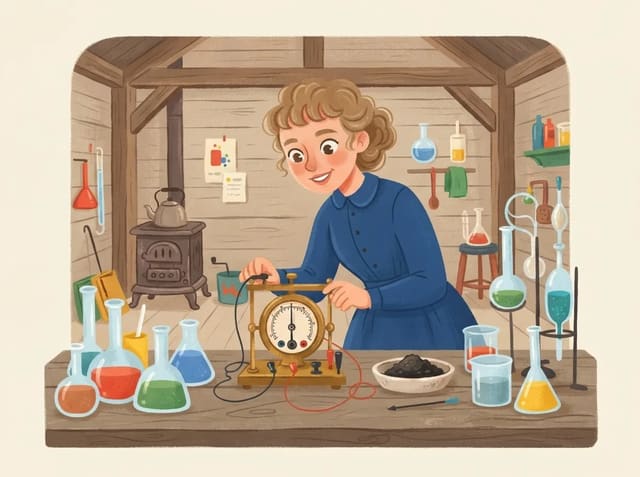
Marie Curie was a scientist, born in Warsaw in 1867, who studied the mysterious rays given off by uranium. In 1898 she and her husband, Pierre Curie, discovered two new elements: polonium, named after her native Poland, and radium, from the Latin word for ray. They did most of their work in a converted shed that was not even waterproof.
| Known for | discoverer of polonium and radium |
|---|---|
| The lesson | When a result surprises you, look closer and keep testing. |
| Topics | Scientists, Medicine, History |
| The book | 10 pages, 3 reading levels, read aloud |
Read the first pages free
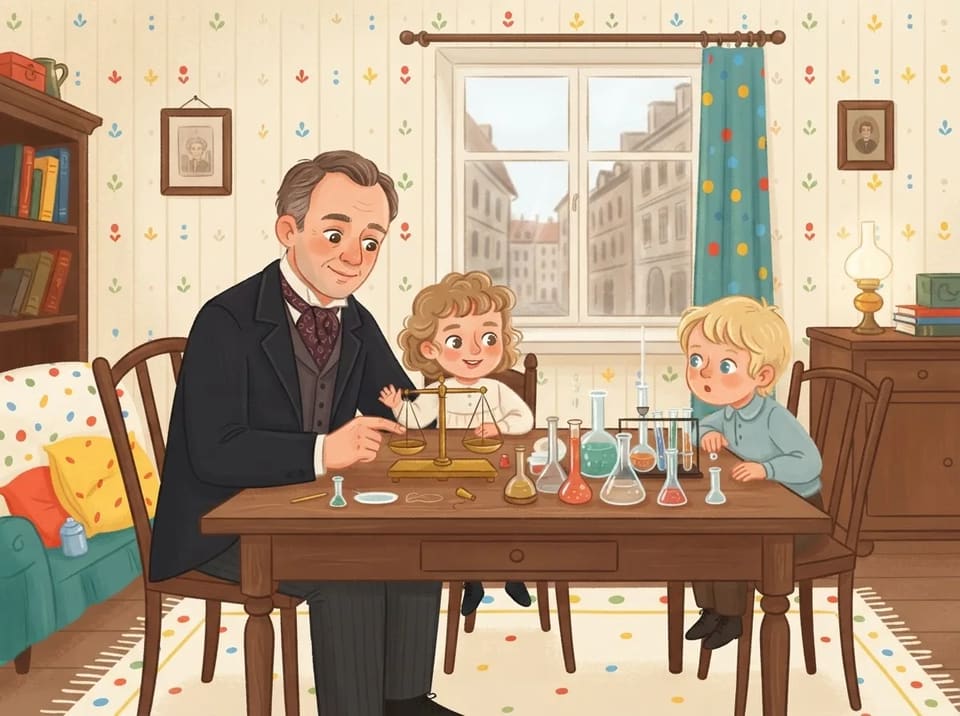
Long ago in Warsaw, schools could not teach science labs. So Marie's dad, a teacher, brought the lab tools home! Later, as a student in Paris, she wore all her clothes at once in the cold winters.
Marie was born in Warsaw, Poland, in 1867, and learning science there was hard. Russian officials had stopped lab lessons in Polish schools, so her father, a teacher, brought the lab tools home. Later Marie studied at a secret university that let women in, and then in Paris, where she was so poor she wore all her clothes at once to keep warm!
Marie was born in Warsaw in 1867, the daughter of a teacher, and learning science there was not easy. Russian authorities had removed laboratory lessons from Polish schools, so her father brought the equipment home and taught his children to use it. Marie and her sister studied at the Flying University, a secret Polish school that admitted women. By 1891 Marie was a student in Paris, so short of money that in cold winters she kept warm by wearing all the clothes she had.
Page 1 of 10
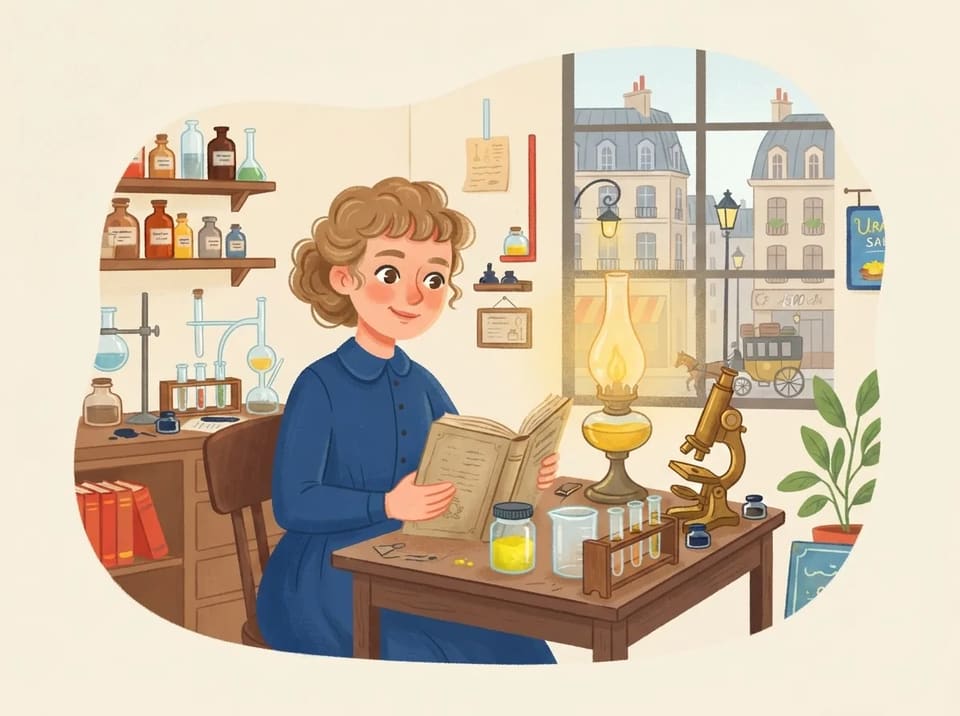
Then scientists found strange new rays that could pass right through things. Some came out of a metal called uranium. Where did their power come from? Nobody knew! Marie chose to study these rays.
Then scientists found mystery rays. First came X-rays. Then a scientist found that salts of a metal called uranium gave off rays that could pass through things, too. X-rays were made with electricity, but these rays seemed to need none. So where did their power come from? Marie decided to study these uranium rays.
In 1895, Wilhelm Röntgen discovered X-rays, though no one yet understood how they were made. In 1896, Henri Becquerel found that uranium salts gave off rays much like X-rays, able to pass through things. X-rays were produced using electricity, but uranium's rays needed none, and nobody knew where their energy came from. Inspired by both discoveries, Marie decided to make uranium rays the subject of her thesis research.
Page 2 of 10
Marie Curie: a timeline of true facts
- In Polish schools, laboratory lessons were removed, so Marie's father brought equipment home to teach his children. source
- Marie and her sister attended a secret Polish university that admitted women. source
- 1891 As a student in Paris, Marie wore all her clothes to keep warm in winter. source
- 1895 Scientists had discovered X-rays, but did not yet understand how they were produced. source
- 1896 Henri Becquerel found that uranium salts gave off rays that could pass through things, like X-rays. source
- Unlike X-rays, the mysterious radiation did not seem to need electricity to be produced. source
- 1867 Marie was born in Warsaw to a teacher and received some science training from her father. source
- 1895 Marie and Pierre Curie married and became scientific collaborators. source
- The discoveries of X-rays and uranium rays inspired Marie to investigate uranium rays for her thesis. source
- Marie and Pierre did much of their research in a converted shed. source
- Their shed had poor ventilation and was not even waterproof. source
- Marie used a sensitive instrument called an electrometer to study uranium rays. source
- She found that a uranium compound's activity depended on how much uranium it contained. source
- Marie measured two minerals and found they were more active than uranium itself. source
- 1898 Marie found that thorium gave off rays, but another scientist reported it first. source
- Marie realized that the unusually active minerals might contain a substance even more active than uranium. source
- 1898 Pierre became so interested in Marie's research that he stopped his own work on crystals to join her. source
- 1898 Marie and Pierre weighed out a small sample of pitchblende and ground it with a pestle and mortar. source
- 1898 In July, Marie and Pierre announced a new element called polonium, named for Marie's native Poland. source
- 1898 In December, they announced a second new element, radium, named from the Latin word for ray. source
- To prove their discoveries, the Curies tried to separate the new elements in pure form. source
- 1898 They obtained traces of radium, but could not yet get larger amounts free of another element, barium. source
- 1902 From a tonne of pitchblende, the Curies separated just one-tenth of a gram of a radium compound. source
- Marie proposed that the radiation came from the atom itself, not from molecules interacting. source
- Marie and Pierre's research helped start the use of radium to treat cancer. source
- Marie's methods for separating radioactive substances are still used in research and medicine. source
Questions kids ask about Marie Curie
When did Marie Curie discover radium?
Marie and Pierre Curie announced radium on December 26, 1898, the second new element they announced that year, after polonium in July. At first they had only traces of it. In 1902, from a tonne of a mineral called pitchblende, they separated just one-tenth of a gram of a radium compound. source
How did Marie Curie discover radium?
Using her husband's electrometer, a sensitive measuring instrument, she found that the mineral pitchblende was four times as active as uranium itself. She reasoned that it must hold a small amount of another substance, far more active than uranium. On April 14, 1898, she and Pierre weighed out 100 grams of pitchblende and ground it with a pestle and mortar to begin the search. source
Was Marie Curie Polish?
Yes. She grew up in Poland, where she and her sister studied at a secret Polish university that admitted women, and she later studied in Paris. She and Pierre named the element polonium after her native Poland. source
3 reading levels
- Read to me (ages 3–5)
- Read together (ages 6–8)
- I'll read (ages 9–12)
The same true story, written three ways. Little kids hear short, bouncy lines; big kids get the details and the numbers.
Quiz time
What surprised Marie about two rocks?
Show the answer
They gave off more rays than pure uranium.
Try this at home
- Find the hidden thing: a grown-up hides a coin inside one of three lumps of play dough. Weigh each lump in your hands, guess which one hides something extra, then check, like Marie finding a hidden substance in a rock.
- Measure like a scientist: pour different amounts of water into three cups, guess which holds the most, then measure each one and write the numbers down.
- Separate a mix: stir salt and pepper together on a plate, rub a balloon on your hair, and hold it just above the plate. Watch the pepper jump up and leave the salt behind.
More true heroes


Read the whole book tonight.
On iPhone, iPad and Android, and in any web browser.
Scan with your iPhone cameraor open it in your browser
Scientists for kids · History for kids · Women inventors for kids · All heroes