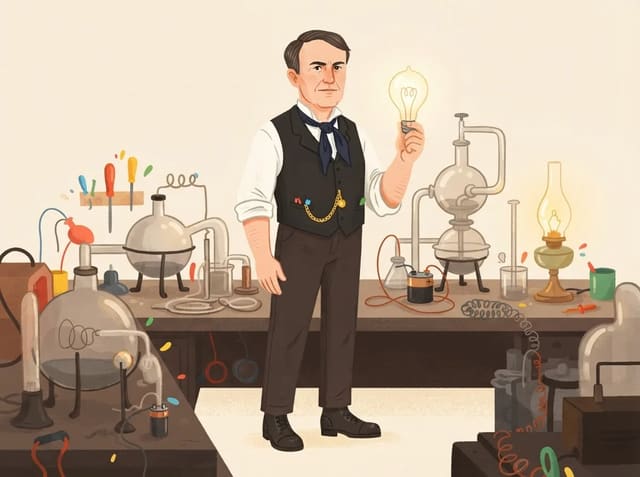
Thomas Edison for kids: a true picture book
Thomas Edison and the Village of Light. 10 pages, fact-checked, at three reading levels, read aloud.
The lesson: When one try fails, learn from it and try the next thing.


Scan with your iPhone cameraor open it in your browser
Books about scientists
Who was Thomas Edison?
Thomas Edison was an inventor who led a team that made a long-lasting electric light bulb. Starting in 1878 at Menlo Park, a small village about 25 miles southwest of New York City, his team tested thousands of materials for the thin thread that glows inside a bulb. In 1879 a bulb with a filament of carbonized sewing thread burned for thirteen and a half hours.
| Known for | maker of a long-lasting electric light bulb |
|---|---|
| The lesson | When one try fails, learn from it and try the next thing. |
| Topics | Inventors, Scientists, Houses |
| The book | 10 pages, 3 reading levels, read aloud |
Read the first pages free
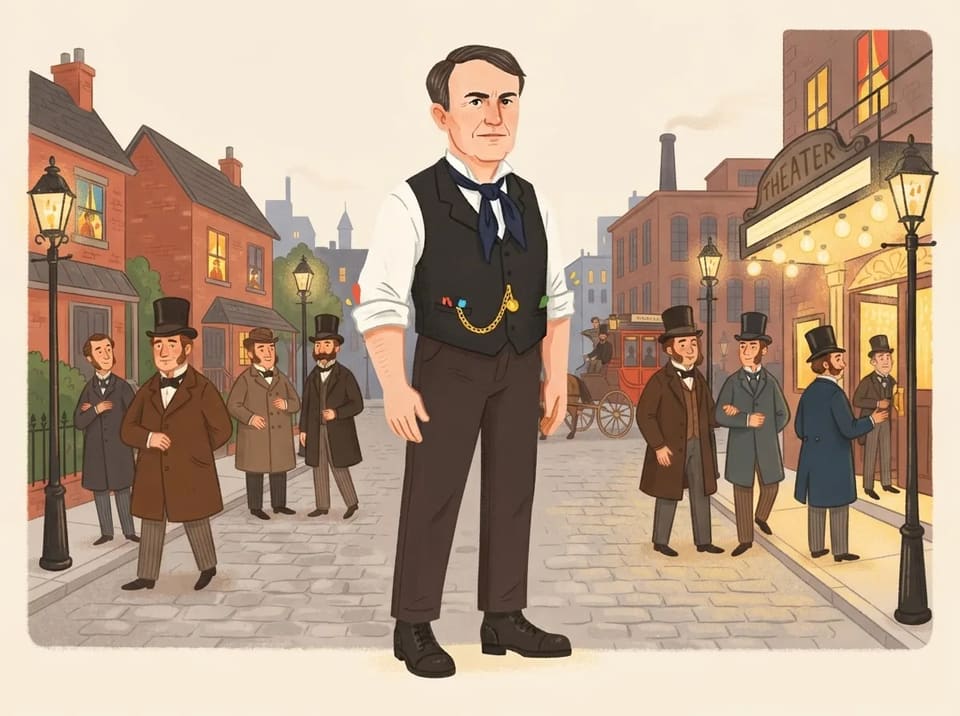
Long ago, in towns and cities, people lit their streets and homes at night with little gas flames. The flames made light, but they were hot. They could even start fires.
Long ago, gas flames lit up streets, homes, factories and theaters in the cities. In theaters, gas made the stage bright. But the flames were hot, and the gas could start fires or even explode.
In the 1800s, people lit streets, homes, factories and theaters with gas. In theaters, gas lights made stages brighter and let the lighting be controlled from one place, but every flame brought heat and the danger of fire and explosions. Each evening, the light that filled a city came from fire. Could electricity do the job instead?
Page 1 of 10
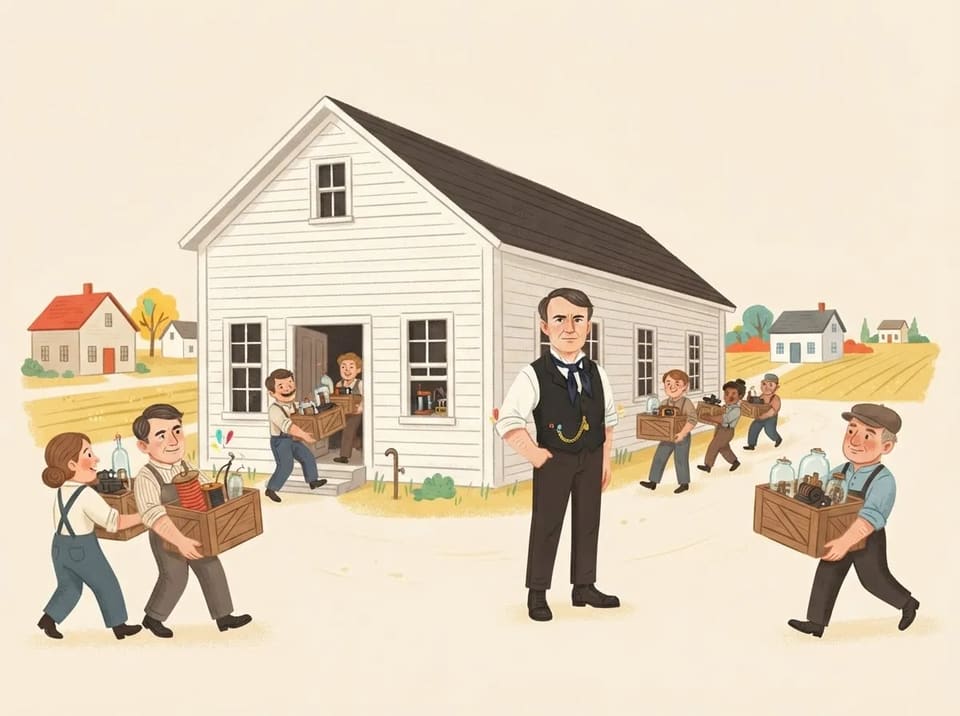
Thomas had a workshop in a little village. He and his helpers made new things there. Now Thomas wanted an electric light, good enough to use instead of gas!
In 1876, Thomas Edison moved his family and his helpers to Menlo Park, a small village near New York City. There he led a laboratory where his team did much of the inventing. Then he set out to make electric lights good enough to use instead of gas.
In 1876, Edison moved his family and his staff of assistants to Menlo Park, a small village twenty-five miles southwest of New York City. He led the laboratory there, and many inventions credited to him were made in large part by the people working under him. In 1878, he began work on a whole system of electric lighting, one he hoped could compete with gas and oil lamps.
Page 2 of 10
Thomas Edison: a timeline of true facts
- People used gas lighting in streets, homes, factories, and theaters. source
- Gas lights in theaters made stages brighter, but they also brought heat and fire risks. source
- Other inventors had already made electric light bulbs before Edison. source
- 1860 Joseph Swan made a working bulb, but it was inefficient and did not last long. source
- A light bulb glows when electricity heats a thin thread called a filament. source
- 1876 Edison moved with his family and assistants to Menlo Park in 1876. source
- Edison led a laboratory where other people helped make inventions. source
- 1878 In 1878, Edison began working on electric lighting that could compete with gas and oil lights. source
- Edison wanted a long-lasting bulb that could be part of a much larger lighting system. source
- Earlier bulbs were hard to use widely because they did not last long and needed a lot of electricity. source
- The team needed more than a bulb: they also had to make parts such as switches and wires. source
- Ludwig Boehm carefully blew the glass for the bulbs. source
- Charles Batchelor tested thousands of filament materials, including rubber and soot. source
- A filament Edison made from cardboard and lampblack burned out too quickly. source
- Edison also experimented with grasses and canes, including hemp and palmetto. source
- 1879 In the fall of 1879, the team tested a small cotton thread as a filament. source
- 1879 They heated the thread to make it hard, put it in glass, and pumped out the air. source
- 1879 After a year and a half of work, a bulb with carbonized sewing thread burned for thirteen and a half hours. source
- 1880 Edison and Batchelor later found that a carbonized bamboo filament could last more than 1,200 hours. source
- The team used a vacuum to help the filament last longer inside the bulb. source
- The team worked on filaments, glass bulbs, and vacuums together. source
- 1880 By February 1880, visitors were coming to see Menlo Park lit up. source
- 1882 In 1882, a power station in Manhattan began providing light and power to customers. source
- 1925 Electricity spread slowly: in 1925, half of all U.S. homes had electric power. source
Questions kids ask about Thomas Edison
Did Thomas Edison invent the light bulb?
Not the first one. Other inventors had made light bulbs before him, but those bulbs burned out very fast and needed a lot of electricity. In 1880, Edison and Charles Batchelor found that a carbonized bamboo filament could last more than 1,200 hours. source
How long did Edison's first light bulb last?
Edison's first success came in 1879, after a year and a half of work: a lamp with a filament of carbonized sewing thread burned for thirteen and a half hours. In September 1882, the first commercial power station, on Pearl Street in lower Manhattan, began sending light and power to customers. source
Who helped Thomas Edison make the light bulb?
A whole team did. Ludwig Boehm, from Germany, carefully blew the glass for the bulbs, and Charles Batchelor tried thousands of materials for the filament, from platinum to rubber to the black soot from kerosene lamps. The team also had to invent light switches, electric meters and wiring. source
3 reading levels
- Read to me (ages 3–5)
- Read together (ages 6–8)
- I'll read (ages 9–12)
The same true story, written three ways. Little kids hear short, bouncy lines; big kids get the details and the numbers.
Quiz time
What did Thomas want to make?
Show the answer
A light bulb that lasts a long time.
Try this at home
- Be a tester like the muckers: gather five things (a leaf, paper, foil, a sock, a straw) and test which one floats best in a bowl of water, one at a time. Keep the winner and try to beat it.
- With a grown-up, light a small candle and gently cover it with a glass jar. Watch the flame go out once the air inside is used up. Edison's team pumped the air out of their bulbs so the hot thread would last longer.
- Go on a light hunt at home: count every light switch you can find. Then imagine lighting each room with a flame instead.
More true heroes
Read the whole book tonight.
On iPhone, iPad and Android, and in any web browser.
Scan with your iPhone cameraor open it in your browser
Inventors for kids · Scientists for kids · Houses for kids · All heroes