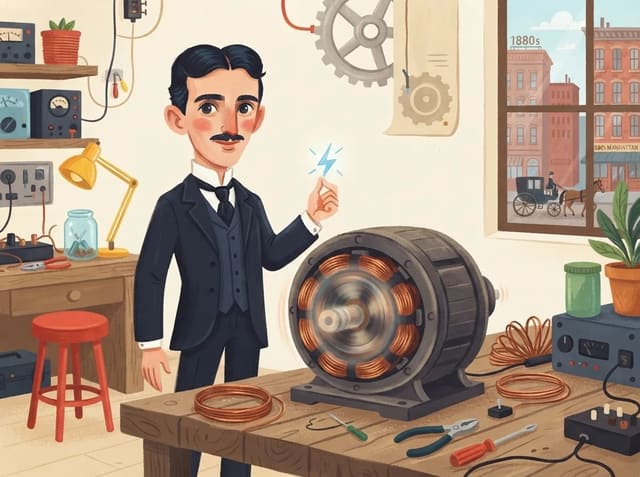
Nikola Tesla for kids: a true picture book
Nikola Tesla and the Spinning Motor. 10 pages, fact-checked, at three reading levels, read aloud.
The lesson: When people turn your idea down, keep building it and find people who will help.


Scan with your iPhone cameraor open it in your browser
Books about scientists
Who was Nikola Tesla?
Nikola Tesla was an inventor known for his work on the modern alternating current, or AC, electricity system. In 1887, in a laboratory in Manhattan, he developed a motor that ran on AC, turned by a rotating magnetic field. Before that, his investors had left him penniless, and he had dug ditches for $2 a day.
| Known for | inventor of the AC induction motor |
|---|---|
| The lesson | When people turn your idea down, keep building it and find people who will help. |
| Topics | Inventors, Scientists, Cities |
| The book | 10 pages, 3 reading levels, read aloud |
Read the first pages free
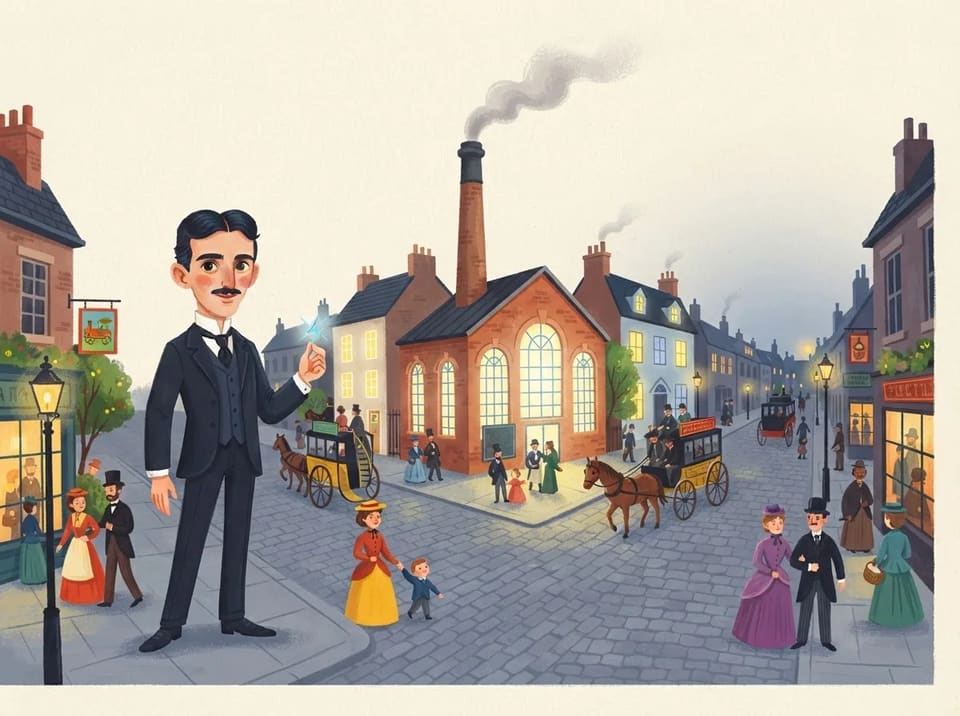
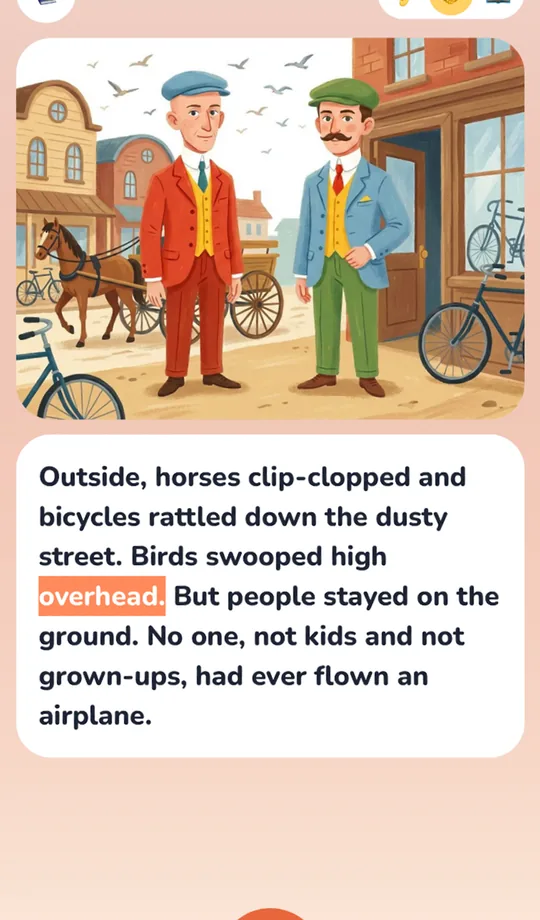
Long ago, in big cities, homes were lit by gas lamps. Then came a new kind of light that used electricity! But this electricity could only reach houses close by.
Long ago, gas lamps lit homes and shops in the cities. Then Thomas Edison's company began lighting homes and businesses with electricity. But each power plant could only reach places less than a mile away. So plants had to be built right in the middle of town.
In the 1880s, gas lamps lit homes and businesses, but electric light was beginning to take their place. In 1882, Thomas Edison launched the first DC electric utility, using direct current to light homes and businesses with his bulbs. DC had a big limit: a power plant could only supply customers less than a mile away, so plants had to sit in the middle of crowded cities.
Page 1 of 10
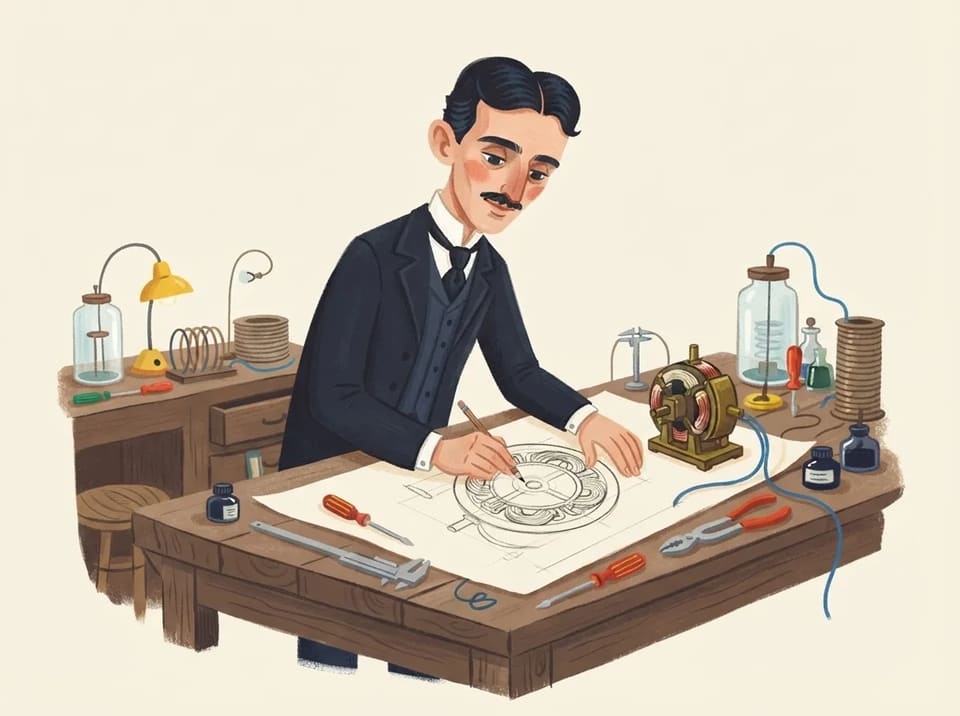
When Nikola was a student, his teacher showed how electricity works. Nikola wanted to know more! When he grew up, he had a big idea: a new kind of motor.
As a student, Nikola Tesla watched his teacher's experiments with electricity. He wanted to know more about this wonderful force. Later, in Paris, he designed better motors. By 1886, he had ideas for new motors that would run on AC, a kind of electricity that flips back and forth.
As a student, Tesla became fascinated by his physics professor's demonstrations of electricity. Tesla later wrote that they made him want to know more about this wonderful force. In Paris, he gained practical experience and was soon designing improved dynamos and motors. By 1886, he had ideas of his own to build: new kinds of motors and equipment to carry electricity, running on alternating current, or AC, which flips direction back and forth many times a second.
Page 2 of 10
Nikola Tesla: a timeline of true facts
- Gas lamps lit homes and businesses before electric lighting began to replace them. source
- 1882 Edison's company used direct current to light homes and businesses. source
- Edison's power plants could serve customers less than a mile away. source
- People knew direct current worked well with electric motors. source
- Transformers let alternating current travel at high voltage and reach homes at lower voltage. source
- 1886 Edison thought the high voltage used in AC systems was too dangerous. source
- 1870 As a student, Tesla became fascinated by his professor's demonstrations of electricity. source
- 1882 In Paris, Tesla gained experience installing electric lighting and improving motors. source
- 1886 Tesla had ideas for new AC motors and equipment to carry electricity. source
- 1886 Tesla's investors abandoned his company and left him penniless. source
- 1886 Tesla lost control of the patents he had given his company. source
- 1886 To get by, Tesla repaired electrical equipment and dug ditches. source
- 1887 Two new partners gave Tesla a laboratory to develop motors and generators. source
- 1887 In 1887, Tesla developed an induction motor that ran on AC. source
- 1887 Tesla's motor used electric currents to make a rotating magnetic field that turned the motor. source
- 1888 The motor started itself and avoided sparks and the upkeep of mechanical brushes. source
- 1888 Tesla demonstrated his motor to engineers in May 1888. source
- 1888 Westinghouse engineers reported that Tesla had a working AC motor and power system they needed. source
- 1888 Tesla went to Pittsburgh to help develop an AC system for streetcars. source
- 1889 Tesla's motor ran at only one speed, so it did not work for the streetcars. source
- 1890 Westinghouse ran short of money, and Tesla's motor was stuck in development. source
- 1893 Westinghouse engineers made progress toward an efficient version of Tesla's motor. source
- 1893 At the Chicago world's fair, people could see models of Tesla's motor. source
- 1893 Westinghouse used AC to light the world's fair and showed the public how well the system worked. source
- 1895 Westinghouse built a large AC power plant at Niagara Falls. source
- Tesla's work contributed to the modern AC electricity supply system. source
Questions kids ask about Nikola Tesla
What did Nikola Tesla invent?
In 1887, Tesla developed an induction motor that ran on alternating current, or AC. Electric currents made a rotating magnetic field that turned it, and it started by itself with no brushes, so it avoided sparks and constant repairs. It was patented in May 1888. source
Did Nikola Tesla dig ditches?
Yes. In 1886 his investors abandoned his company and left him penniless, so he worked electrical repair jobs and dug ditches for $2 a day. In 1887 two new partners set up a laboratory for him in Manhattan. source
Was Tesla's motor at the 1893 Chicago world's fair?
Yes. A special exhibit at the 1893 world's fair in Chicago showed many forms and models of Tesla's induction motor. Westinghouse's company also lit the fair with alternating current and showed the American public that the system was safe, reliable and efficient. source
3 reading levels
- Read to me (ages 3–5)
- Read together (ages 6–8)
- I'll read (ages 9–12)
The same true story, written three ways. Little kids hear short, bouncy lines; big kids get the details and the numbers.
Quiz time
What did Nikola want to build?
Show the answer
A motor that runs on AC electricity.
Try this at home
- Spinning pull: put a paper clip on a paper plate and slowly move a magnet in a circle underneath. Watch the clip follow it round and round, a little like the spinning pull inside Nikola's motor.
- Back and forth: hold one end of a jump rope while a friend holds the other, and shake it side to side. Electricity that flips back and forth like that wave is AC.
- With a grown-up, find where electricity comes into your home, like the meter or the breaker box. That power may have traveled a long way on wires to get there.
More true heroes
Build one with bricks
Read the whole book tonight.
On iPhone, iPad and Android, and in any web browser.
Scan with your iPhone cameraor open it in your browser
Inventors for kids · Scientists for kids · Cities for kids · All heroes