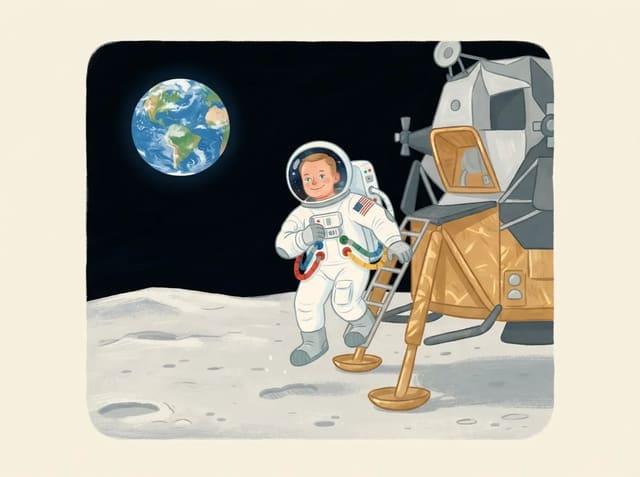
Neil Armstrong for kids: a true picture book
Neil Finds a Safe Place to Land. 10 pages, fact-checked, at three reading levels, read aloud.
The lesson: When the plan stops being safe, keep a cool head and steer toward a better way.


Scan with your iPhone cameraor open it in your browser
Books about space and rockets
Who was Neil Armstrong?
Neil Armstrong was a test pilot and NASA astronaut who landed on the Moon with Apollo 11. On July 20, 1969, when the landing area ahead looked unsafe, he took over the controls of the lunar module Eagle and flew it to a safer place in the Sea of Tranquility. Then he climbed down Eagle's ladder and set his left boot on the Moon while a fifth of the world's people watched.
| Known for | Apollo 11 astronaut who landed on the Moon |
|---|---|
| The lesson | When the plan stops being safe, keep a cool head and steer toward a better way. |
| Topics | Space and rockets, Explorers, Scientists |
| The book | 10 pages, 3 reading levels, read aloud |
Read the first pages free

Long ago, a little boy named Neil watched airplanes race across the sky. He loved flying! But back then, no person had ever flown into space. Then two big countries began a race to space.
When Neil Armstrong was a tiny boy, his father took him to watch airplanes race. His love of flying grew from there. Years later, in 1957, the Soviet Union sent up the first satellite, and America and the Soviet Union raced to do more in space. But no person had flown into space yet.
Neil Armstrong's love of flying began when he was two, when his father took him to the Cleveland Air Races. Years later, on October 4, 1957, the Soviet Union launched Sputnik 1, the first successful artificial satellite. The United States and the Soviet Union, rivals in the Cold War, were now competing to show who could do more in space. But no person had yet flown into space.
Page 1 of 10
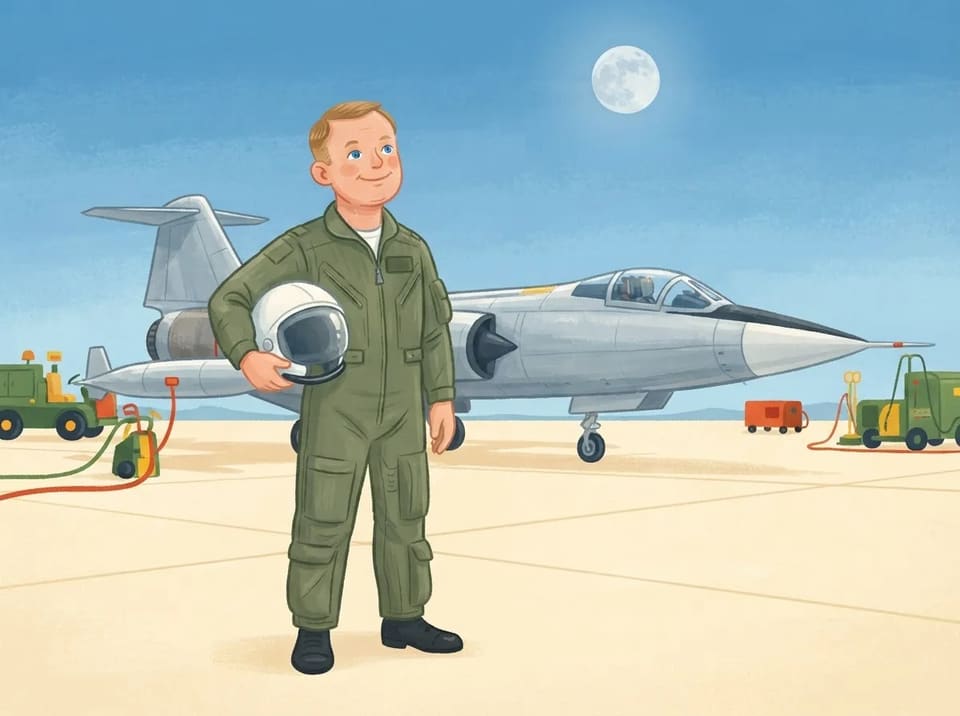
Another country took the lead: a man from there flew all the way around the Earth! Then America's president set a big goal: land a person on the Moon, and bring him home safe.
In 1961, the Soviet Union took the lead when Yuri Gagarin became the first person in space. Then President Kennedy set a goal for America: land a person on the Moon and bring him home safely, before the decade was out. Neil, a test pilot, joined NASA's astronauts.
On April 12, 1961, the Soviets took the lead when cosmonaut Yuri Gagarin became the first person in space and the first to orbit the Earth. The next month, President John F. Kennedy challenged the United States to land a man on the Moon and return him safely before the end of the decade. Neil Armstrong, an experienced test pilot, joined NASA's second group of astronauts in 1962.
Page 2 of 10
Neil Armstrong: a timeline of true facts
- 1957 In 1957, the Soviet Union launched Sputnik 1, the first successful artificial satellite. source
- 1961 The United States and the Soviet Union were competing to show who could do more in space. source
- 1968 On Christmas Eve 1968, people watched a television broadcast sent from astronauts orbiting the Moon. source
- 1961 In 1961, Yuri Gagarin became the first person to travel into space and orbit Earth. source
- 1961 President Kennedy challenged the United States to land a person on the Moon and bring him home before the decade ended. source
- 1969 Armstrong thought the chance of a successful Moon landing was only about fifty-fifty. source
- As a boy, Armstrong loved flying and built model aircraft. source
- 1962 Armstrong was an experienced test pilot who joined NASA's astronaut group in 1962. source
- 1969 Apollo 11's goal was to land safely on the Moon, not to reach one exact spot. source
- 1969 Armstrong and his crewmates left their names off their mission patch so it could represent everyone who worked toward the landing. source
- 1967 A fire during an Apollo 1 ground test killed all three astronauts aboard. source
- 1969 Armstrong and Aldrin practiced getting out of their small Moon lander, but Aldrin damaged the simulator. source
- 1966 On Gemini 8, Armstrong and David Scott joined two spacecraft together in space for the first time. source
- 1966 A stuck thruster sent Gemini 8 spinning, and the mission had to end early. source
- 1969 Before Apollo 11, other Apollo crews tested spacecraft in Earth orbit and around the Moon. source
- 1969 Armstrong practiced Moon landings, sometimes landing with less than 15 seconds of fuel left. source
- 1969 Apollo 11 launched on a Saturn V rocket on July 16, 1969. source
- 1969 As Eagle approached the Moon, computer alarms sounded that neither Armstrong nor Aldrin recognized. source
- 1969 When Armstrong saw that the landing area looked unsafe, he took the controls to find a safer place. source
- 1969 Finding a safer landing place took extra time, and Mission Control worried that fuel was running low. source
- 1969 Armstrong and Aldrin landed Eagle on the Moon on July 20, while Collins stayed in orbit. source
- 1969 Armstrong put his left boot on the Moon and spoke of a small step and a giant leap. source
- 1969 As Armstrong climbed down Eagle's ladder, he pulled a ring that activated a television camera. source
- 1969 Armstrong and Aldrin worked outside for about two and a half hours, collecting samples and setting up science instruments. source
- 1969 After leaving the Moon, Armstrong and Aldrin rejoined Collins, and all three returned safely to Earth. source
- 1969 Around the world, millions of people watched humans walk on the Moon for the first time. source
- 1972 Five more Apollo crews landed on the Moon after Apollo 11. source
Questions kids ask about Neil Armstrong
When did Neil Armstrong walk on the Moon?
Neil Armstrong set his left boot on the Moon on July 21, 1969, at 02:56 UTC. Apollo 11 had launched on a Saturn V rocket from the Kennedy Space Center on July 16, 1969. source
What did Neil Armstrong say when he stepped on the Moon?
As he set his left boot on the Moon, Armstrong said it was one small step for man, one giant leap for mankind. Before the flight, he had thought the chances of a successful touchdown on the Moon were only about fifty-fifty. source
Did Neil Armstrong almost run out of fuel?
Mission Control worried he might. When the landing area ahead looked unsafe, Armstrong took control of Eagle to find a safer place, which took longer than expected, so Mission Control was concerned the fuel was running low. In training, he had landed several times with less than 15 seconds of fuel left. source
3 reading levels
- Read to me (ages 3–5)
- Read together (ages 6–8)
- I'll read (ages 9–12)
The same true story, written three ways. Little kids hear short, bouncy lines; big kids get the details and the numbers.
Quiz time
Why did Neil take the controls of the Moon ship?
Show the answer
The landing spot looked unsafe.
Try this at home
- Land the lander: drop a paper cup with a paper-towel parachute from a chair, aiming for a plate on the floor. If it misses, change it and try again, like Neil steering to a safe spot.
- Make Moon footprints: press a shoe into a tray of flour or sand, then look closely at the print it leaves in the dust.
- Moon watch: look at the Moon each night for a week and draw its shape every time.
More true heroes



Build one with bricks

Read the whole book tonight.
On iPhone, iPad and Android, and in any web browser.
Scan with your iPhone cameraor open it in your browser
Space and rockets for kids · Explorers for kids · Scientists for kids · All heroes