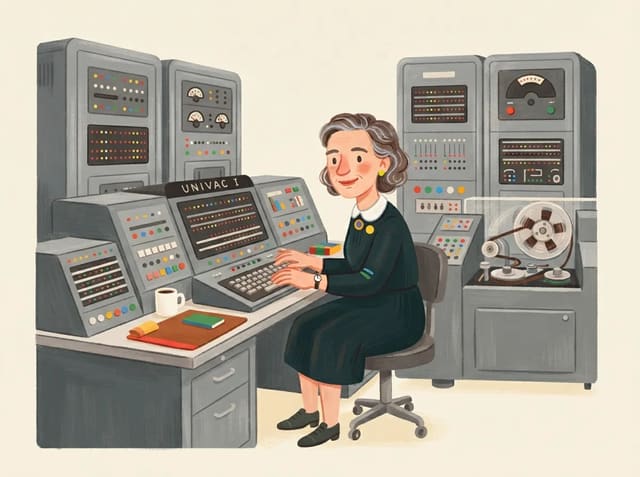
Grace Hopper for kids: a true picture book
Grace Hopper Teaches Computers Words. 10 pages, fact-checked, at three reading levels, read aloud.
The lesson: When people say your idea can't work, build it anyway and keep making it better.


Scan with your iPhone cameraor open it in your browser
Books about scientists
Who was Grace Hopper?
Grace Hopper was a mathematician and computer pioneer who began her computing career on the Harvard Mark I team in 1944. She wanted people to write computer programs in English words instead of number codes, and in 1959 she helped create COBOL, a programming language based on English words. As a girl of seven, she took apart seven alarm clocks to see how they worked.
| Known for | computer pioneer who helped create COBOL |
|---|---|
| The lesson | When people say your idea can't work, build it anyway and keep making it better. |
| Topics | Inventors, Scientists, History |
| The book | 10 pages, 3 reading levels, read aloud |
Read the first pages free
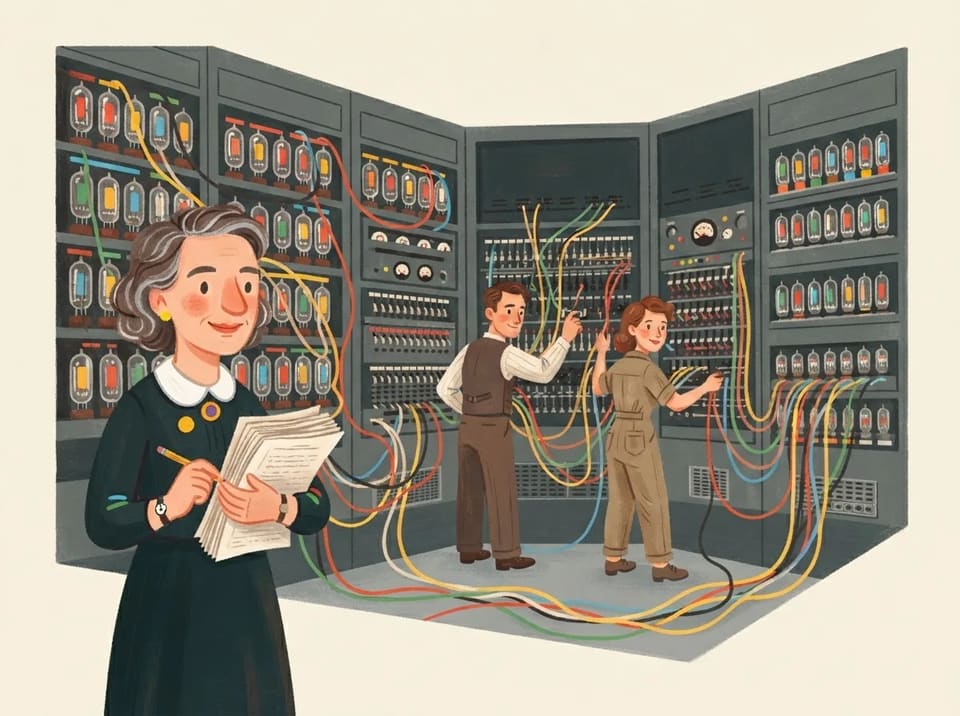
Long ago in America, computers were giant machines, as big as a room and full of glowing glass tubes. They were made for doing math. Their instructions were numbers, not words.
Long ago in America, computers were giant machines made for doing math. One weighed 30 tons and was packed with thousands of glass tubes! Inside, each instruction a computer followed was stored as a number, not a word.
In the 1940s, computers were meant for one job: calculations. One early American computer weighed 30 tons and held more than 18,000 vacuum tubes. Inside most computers, each instruction was stored as machine code, with its own number. To tell a computer to add, you gave it the number that meant add.
Page 1 of 10
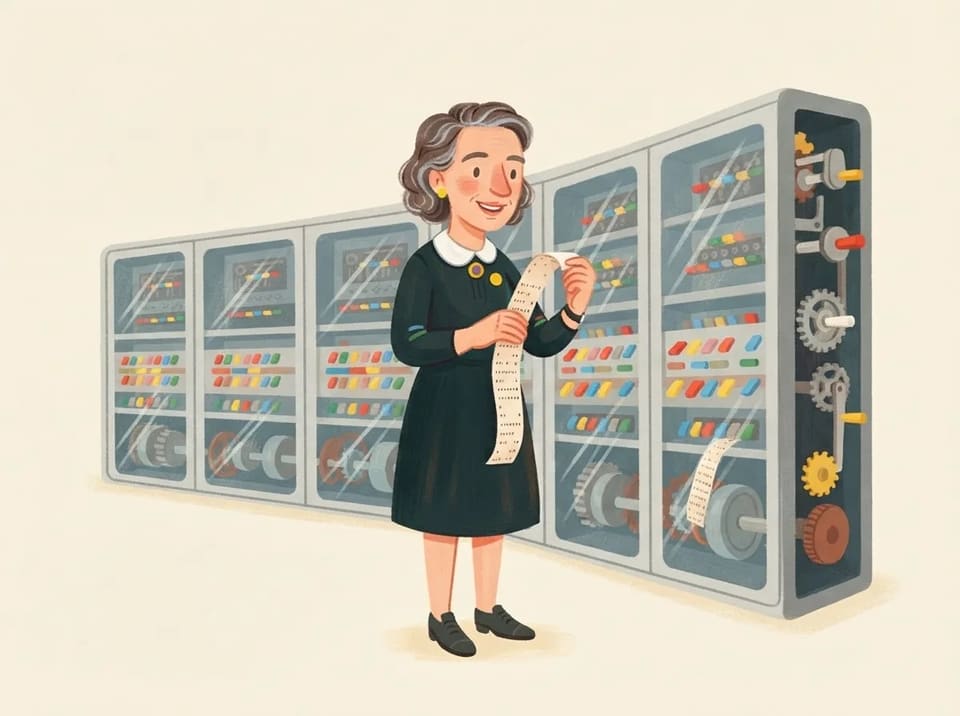
When Grace was seven, she took apart seven clocks to see inside! Later, she worked on a giant computer. To tell it what to do, people wrote long lists of numbers.
When Grace was seven, she took apart seven alarm clocks to see how they worked. Later, she joined the team working on a giant computer called the Harvard Mark I. Programs back then were long lists of numbers. Writing them was slow, boring work, and it was easy to make mistakes.
At age seven, Grace decided to find out how an alarm clock worked, and she took apart seven of them before her mother realized what she was doing. In 1944, she began her computing career on the Harvard Mark I team, led by Howard Aiken. Programs could be written as long lists of numbers, called machine language, and many early computers were programmed that way. It worked, but it was extremely tedious, and mistakes were easy to make.
Page 2 of 10
Grace Hopper: a timeline of true facts
- Early computers were meant to do calculations. source
- 1945 One early American computer weighed 30 tons and contained more than 18,000 vacuum tubes. source
- Writing programs as long lists of numbers was tedious and could lead to mistakes. source
- Computers could store instructions as number codes. source
- 1949 An early language called Short Code made math expressions easier to understand, but translating it each time was slow. source
- Grace was curious as a child and took apart seven alarm clocks to see how they worked. source
- 1944 Grace began her computing career on the Harvard Mark I team. source
- Grace wanted people without a math or technology background to understand a programming language. source
- Grace thought English statements would be easier for most people to write than symbols. source
- Grace was told that a programming language using English words would not work. source
- Early computers had little memory, making compilers hard to design. source
- 1949 Grace joined the team developing a computer called UNIVAC I. source
- 1952 While her idea waited for acceptance, Grace published a paper about compilers. source
- 1952 Even when Grace had a working compiler, she said people would not use it. source
- 1955 Grace and her team planned an English-language programming language and made an early model. source
- Grace decided people should write programs in English and let computers translate them. source
- A compiler is a program that translates code from one language into another. source
- 1952 In 1952, Grace had a working program that was then called a compiler. source
- 1958 The FLOW-MATIC compiler became publicly available in early 1958. source
- Grace explained that her A-0 translated mathematical notation into machine code. source
- FLOW-MATIC could help with business jobs such as billing and payroll. source
- 1959 Grace helped create COBOL, a language based on English words. source
- COBOL can be used on computers made by different companies, and many organizations still rely on it. source
Questions kids ask about Grace Hopper
What did Grace Hopper invent?
In 1952, Grace Hopper had a working compiler, a program that translates instructions into the machine code a computer runs. Her compiler, A-0, turned math notation into machine code. In 1959 she helped create COBOL, a programming language based on English words. source
Why did Grace Hopper want computers to understand English?
She said it is much easier for most people to write an English statement than to use symbols. She decided people who process data should write their programs in English and let computers translate them into machine code. When she first suggested it, she was told she couldn't, because computers didn't understand English. source
Did Grace Hopper invent COBOL?
She helped create it. In 1959 she worked with a group called CODASYL to make COBOL, a programming language based on English words that could run on different kinds of computers. source
3 reading levels
- Read to me (ages 3–5)
- Read together (ages 6–8)
- I'll read (ages 9–12)
The same true story, written three ways. Little kids hear short, bouncy lines; big kids get the details and the numbers.
Quiz time
What did Grace want people to use to tell computers what to do?
Show the answer
Plain English words.
Try this at home
- Number code: make a code where 1 means step forward, 2 means turn around and 3 means clap. Write a list of numbers for a grown-up to follow. Then write the same steps in words. Which was easier to write?
- Be the compiler: someone says a command in words, like jump twice and clap, and you translate it into your number code. Then a third person follows only the numbers.
- With a grown-up's OK, take apart something old and broken, like a clicky pen or a flashlight, and see how the parts fit together, the way Grace did with alarm clocks.
More true heroes

Read the whole book tonight.
On iPhone, iPad and Android, and in any web browser.
Scan with your iPhone cameraor open it in your browser
Inventors for kids · Scientists for kids · History for kids · Women inventors for kids · All heroes