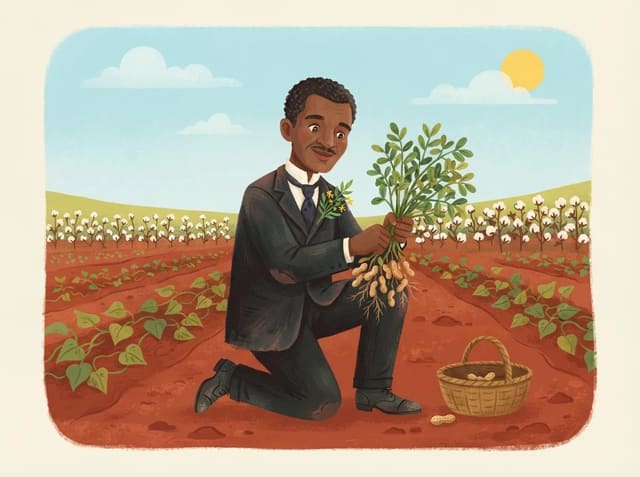
George Washington Carver for kids: a true picture book
George Washington Carver and the Tired Soil. 10 pages, fact-checked, at three reading levels, read aloud.
The lesson: Study a problem up close, then carry what you learn to the people who need it.


Scan with your iPhone cameraor open it in your browser
Books about scientists
Who was George Washington Carver?
George Washington Carver was a scientist who worked to improve the lives of poor farmers in southeastern Alabama. In 1896, Booker T. Washington invited him to lead the agriculture department at the Tuskegee Institute, where he worked on soil worn out by planting cotton again and again. He designed a classroom on wheels to take lessons out to farmers and urged them to grow peanuts and sweet potatoes to feed their families.
| Known for | agricultural scientist at Tuskegee Institute |
|---|---|
| The lesson | Study a problem up close, then carry what you learn to the people who need it. |
| Topics | Farms and food, Food, Scientists |
| The book | 10 pages, 3 reading levels, read aloud |
Read the first pages free
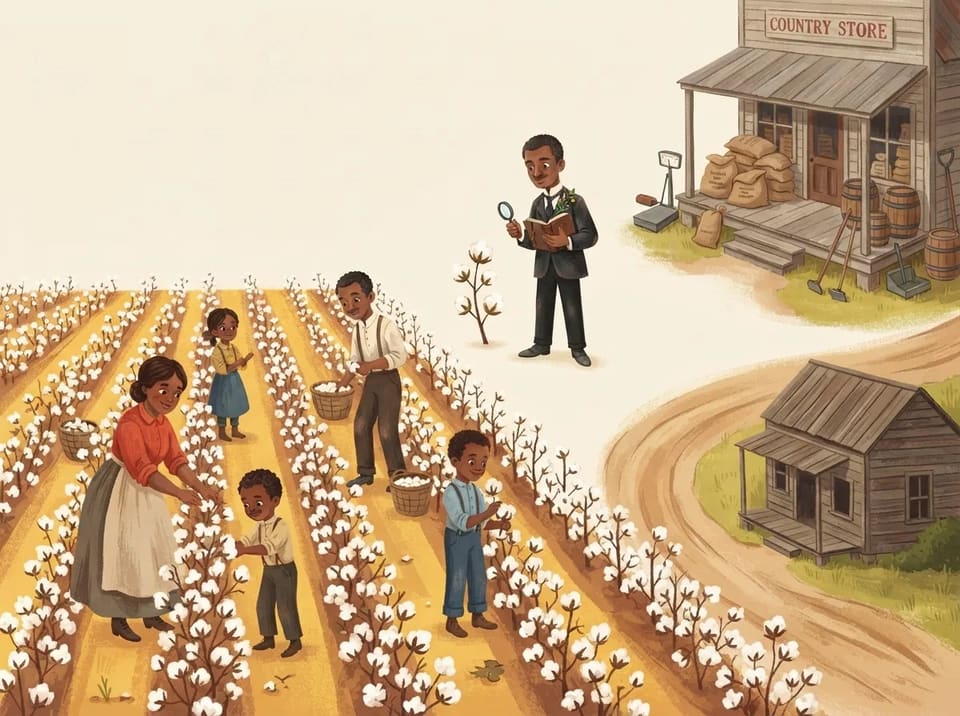
Long ago, in the American South, cotton was the main crop. Many farmers worked land that belonged to someone else. They got food at the store and paid for it later.
Long ago, in the American South, cotton was usually the main crop. Many families farmed land that belonged to someone else, and paid for it with part of their crop. Local stores sold them food and supplies on credit, to be paid back later.
When this story begins, in the 1890s, cotton was usually the main crop in Southern states such as Georgia, Alabama and Mississippi. Many farmers were sharecroppers. They worked land that someone else owned and paid for it with a share of the crops they grew. Local merchants sold them food and other supplies on credit, to be paid back later.
Page 1 of 10
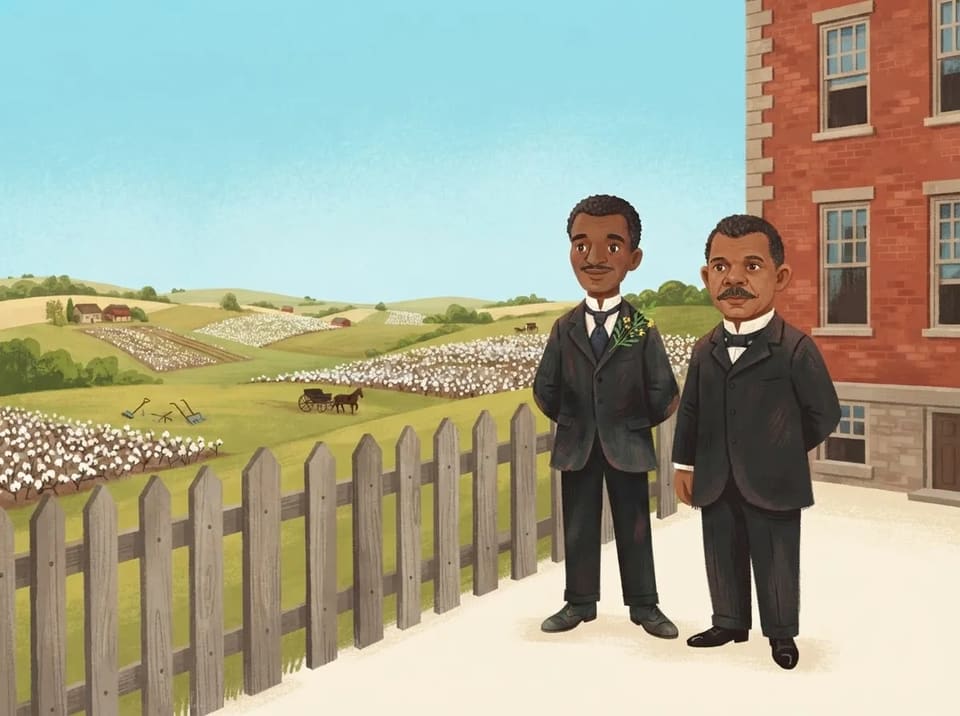
George loved plants. As a boy, he hunted for them in the woods. He grew up to be a teacher at a school in Alabama. He wanted to help poor farmers live better.
George Washington Carver had loved plants since he was a boy, collecting them in the woods. In 1896, Booker T. Washington asked him to lead the farming department at Tuskegee Institute in Alabama. There, George wanted to use science to make life better for poor farmers.
George Washington Carver had loved plants since childhood, when he collected specimens in the woods on the farm where he grew up. In 1896, Booker T. Washington, the first principal of the Tuskegee Institute in Alabama, invited Carver to head its Agriculture Department. Carver's main interest was clear: using chemistry and careful science to improve the lives of the poor farmers of southeastern Alabama.
Page 2 of 10
George Washington Carver: a timeline of true facts
- Cotton was usually the main crop in several Southern states. source
- Some farmers worked land owned by someone else and paid with a share of their crops. source
- Sharecroppers could get food and supplies on credit but might still owe money after harvest. source
- Farmers had long known that changing crops could help keep soil productive. source
- Carver and other researchers wanted to help farmers grow more and better cotton. source
- As a child, Carver loved plants and collected them in the woods. source
- 1896 In 1896, Booker T. Washington invited Carver to lead Tuskegee Institute’s agriculture department. source
- Carver wanted to use science to improve the lives of poor farmers in southeastern Alabama. source
- He wanted farmers to grow peanuts and sweet potatoes for food and a better life. source
- Planting cotton again and again had worn out the soil. source
- Farmers needed help, but many were hesitant to try something new. source
- At the time, few people ate peanuts or sweet potatoes, and the crops had few other uses. source
- Carver studied the soil to find crops that would grow well in the region. source
- Working with the USDA, Carver experimented with sugar beets and a new kind of cowpea. source
- 1903 In 1903, Carver began testing the Spanish peanut. source
- Carver worked to convince farmers that the new crops were valuable. source
- Carver designed a classroom on wheels to take lessons to farmers. source
- Carver began focusing on three promising crops: cowpeas, sweet potatoes, and peanuts. source
- Carver and other experts urged farmers to alternate cotton with crops such as sweet potatoes and peanuts. source
- Crop rotation improved cotton harvests and gave farmers other crops to sell. source
- 1917 In a peanut bulletin, Carver explained that peanuts were cheap to grow and enriched the soil. source
- Carver showed farmers that the crops could build soil and supply things they had previously bought. source
- Carver and his helpers researched and shared hundreds of ways to use the new crops. source
- Carver shared recipes for the alternative crops to encourage better nutrition. source
- Tuskegee’s experiment station published more than forty practical bulletins for farmers. source
Questions kids ask about George Washington Carver
What did George Washington Carver invent?
At Tuskegee, Carver founded a research laboratory where he and his assistants developed hundreds of uses for new crops such as peanuts and sweet potatoes, to make them popular. He also handed out recipes using these crops to help people in the South eat better. source
Why did George Washington Carver want farmers to grow peanuts?
In his peanut bulletin, Carver explained that peanuts, like other plants with pods, enrich the soil, and that they are easy and cheap to grow. He also showed farmers that the new crops could build up their soil and give them things they used to have to buy. He began testing the Spanish peanut in 1903. source
How did George Washington Carver help farmers?
With other farm experts, he urged farmers to take turns planting cotton and crops such as sweet potatoes, peanuts, soybeans and cowpeas, which put nitrogen back into the soil. This crop rotation gave them bigger cotton harvests and other crops to sell. Under his lead, Tuskegee's experiment station also published more than forty practical bulletins for farmers. source
3 reading levels
- Read to me (ages 3–5)
- Read together (ages 6–8)
- I'll read (ages 9–12)
The same true story, written three ways. Little kids hear short, bouncy lines; big kids get the details and the numbers.
Quiz time
What happened to the soil when farmers planted cotton again and again?
Show the answer
It got worn out.
Try this at home
- Plant three dried beans in a cup of soil by a sunny window and water them. After a few weeks, gently pull one up and look for tiny bumps on its roots: they help bean plants put plant food back into the soil.
- Grow a sweet potato vine: stick three toothpicks into a sweet potato, rest it in a jar so its bottom half sits in water, and watch roots and leafy vines appear over the next weeks.
- Plan a crop rotation: draw a garden of four squares and choose a crop for each square for four years, so no square grows the same crop two years in a row.
More true heroes


Read the whole book tonight.
On iPhone, iPad and Android, and in any web browser.
Scan with your iPhone cameraor open it in your browser
Farms and food for kids · Food for kids · Scientists for kids · Black inventors for kids · All heroes